
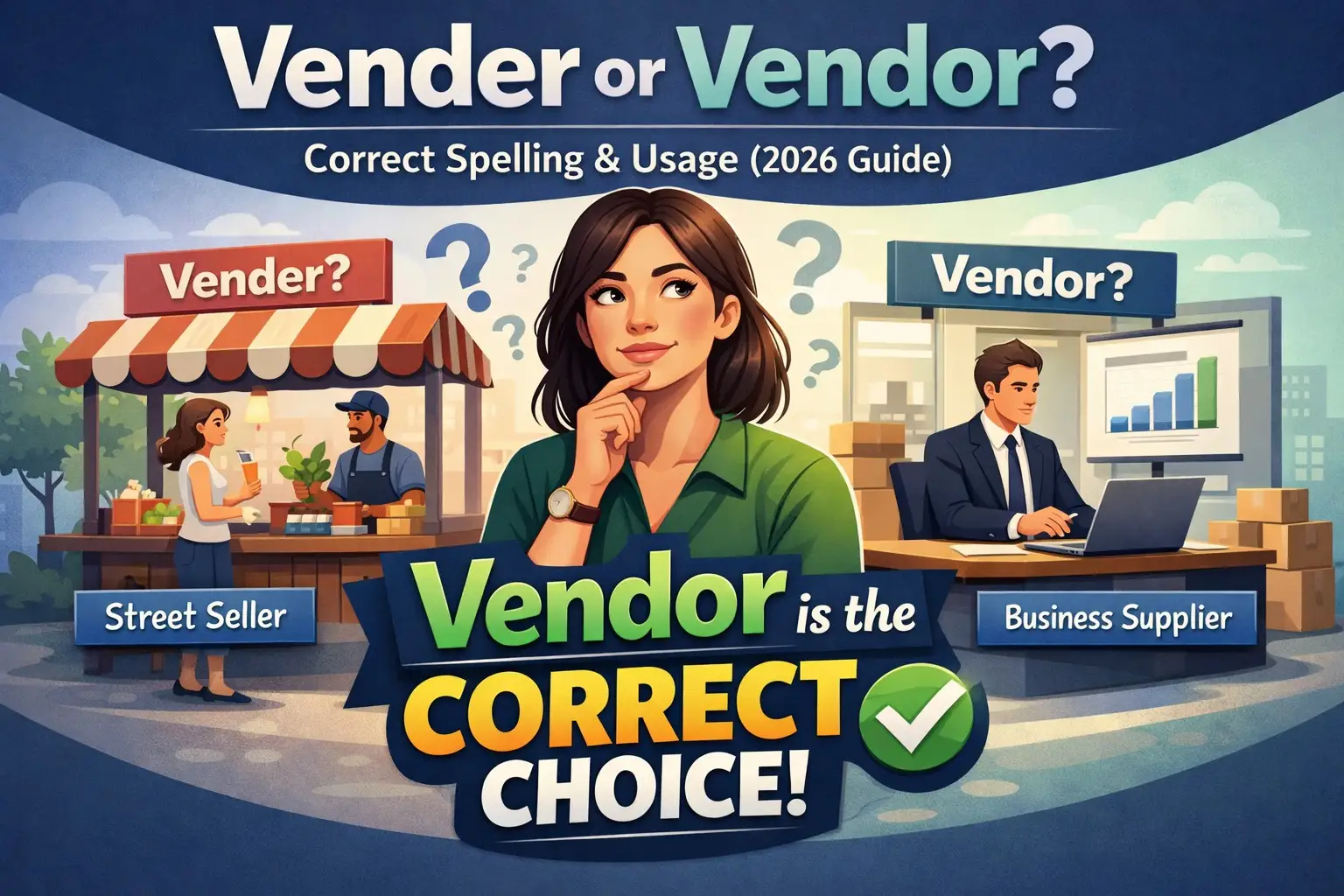
If you’ve ever paused while writing an email, invoice, or assignment and wondered “vender or vendor?”, you’re not alone. These two spellings look close, sound similar, and appear in real writing, especially in business contexts.
But here’s the key: one form is standard in modern English, and the other is usually considered a variant or uncommon form depending on region and context.
In this guide, you’ll learn the meaning, the grammar rules, how professionals use these words, and exactly how to avoid common mistakes.
What Does Vender or Vendor Mean?
Both vender and vendor relate to the idea of selling. In everyday English, the meaning most people intend is:
- Vendor: a person or company that sells goods or services (especially in business or formal contexts).
- Vender: an uncommon spelling in modern English; historically related to “to vend” (to sell), but rarely preferred today.
In most professional and academic writing, vendor is the safest and most widely accepted choice.
Simple meaning examples
- A vendor sells something (products, services, or supplies).
- A vendor can be a person (street vendor) or a company (software vendor).
Which Is Correct: Vender or Vendor?
In modern English, vendor is the standard spelling in most countries and most types of writing (business, legal, academic, and everyday communication).
Vender may appear as a variant spelling, but it’s far less common and can look like a mistake to many readers.
If your goal is clear, professional writing, choose:
✅ Vendor (recommended in almost all situations)
⚠️ Vender (rare; may be seen as incorrect or outdated)
Quick rule
- Use “vendor” for suppliers, sellers, and businesses.
- Avoid “vender” unless you are quoting a source, using a specific regional style, or writing historically.
Grammar Rules of Vender or Vendor
Understanding the grammar is simple once you know which form is standard.
Vendor is a countable noun:
- Singular: a vendor
- Plural: vendors
- Possessive: vendor’s (one) / vendors’ (many)
It often appears in business phrases like:
- vendor list
- vendor agreement
- approved vendor
- vendor management
- vendor payment terms
Rule Table (Vendor Forms)
| Form | Meaning | Example |
| vendor (singular) | one seller | The vendor delivered the order. |
| vendors (plural) | many sellers | We compared three vendors. |
| vendor’s (possessive) | belonging to one vendor | The vendor’s invoice is missing. |
| vendors’ (possessive plural) | belonging to many vendors | The vendors’ prices vary widely. |
✅ Grammar tip: Because “vendor” is a noun, you can use it with articles (a/an/the) and adjectives (trusted vendor, local vendor).
Vender or Vendor Examples With Simple Sentences
The best way to master vender or vendor is by seeing natural examples. Below are beginner-friendly sentences you can confidently reuse.
Real-life example sentences
We chose a new vendor for office supplies this month.
The vendor sent the invoice by email.
Please contact the vendor before placing the order.
Our event has food vendors and craft stalls.
The street vendor sells fresh fruit every morning.
The software vendor released an update last week.
The vendor’s delivery was delayed due to bad weather.
Always verify a vendor before making an online payment.
We keep a list of approved vendors for projects.
The company signed a vendor agreement for two years.
The vendor offered a discount for bulk orders.
The market vendors were friendly and helpful.
Ask the vendor about the return policy.
Their vendors’ rates increased after the new tax rule.
She works as a vendor at the weekend bazaar.
Note: You may see “vender” in some writing, but vendor is the spelling most readers expect.
Common Mistakes Students Make
Learners often make small mistakes with spelling, word choice, and context. Fixing these issues can instantly make your English look more professional.
Mistake 1: Using “vender” in formal writing
Many readers will assume vender is a typo. In resumes, business emails, or reports, that’s risky.
✅ Correct: We hired a new vendor for packaging.
❌ Wrong: We hired a new vendor for packaging.
Mistake 2: Confusing “vendor” with “customer” or “buyer.”
A vendor sells. A customer buys.
✅ Correct: The vendor sells phones; the customer buys them.
❌ Wrong: The vendor bought phones from us.
Mistake 3: Mixing up “vendor” with “supplier.”
A supplier provides materials; a vendor sells goods/services. In business, the terms overlap, but they are not always identical.
Vendor vs Supplier vs Seller – What’s the Difference?
This is where many learners feel unsure. Here’s a beginner-friendly breakdown:
- Vendor: a general business term for someone/company that sells goods/services (often under a contract or in a formal system).
- Supplier: usually provides raw materials or parts to a business (often B2B).
- Seller: the simplest everyday word for “someone who sells,” especially in casual contexts.
| The seller replied quickly online. | Best Use | Example |
| vendor | business/official contexts | Our IT vendor handles security. |
| supplier | materials/production chain | The supplier provides steel. |
| seller | everyday/casual contexts | The seller replied quickly online. |
✅ Quick tip: In business writing, vendor often sounds more professional than seller.
Correct vs Incorrect Usage Table
When you’re learning grammar, seeing right vs wrong makes the rules stick faster.
| The vendor sells services. | Correct | Incorrect |
| Business email | Please contact the vendor for updates. | Please contact the vender for updates. |
| Plural form | We met several vendors today. | We met several venders today. |
| Possessive | The vendor’s invoice is attached. | The vendors invoice is attached. |
| Meaning (seller vs buyer) | The vendor sells services. | The vendor purchased services from us. |
Table Summary of Rules
Use this table as a fast “cheat sheet” whenever you’re unsure.
| Rule | Best Choice | Why It Works |
| Standard spelling today | vendor | Most common and widely accepted |
| Formal/business writing | vendor | Looks professional and correct |
| Plural form | vendors | Correct noun plural |
| Possessive form | vendor’s / vendors’ | Correct grammar for ownership |
| Avoid in most cases | vender | Rare; often looks like a spelling error |
Practice Exercises: Vender or Vendor
Practice is where your confidence grows. Try these exercises without looking at the answers first.
A) Fill in the blanks
Choose the best word: vendor / vendors / vendor’s / vendors’
We selected a new ______ for our website hosting.
The ______ invoice includes the wrong tax amount.
Several ______ will attend the trade show this year.
The ______ prices changed after the contract renewal.
Please email the ______ about the delivery time.
B) Correct the sentence
Each sentence contains a mistake. Rewrite it correctly.
The vender sent the payment request yesterday.
We compared three vender before choosing one.
The vendors invoice is attached to the email.
Our vendor buys raw materials from the market.
The venders prices are too high for our budget.
Answer Key
A) Fill in the blanks
vendor
vendor’s
vendors
vendors’
vendor
B) Correct the sentence
The vendor sent the payment request yesterday.
We compared three vendors before choosing one.
The vendor’s invoice is attached to the email.
Our supplier buys raw materials from the market. (or: Our vendor buys raw materials… if vendor is truly the buyer)
The vendors’ prices are too high for our budget. (or: The vendors’ prices…)
FAQs
Q: Is “vender” a real word in English?
Answer: Yes, it exists as a variant spelling related to “vend,” but it’s uncommon in modern English and often looks like a mistake.
Q: Which spelling should I use in business writing: vender or vendor?
Answer: Use vendor. It’s the standard spelling in modern professional English and the safest choice for emails, contracts, and reports.
Q: What is the plural of vendor?
Answer: The plural is vendors.
Q: How do I write the possessive form of vendor?
Answer: Use vendor’s for one vendor and vendors’ for more than one vendor.
Q: What’s the difference between a vendor and a supplier?
Answer: A vendor sells goods/services (often formally), while a supplier typically provides materials or parts in a production chain. In some businesses, the terms overlap.
Final Tips for Learners
If you want your English to look polished and confident, keep these tips in mind:
- In almost all writing, choose vendor over vender.
- Remember: vendor sells; customer buys.
- Use correct grammar forms:
- vendors (plural)
- vendor’s (one vendor’s item)
- vendors’ (many vendors’ items)
- vendors (plural)
- In business documents, “vendor” is a strong, professional word; use it consistently.
Conclusion: The Best Choice for Vender or Vendor
When deciding vender or vendor, the clear winner for modern English is vendor. It’s the standard spelling in professional writing, the most widely recognized form, and the one that will make your emails, assignments, and documents look correct instantly.
While vender may appear as a rare variant, it’s uncommon enough that many readers will assume it’s an error, so using vendor is the smartest move in nearly every situation.