English learners often struggle with small spelling differences that change the correctness of a sentence. One common confusion is Mistakingly or Mistakenly. At first glance, both words appear logical, and many people assume they are interchangeable.
However, only one of these forms is considered standard and correct in modern English grammar. Understanding the difference is important for students, writers, bloggers, and professionals who want to write clearly and correctly.
In this complete English grammar guide, we will explore the meaning, rules, examples, common mistakes, and practice exercises related to Mistakingly or Mistakenly. By the end of this article, you will confidently know which word to use in your writing.
What Does Mistakingly or Mistakenly Mean?
Both mistakingly and mistakenly are intended to function as adverbs describing an action done by mistake. They come from the verb “mistake,” which means to misunderstand something or believe something incorrectly.
However, in standard English usage:
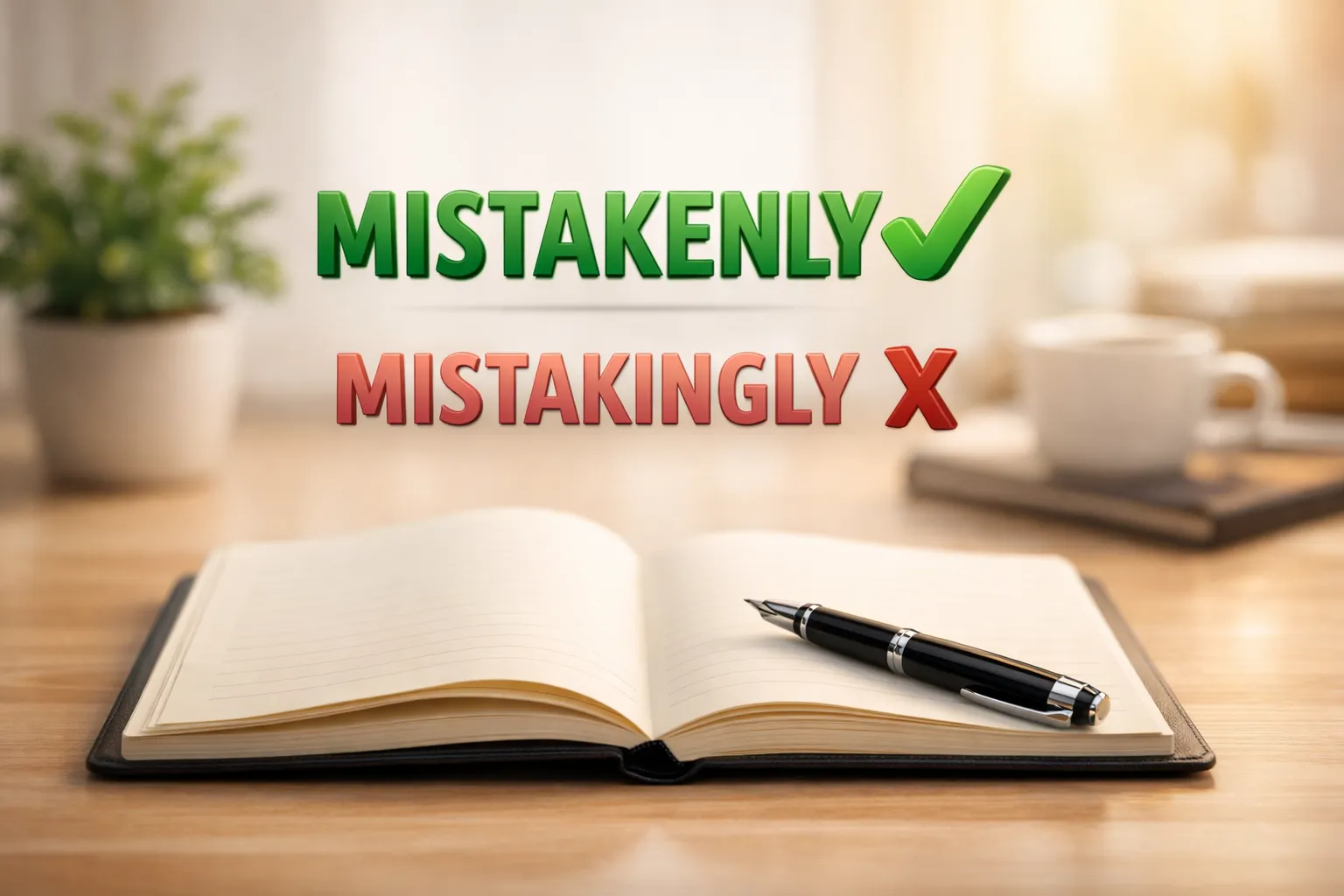
- Mistakenly is the correct and widely accepted adverb.
- Mistakingly is generally considered nonstandard or incorrect.
When someone does something mistakenly, they perform the action because of an error or misunderstanding.
Simple Meaning
| Word | Meaning | Status |
| Mistakenly | Done by mistake or error | Correct |
| Mistakingly | Intended to mean the same, but not standard | Incorrect / Rare |
Example Sentences
- I mistakenly sent the email to the wrong person.
- She mistakenly believed the meeting was today.
- The cashier mistakenly charged me twice.
- He mistakenly thought the store was open.
Incorrect usage:
- I mistakingly sent the email to the wrong person. ❌
In modern grammar, mistakenly should always be used instead of mistakingly.
Grammar Rules of Mistakingly or Mistakenly
To understand the correct usage, it helps to know how English adverbs are formed.
Most adverbs are created by adding “-ly” to an adjective.
Example:
| Adjective | Adverb |
| Quick | Quickly |
| Careful | Carefully |
| Correct | Correctly |
In this case:
- Mistaken (adjective) → Mistakenly (adverb)
The word mistakingly does not follow this standard pattern, which is why it is considered incorrect in modern English.
Key Grammar Rules
| Rule | Explanation | Example |
| Use “mistakenly” as an adverb | It describes an action done by error | She mistakenly deleted the file |
| Avoid “mistakingly” | It is nonstandard and rarely accepted | She mistakingly deleted the file ❌ |
| Use before or after verbs | Works with many verbs naturally | He mistakenly assumed the answer |
Important Tip
Think of mistaken → mistakenly as the natural transformation.
Just like:
- Broken → Brokenly (rare)
- Mistaken → Mistakenly (correct)
Mistakingly or Mistakenly With Simple Examples
Examples are the best way to fully understand grammar rules. Below are several real-life sentences showing how mistakenly is used.
Everyday Examples
- I mistakenly took someone else’s umbrella.
- She mistakenly called the wrong number.
- The teacher mistakenly marked my answer incorrect.
- He mistakenly thought the event was canceled.
- We mistakenly believed the road was closed.
Workplace Examples
- The assistant mistakenly attached the wrong document.
- The manager mistakenly approved the payment.
- Someone mistakenly scheduled two meetings at the same time.
Casual Conversation Examples
- I mistakenly added too much salt to the soup.
- She mistakenly assumed I was angry.
- He mistakenly opened my package.
Incorrect examples:
- I mistakingly sent the wrong file. ❌
- She mistakingly believed the rumor. ❌
Using mistakenly ensures your writing follows correct grammar standards.
Common Mistakes Students Make
Many English learners make mistakes when writing mistakenly because the word mistaking already exists as a verb form.
This leads people to think mistakingly must also be correct.
Frequent Errors
| Incorrect Usage | Correct Usage |
| I mistakingly sent the message. | I mistakenly sent the message. |
| She mistakingly believed the news. | She mistakenly believed the news. |
| He mistakingly took my phone. | He mistakenly took my phone. |
| They mistakingly entered the wrong room. | They mistakenly entered the wrong room. |
Why This Happens
Common reasons include:
- Confusing mistake with mistaking
- Incorrect assumptions about adverb formation
- Influence of informal internet writing
- Lack of grammar awareness
Quick Rule to Remember
Mistakenly = correct
Mistakingly = incorrect
Whenever you feel unsure, simply remember this rule.
Difference Between Similar Grammar Words
Sometimes learners confuse mistakenly with other words related to errors.
Understanding the difference will improve your grammar accuracy.
Comparison Table
| Word | Meaning | Example |
| Mistakenly | By mistake | I mistakenly deleted the file |
| Accidentally | Without intention | I accidentally dropped the glass |
| Incorrectly | Not done correctly | He answered the question incorrectly |
| Wrongly | In an unfair or incorrect way | She was wrongly accused |
Example Sentences
- I mistakenly sent the message to my boss.
- I accidentally broke the cup.
- He incorrectly solved the math problem.
- She was wrongly blamed for the mistake.
While these words can sometimes overlap, mistakenly specifically refers to an error caused by misunderstanding.
Table Summary of Mistakingly or Mistakenly Rules
The following summary table will help you quickly remember the correct usage.
| Topic | Correct Form | Incorrect Form |
| Standard English | Mistakenly | Mistakingly |
| Grammar type | Adverb | Nonstandard form |
| Meaning | Done by mistake | Intended the same meaning but wrong |
| Usage | Formal and informal writing | Should be avoided |
| Example | She mistakenly sent the email | She mistakingly sent the email |
Quick Memory Trick
Think of this sentence:
“I was mistaken, so I acted mistakenly.”
This helps connect mistaken → mistakenly.
Practice Exercises
Now it’s time to test your understanding of Mistakingly or Mistakenly.
Exercise 1: Fill in the Blanks
Choose the correct word.
I ______ deleted the important file.
She ______ thought the store was closed.
He ______ believed the wrong information.
The assistant ______ sent the email to the wrong client.
We ______ assumed the meeting was canceled.
Exercise 2: Correct the Sentence
Each sentence contains an error. Fix it.
I mistakingly called you last night.
She mistakingly sent the wrong document.
He mistakingly believed the rumor.
They mistakingly entered the wrong classroom.
The cashier mistakingly charged extra.
Answers
Exercise 1
mistakenly
mistakenly
mistakenly
mistakenly
mistakenly
Exercise 2
I mistakenly called you last night.
She mistakenly sent the wrong document.
He mistakenly believed the rumor.
They mistakenly entered the wrong classroom.
The cashier mistakenly charged extra.
FAQs
Q: Is mistakingly a real word?
Answer:
Mistakingly appears occasionally in informal writing, but it is not considered correct in standard English grammar. The correct form is mistakenly.
Q: Which spelling is correct: mistakingly or mistakenly?
Answer:
The correct spelling is mistakenly. The word mistakingly should be avoided in professional or academic writing.
Q: Why do people say mistakingly?
Answer:
People sometimes form it incorrectly from the verb mistaking, assuming the adverb should be mistakingly. However, English grammar forms the adverb from mistaken, producing mistakenly.
Q: Is it mistakenly formal or informal?
Answer:
Mistakenly can be used in both formal and informal English. It is acceptable in professional emails, academic writing, and everyday conversation.
Q: What is another word for mistakenly?
Answer:
Common alternatives include:
- accidentally
- incorrectly
- wrongly
- unintentionally
Each word has slightly different nuances.
Final Tips for Learners
Learning small grammar differences, like Mistakingly or Mistakenly can significantly improve your writing clarity.
Here are a few quick tips to remember:
- Always use mistakenly, never mistakingly.
- Remember that mistakenly comes from the adjective “mistaken.”
- Practice writing sentences using the word.
- Read professional English content to reinforce correct usage.
- When unsure, check trusted grammar guides.
Mastering these details helps your writing appear more professional, accurate, and polished.
Conclusion
Understanding the difference between Mistakingly or Mistakenly is simple once you learn the correct rule. In modern English grammar, mistakenly is the correct and accepted form, while mistakingly is considered nonstandard and should be avoided.
By learning the grammar rules, reviewing real-life examples, and practicing with exercises, you can confidently use mistakenly in your writing. Whether you’re writing emails, essays, blog posts, or professional documents, using the correct word improves your communication and credibility.