
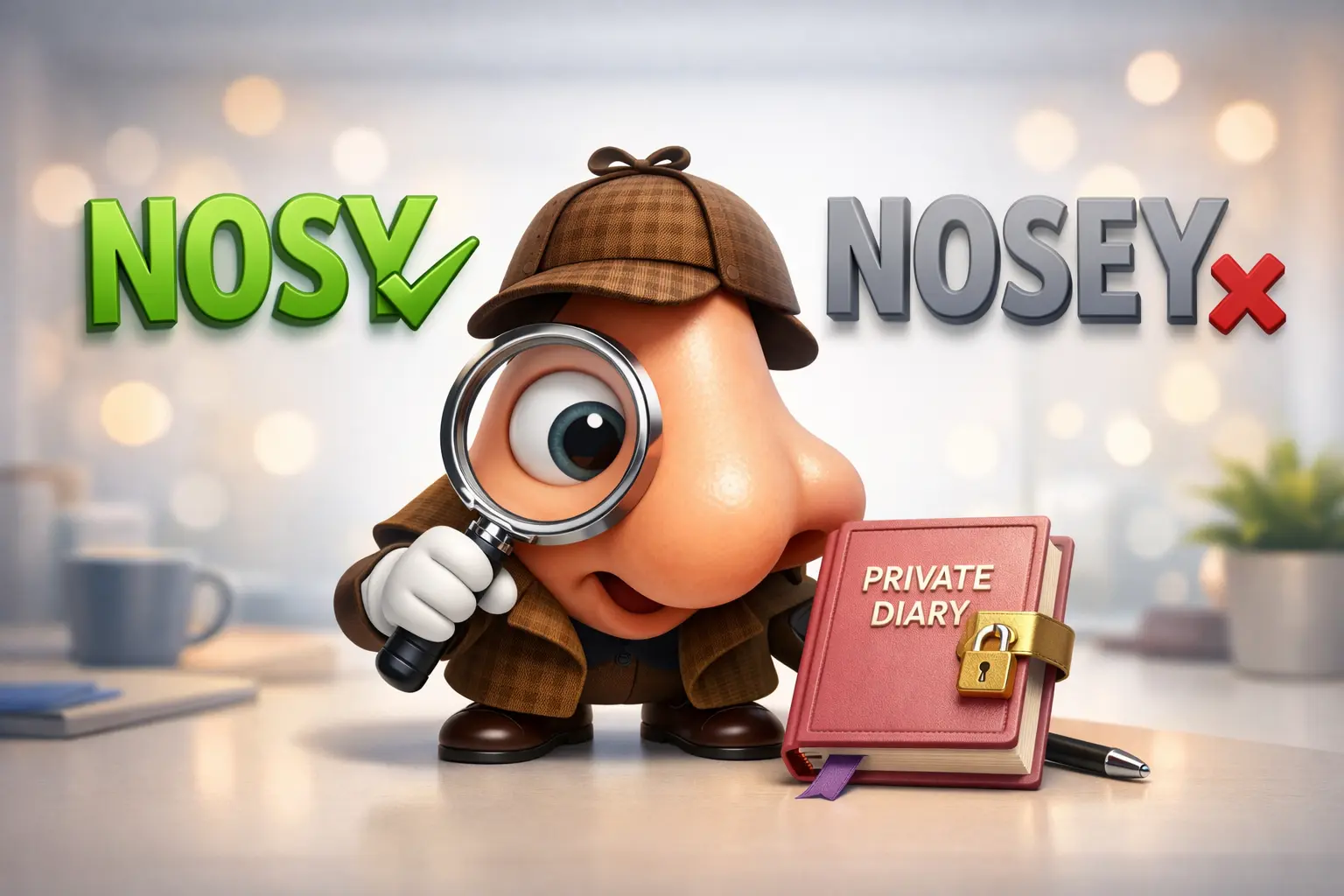
Many English learners often get confused about nosey or nosy. At first glance, both spellings look correct. They sound the same. They even appear in books and online posts. So which one is right?
If you’ve ever hesitated before writing this word, you’re not alone. Small spelling differences can make a big impact on your writing clarity and professionalism. Whether you’re a student, blogger, or professional writer, understanding the correct usage of nosey or nosy will instantly improve your grammar accuracy.
In this complete English grammar guide, we’ll break everything down in a simple, friendly, and expert-level way – including rules, examples, tables, common mistakes, exercises, and FAQs.
Let’s clear up the confusion once and for all.
What Does Nosey or Nosy Mean?
The word (whether spelled nosey or nosy) describes someone too curious about other people’s private matters. It refers to a person who asks personal questions or interferes in things that do not concern them.
In simple words:
- A nosy person wants to know everything.
- They often ask unnecessary or private questions.
- They may look through other people’s belongings or conversations.
Simple Meaning:
Nosy = overly curious about others’ personal matters
Real-Life Examples:
- She is too nosy and always asks about my salary.
- Don’t be nosy – that’s private.
- My neighbor is so nosy that she watches everyone from her window.
- Stop being nosy and focus on your own work.
- He made a nosy comment about my relationship.
The meaning does not change between nosey or nosy, but the spelling preference does.
Nosey or Nosy – Which Spelling Is Correct?
This is the most important question.
The correct and standard spelling in modern English is:
✅ Nosy
⚠️ Nosey (less common variant)
While both spellings exist, “nosy” is the preferred spelling in American and British English today.
Why Does “Nosey” Exist?
The word comes from “nose”, meaning someone who “sticks their nose” into other people’s business. Over time, the spelling changed to nosy, following standard adjective formation patterns.
Spelling Comparison Table
| Version | Status | Common Usage | Recommended? |
| Nosy | Standard spelling | Widely used worldwide | ✅ Yes |
| Nosey | Variant spelling | Less common | ❌ Avoid in formal writing |
Professional Tip:
Always use nosy in academic, professional, or online writing.
Grammar Rules of Nosey or Nosy
Understanding the grammar behind nosey or nosy rules helps you use them confidently.
Rule 1: It Is an Adjective
“Nosy” describes a person or behavior.
Examples:
- She is a nosy coworker.
- That was a nosy question.
Rule 2: It Can Modify a Noun
- A nosy neighbor
- A nosy reporter
- A nosy relative
Rule 3: It Can Be Used with “Be” Verbs
- She is nosy.
- They were nosy.
- Stop being nosy.
Grammar Rule Table
| Rule | Correct Example | Wrong Example |
| Used as an adjective | She is nosy. | She is nosily. |
| Before noun | A nosy neighbor | A nosey neighbor (formal) |
| After verb | Don’t be nosy. | Don’t be nosey. |
Nosey or Nosy With Simple Examples
Let’s look at more real-life nosey or nosy examples to make things clearer.
Everyday Examples:
My sister is nosy about my phone messages.
He asked a nosy question about my income.
Please stop being nosy.
The reporter sounded nosy.
Kids can be nosy sometimes.
My aunt is very nosy about family matters.
That was a nosy thing to say.
Why are you so nosy today?
I don’t like nosy people.
She gave me a nosy look.
He made a nosy comment about my clothes.
Our landlord is too nosy.
It’s rude to be nosy.
The teacher told him not to be nosy.
My friend isn’t nosy at all.
Notice how all examples use nosy, not nosey.
Common Mistakes Students Make
Even advanced learners make mistakes with nosey or nosy. Let’s correct them.
Mistake 1: Using “nosey” in formal writing
❌ She is very nosey.
✅ She is very nosy.
Mistake 2: Using it as an adverb
❌ She asked nosy.
✅ She asked a nosy question.
Mistake 3: Confusing It with “Curious”
Being curious can be positive. Being nosy usually has a negative meaning.
Correct vs Incorrect Table
| Incorrect Sentence | Correct Sentence |
| He is nosey. | He is nosy. |
| She asked nosy. | She asked a nosy question. |
| Don’t be nosey. | Don’t be nosy. |
| That was very nosey behavior. | That was very nosy behavior. |
Difference Between Similar Grammar Topics
Students often confuse nosy with similar words like:
- Curious
- Inquisitive
- Interfering
- Meddling
Let’s understand the difference.
Comparison Table
| Word | Meaning | Positive or Negative? | Example |
| Nosy | Too curious about private matters | Negative | Stop being nosy. |
| Curious | Interested in learning | Neutral/Positive | She is curious about science. |
| Inquisitive | Likes asking questions | Positive | An inquisitive child. |
| Meddling | Interfering unnecessarily | Negative | A meddling neighbor. |
Key Difference:
Nosy often suggests rudeness, while curiosity can be healthy and positive.
Table Summary of Nosey or Nosy Rules
Here’s a quick professional summary of everything we’ve learned.
Quick Summary Table
| Topic | Correct Usage |
| Correct spelling | Nosy |
| Part of speech | Adjective |
| Meaning | Too curious about others’ private matters |
| Formal writing | Use “nosy” |
| Common mistake | Writing “nosey” |
This summary helps you remember the correct usage quickly.
Practice Exercises – Nosey or Nosy
Now it’s time to test your understanding.
Part 1: Fill in the blanks
Choose the correct spelling (nosy / nosey).
My neighbor is very ______.
Stop being so ______ about my personal life.
That was a ______ question.
Don’t be ______.
She made a ______ comment.
Part 2: Correct the Sentence
Find and correct the mistake.
He is a very nosey person.
Don’t be nosey about my phone.
That was nosey behavior.
Why are you so nosey today?
She asked a nosey question.
Answers
nosy
nosy
nosy
nosy
nosy
He is a very nosy person.
Don’t be nosy about my phone.
That was nosy behavior.
Why are you so nosy today?
She asked a nosy question.
If you got all correct – excellent work!
FAQs
Q: Is nosey or nosy correct?
Answer: Both exist, but “nosy” is the correct and preferred spelling in modern English.
Q: Is nosey wrong?
Answer: It is not completely wrong, but it is considered a less common variant. Use “nosy” in formal writing.
Q: Is nosy a negative word?
Answer: Yes, it usually has a negative meaning because it describes someone who interferes in private matters.
Q: Can nosy be used for children?
Answer: Yes. For example, “Kids can be nosy sometimes.”
Q: What is the noun form of nosy?
Answer: There is no direct noun form. You would say “a nosy person” instead of using a noun like “nosiness” (though “nosiness” exists informally).
Final Tips for Learners
Mastering small spelling differences like nosey or nosy makes your English stronger and more professional.
Here are some final expert tips:
- Always use nosy in exams and formal writing.
- Remember: “Nosy” comes from “nose,” but the spelling changes.
- Avoid confusing it with “curious.”
- Practice using it in daily conversation.
- Review spelling carefully before publishing or submitting assignments.
Small grammar improvements create big boosts in confidence.
Conclusion
Understanding the difference between nosey or nosy is simple once you know the rule. While both spellings appear in English, “nosy” is the correct and standard spelling in modern usage. It is an adjective that describes someone who is overly curious about other people’s private matters.
By learning the grammar rules, reviewing real-life examples, avoiding common mistakes, and practicing regularly, you can confidently use this word in both speech and writing.