
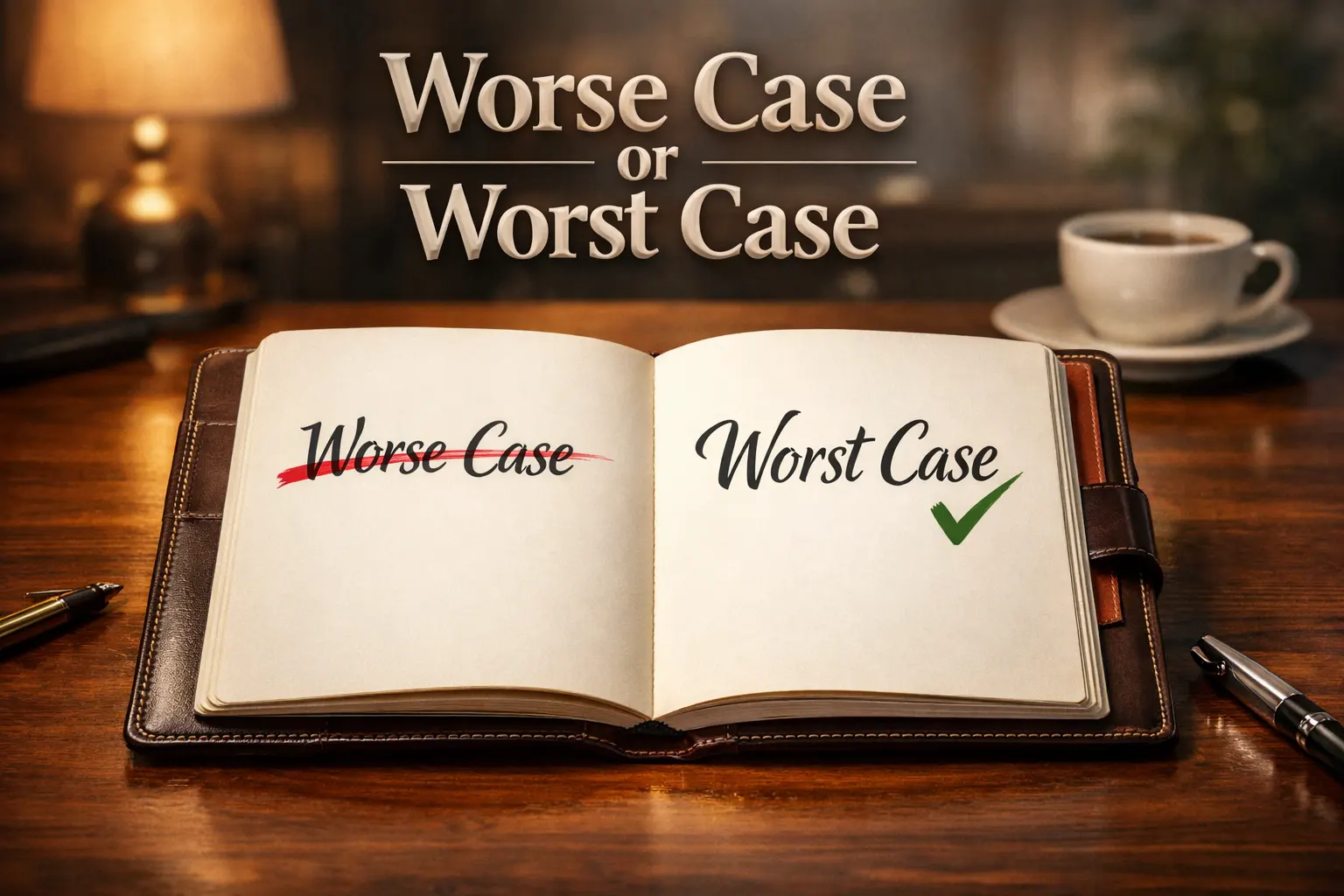
English learners often struggle with confusing word pairs, and worse case or worst case is one of the most common examples. These two phrases look very similar, but only one of them is grammatically correct in most situations.
Understanding the difference between worse case and worst case helps you speak and write English more confidently. Many students accidentally use the wrong phrase in emails, essays, or conversations because the words worse and worst both come from the same root word.
In this beginner-friendly grammar guide, you will learn the correct meaning, grammar rules, examples, common mistakes, and practice exercises to master this topic easily.
What Does Worse Case or Worst Case Mean?
The phrase worst case is a common English expression that describes the most negative or most difficult possible situation.
People use it when discussing possibilities, risks, or planning for something that might go wrong.
The phrase worse case, however, is generally incorrect in standard English and rarely used.
Simple Meaning
- Worst case → the most serious or negative outcome
- Worse case → grammatically incorrect in most situations
Example Sentences
- Worst case, we might lose the project.
- Let’s prepare for the worst case scenario.
- Worst case, the meeting will be postponed.
- In the worst case, we will need more time.
- The worst case outcome is losing the data.
These examples show that worst case is used to describe the maximum possible problem or difficulty.
Grammar Rules of Worse Case or Worst Case
To understand this topic properly, you must first know the difference between worse and worst.
Both words are forms of the adjective bad, but they belong to different levels of comparison.
| Word | Type | Meaning | Example |
| Bad | Positive form | Something negative | This is a bad result |
| Worse | Comparative | More bad than something else | This result is worse |
| Worst | Superlative | The worst | This is the worst result |
Because worst represents the highest degree, the phrase worst case refers to the most negative situation possible.
Important Rule
When describing the most extreme negative possibility, you must use worst case, not worse case.
Example:
- Correct: Worst case, we cancel the event.
- Incorrect: Worse case, we cancel the event.
Worse Case or Worst Case: With Simple Examples
Examples help learners understand grammar quickly. Below are several real-life examples showing how worst case is used naturally.
Everyday Examples
- Worst case, we take a later flight.
- Worst case, we restart the computer.
- Worst case scenario, we lose some money.
- Worst case, the product arrives late.
- Worst case, we try again next week.
Work or Business Examples
- Worst case, the company delays the launch.
- Worst case scenario, the system crashes.
- The worst case outcome is losing customers.
- In the worst case, we need a new strategy.
- The worst case cost could be very high.
Personal Life Examples
- Worst case, we stay home this weekend.
- Worst case, I will study again for the exam.
- Worst case, we arrive a little late.
These sentences show how worst case is commonly used when discussing possibilities or planning.
Common Mistakes Students Make
Many English learners accidentally write worse case because they confuse comparative and superlative forms.
Understanding these mistakes will help you avoid them.
Mistake 1: Using “worse case” instead of “worst case”
❌ Worse case, we cancel the trip.
✅ Worst case, we cancel the trip.
Mistake 2: Mixing comparative and superlative forms
❌ This is the worse case scenario.
✅ This is the worst-case scenario.
Mistake 3: Thinking both phrases are correct
In reality, worse case is rarely correct in standard grammar.
Correct vs Incorrect Table
| Incorrect Sentence | Correct Sentence |
| Worse case, we lose the match | Worst case, we lose the match |
| This is the worse case scenario | This is the worst case scenario |
| Plan for the worse case | Plan for the worst case |
| Worse case, we start again | Worst case, we start again |
Always remember that superlative situations require the word “worst.”
Difference Between Worse and Worst in English Grammar
Understanding the difference between worse and worst will completely solve this confusion.
Comparative vs Superlative
| Form | Grammar Type | Example |
| Bad | Basic adjective | This is a bad result |
| Worse | Comparative | This result is worse than yesterday |
| Worst | Superlative | This is the worst result |
Simple Explanation
- Worse compares two things
- Worst describes the most extreme situation
Example:
- Today is worse than yesterday.
- This is the worst day of the week.
Because worst represents the maximum level, the phrase worst case is grammatically correct.
Quick Rule Summary Table
This table helps you quickly remember the grammar rule.
| Phrase | Correct or Incorrect | Explanation |
| Worse case | Incorrect | Uses comparative form |
| Worst case | Correct | Uses superlative form |
| Worst case scenario | Correct | Common English phrase |
| Worse scenario | Incorrect | Wrong comparison level |
Easy Trick to Remember
If you mean the most negative situation possible, always use worst case.
Practice Exercises
Practice is the best way to master grammar. Try the exercises below.
Fill in the Blanks
Choose worse case or worst case.
______ scenario, the meeting will be delayed.
______ we need to cancel the trip.
Let’s prepare for the ______ scenario.
______ we will finish tomorrow.
The ______ outcome is losing the client.
Correct the Sentence
Each sentence contains a mistake. Rewrite it correctly.
Worse case, we restart the project.
This is the worse case scenario.
Plan for the worse case.
Worse case, we try again.
The worse case outcome is failure.
Answers
Fill in the Blanks
Worst case
Worst case
Worst case
Worst case
Worst case
Correct the Sentence
Worst case, we restart the project.
This is the worst case scenario.
Plan for the worst case.
Worst case, we try again.
The worst case outcome is failure.
FAQs
Q1: Is “worse case” ever correct in English?
Answer: In standard English grammar, worse case is usually incorrect. The correct expression is worst case.
Q: What does “worst case scenario” mean?
Answer: It means the most negative or difficult possible situation that could happen.
Example:
Worst case scenario, we lose the data.
Q: Why do people say “worst case”?
Answer: Because worst is the superlative form of bad, which describes the most extreme negative situation.
Q: Can “worst case” be used in everyday conversation?
Answer: Yes. It is very common in daily conversations, business discussions, and planning situations.
Example:
Worst case, we finish the work tomorrow.
Q: How can I remember the correct phrase easily?
Answer: Think of worst case as the maximum problem. Since it represents the extreme situation, the superlative worst is always correct.
Final Tips for Learners
Learning grammar becomes easier when you understand the logic behind the rules. The confusion between worse case or worst case happens mainly because both words come from the adjective bad.
Remember these simple tips:
- Worst case is the correct phrase.
- Worse case is usually incorrect.
- Use worst case when discussing the most negative possibility.
- The phrase worst case scenario is extremely common in English.
Try using this phrase in daily conversations so it becomes natural for you.
Conclusion
The difference between worse case or worst case is simple once you understand comparative and superlative grammar. While worse compares two things, worst describes the most extreme situation. That is why the correct and widely accepted phrase is worst case.
In real-life English communication, people frequently say worst case scenario when discussing risks, planning outcomes, or preparing for unexpected problems. Using the correct phrase will improve both your grammar accuracy and confidence in English writing.
By understanding the rules, reviewing examples, and completing the practice exercises in this guide, you can easily avoid the common mistake of writing worse case.