
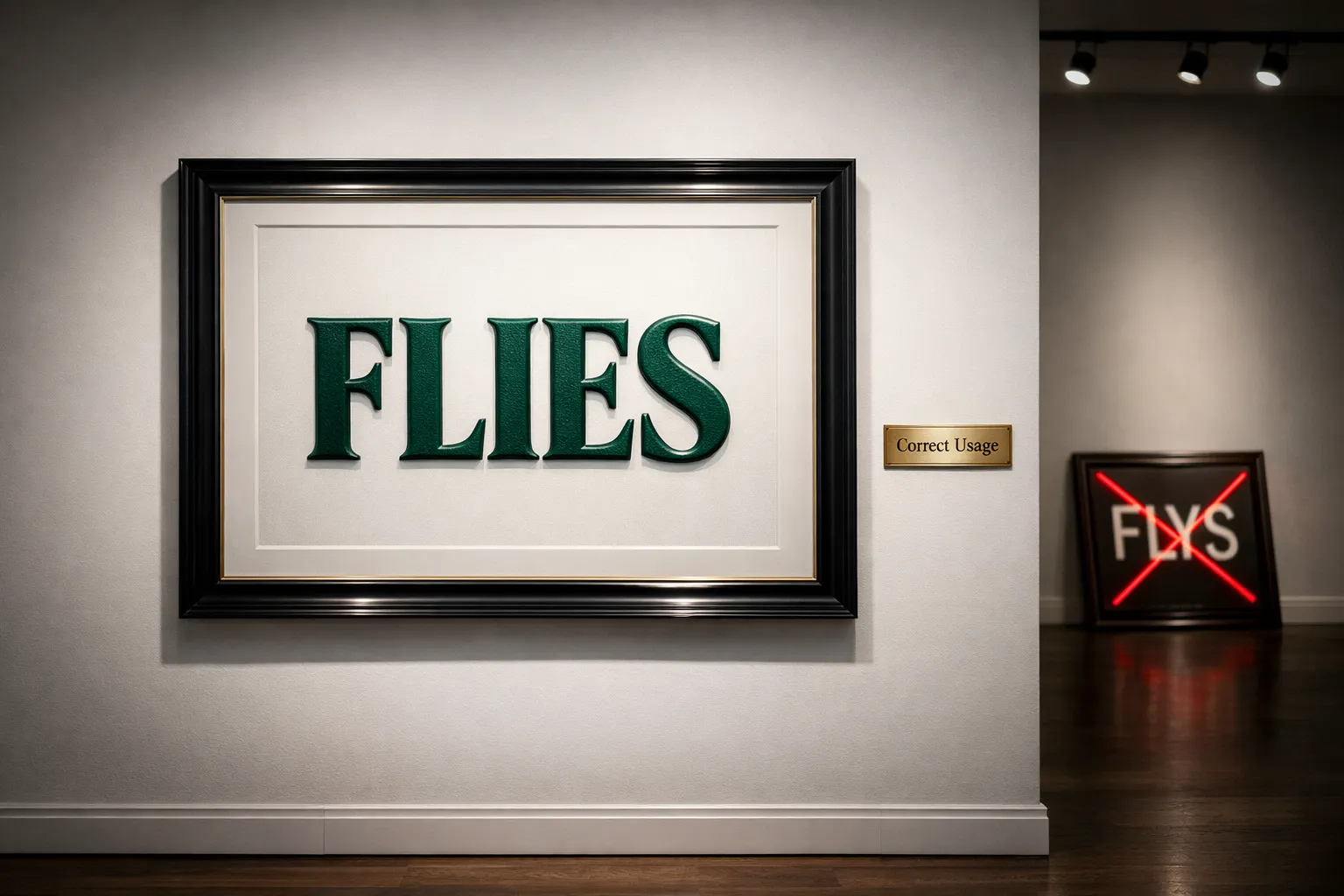
English spelling can sometimes be confusing, especially when words change form in different situations. One common question learners ask is whether “flys or flies” is the correct spelling. At first glance, both words may seem possible, but only one is commonly correct in modern English.
Understanding the difference between flys or flies is important because it helps improve writing accuracy, grammar skills, and professional communication. Whether you are writing emails, essays, or social media posts, using the correct word shows strong language skills.
In this complete grammar guide, you will learn the correct usage of flys or flies, simple grammar rules, real-life examples, common mistakes, and practice exercises to help you master this topic confidently.
What Does Flys or Flies Mean?
When comparing flys or flies, the correct and commonly used spelling in English is “flies.”
The word flies can have several meanings depending on context:
- The plural form of “fly” refers to the insect.
- The third-person singular form of the verb “fly.”
On the other hand, “flys” is usually considered incorrect in standard English, except in rare technical or proper-name contexts.
Examples of “flies” as a plural noun
- Flies are buzzing around the kitchen.
- These flies appear during the summer.
- The fruit flies are attracted to sweet food.
Examples of “flies” as a verb
- The bird flies over the lake every morning.
- She flies to New York for work.
- The airplane flies at a high altitude.
In everyday English writing, “flies” is the correct spelling you should use.
Grammar Rules of Flys or Flies
To understand why flies is correct, we need to look at how English spelling rules work when forming plurals or verb forms.
The word “fly” ends with a consonant + y, which means the spelling changes when we add endings.
Basic Rule
When a word ends with a consonant + y, the y changes to i before adding “es.”
This rule applies to both plural nouns and verb forms.
Rule Table
| Base Word | Rule Applied | Correct Form |
| fly | y → ies | flies |
| cry | y → ies | cries |
| try | y → ies | tries |
| spy | y → ies | spies |
Why “flys” is wrong
If we simply add “s” without changing y, the spelling becomes incorrect.
| Incorrect | Correct |
| flys | flies |
| crys | cries |
| trys | tries |
So, according to English grammar rules, “flies” is always correct in standard usage.
Flys or Flies With Simple Examples
Understanding grammar rules becomes easier when you see them used in real sentences.
Here are several real-life examples showing correct usage of “flies.”
Examples with insects
Flies are common in warm weather.
The flies are buzzing around the fruit bowl.
These flies carry bacteria.
Farmers try to control flies on their farms.
Flies are attracted to sweet smells.
Examples with the verb “fly.”
The eagle flies high in the sky.
She flies to London every year.
The superhero flies across the city.
The flag flies proudly on the building.
Time flies when you are having fun.
Everyday conversation examples
My brother flies drones as a hobby.
The kite flies beautifully in the wind.
The airline flies to many countries.
The bird flies back to its nest.
Dust flies when the wind blows strongly.
These examples show how flies work naturally in everyday English sentences.
Common Mistakes Students Make
Many learners mistakenly write “flys” instead of “flies.” This usually happens because they apply a simple plural rule incorrectly.
Let’s look at some common mistakes.
Correct vs Incorrect Table
| Incorrect Sentence | Correct Sentence |
| The bird flys over the lake. | The bird flies over the lake. |
| Many flys are in the room. | Many flies are in the room. |
| She flys to Dubai often. | She flies to Dubai often. |
| Time flys quickly. | Time flies quickly. |
| The kite flys in the wind. | The kite flies in the wind. |
Why learners make this mistake
Common reasons include:
- Not knowing the consonant + y spelling rule
- Applying simple plural rules incorrectly
- Typing quickly without checking spelling
- Learning English as a second language
Understanding grammar rules solves this problem easily.
Difference Between Similar Grammar Topics
The confusion with flys or flies often appears alongside other words that follow the same spelling rule.
Let’s compare similar examples.
| Base Word | Correct Plural / Verb | Example Sentence |
| fly | flies | The bird flies away. |
| cry | cries | The baby cries loudly. |
| try | tries | She tries her best. |
| spy | spies | The detective spies on suspects. |
| apply | applies | The rule applies here. |
Notice how each word changes “y” to “ies.”
Exception Rule
If a word ends with a vowel + y, we simply add s.
Examples:
| Word | Correct Form |
| play | plays |
| stay | stays |
| enjoy | enjoys |
So the y → ies rule only applies when a consonant comes before y.
Flys or Flies Rules Summary Table
Here is a quick summary to help you remember the correct usage easily.
| Situation | Correct Form | Example |
| Plural of insect “fly.” | flies | The flies are annoying. |
| Third-person verb form | flies | The plane flies daily. |
| Incorrect spelling | flys | Not used in standard English |
| Spelling rule | consonant + y → ies | fly → flies |
Quick memory tip
If a word ends in a consonant + y, change y to ies.
Examples:
- fly → flies
- cry → cries
- try → tries
This rule will help you avoid spelling mistakes in many English words.
Practice Exercises – Flys or Flies
Practice is the best way to master grammar.
Try these exercises to test your understanding of flys or flies.
Fill in the blanks
Choose the correct word.
The bird ______ over the mountain.
Many ______ are near the trash can.
Time ______ very quickly.
The kite ______ high in the sky.
The eagle ______ above the valley.
Correct the sentence
Each sentence has a mistake. Rewrite it correctly.
The airplane flys across the ocean.
The flys are bothering us.
Time flys when you are busy.
The bird flys back to the tree.
The superhero flys through the city.
Answers
Fill in the blanks
flies
flies
flies
flies
flies
Correct sentences
The airplane flies across the ocean.
The flies are bothering us.
Time flies when you are busy.
The bird flies back to the tree.
The superhero flies through the city.
FAQs
Q: Is “flys” ever correct in English?
Answer: In standard English grammar, flys is usually incorrect. The correct spelling is flies for both plural nouns and verb forms.
Q: Why does “fly” become “flies”?
Answer: Because English spelling rules state that words ending with a consonant + y change y to ies when forming plurals or verb forms.
Q: Is “flies” a noun or a verb?
Answer: It can be both.
- Noun: plural of fly (insect)
- Verb: third-person singular of fly
Example:
- The flies are everywhere.
- The bird flies quickly.
Q: Why do learners confuse flys or flies?
Answer: Many learners apply the simple rule of adding s to form plurals, but words ending in consonant + y follow a different spelling rule.
Q: How can I remember the correct spelling easily?
Answer: Use this memory tip:
Consonant + y → change y to ies
Example:
- fly → flies
- cry → cries
- try → tries
Final Tips for Learners
Learning grammar rules like flys or flies becomes easier when you focus on patterns in English spelling. Instead of memorizing every word individually, understanding the rules helps you apply them to many situations.
Here are some useful tips:
- Remember the consonant + y → ies rule
- Practice writing example sentences
- Read English articles regularly
- Use grammar tools to check spelling
- Review common mistakes while learning
The more you practice, the more natural correct spelling will become.
Conclusion
Understanding the difference between flys or flies is an important step in improving your English grammar. While “flys” is generally incorrect, “flies” is the proper spelling used in both plural nouns and third-person verb forms.
By learning the simple rule of changing y to ies when a word ends in consonant + y, you can avoid many spelling mistakes in English writing.
Whether you are writing essays, emails, or online content, mastering small grammar topics like flys or flies makes your English clearer, more professional, and easier to understand.