
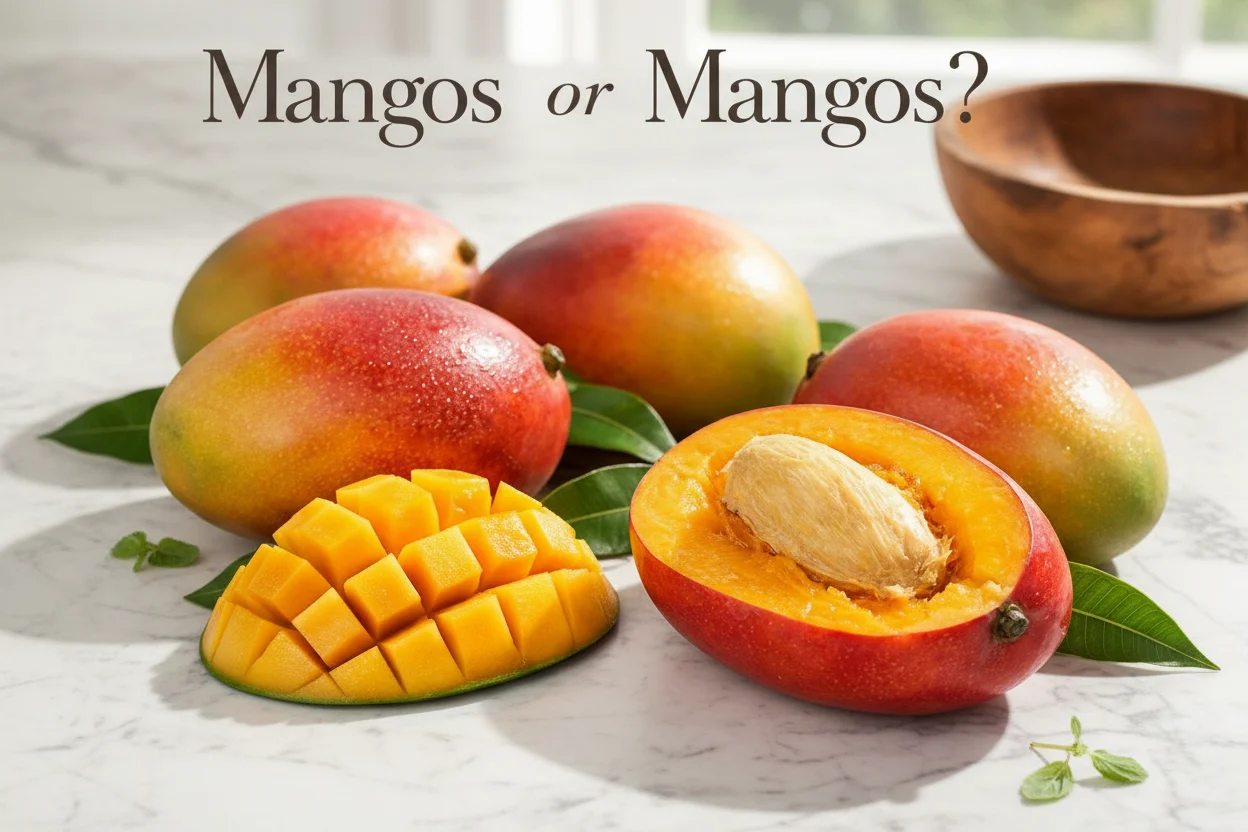
The English language often confuses plural forms of words. One common question many learners ask is mangos or mangoes – which spelling is correct?
Both forms appear in English writing, but many learners are unsure when to use each one. Understanding this grammar topic helps improve writing clarity, spelling accuracy, and confidence in everyday English communication.
In this complete English grammar guide, we will explain the correct plural form of mango, the rules behind it, real-life examples, common mistakes, and practice exercises to help you master this topic easily.
What Does Mangos or Mangoes Mean?
The words mangos and mangoes are plural forms of the noun mango, which refers to a tropical fruit that is popular around the world.
When we talk about more than one mango, we need to use a plural form. English grammar sometimes allows more than one plural spelling, and mango is one of those cases.
In general English usage:
- Mangoes is the more traditional and widely accepted plural form
- Mangos is also accepted, especially in modern or American English
Both forms refer to the same meaning: multiple mango fruits.
Examples
- I bought three mangoes from the market.
- The tree is full of ripe mangos.
- She made a smoothie using fresh mangoes.
- We exported hundreds of mangos last year.
Even though both spellings exist, most grammar guides recommend mangoes as the safer and more formal option.
Grammar Rules of Mangos or Mangoes
The confusion between “mangoes” and “mangos” comes from the general English rule about plural nouns ending in -o.
In English, many nouns ending in -o form their plural by adding -es, but some simply add -s.
Common Plural Patterns
| Word Ending | Plural Rule | Example |
| consonant + o | usually add -es | mango → mangoes |
| vowel + o | usually add -s | radio → radios |
| exceptions | Sometimes both forms are accepted | mango → mangoes/mangos |
Examples of Similar Words
| Singular | Plural |
| tomato | tomatoes |
| potato | potatoes |
| hero | heroes |
| mango | mangoes/mangos |
Because mango follows the consonant + o pattern, the traditional plural becomes mangoes.
However, modern English dictionaries accept mangos as well.
Mangos or Mangoes With Simple Examples
The best way to understand grammar is through clear and simple examples. Below are real-life sentences that show how both forms can appear in English.
Examples Using “Mangoes”
- She cut the mangoes into small slices.
- The basket was filled with juicy mangoes.
- We planted several mango trees in the garden.
- Farmers harvested thousands of mangoes this season.
- These mangoes taste very sweet.
Examples Using “Mangos”
- The shop sells fresh mangos every morning.
- They exported Indian mangos to Europe.
- I love eating chilled mangos in summer.
- The market displayed colorful mangos.
- The smoothie contains bananas and mangos.
Both are correct, but in formal writing and academic English, mangoes is preferred.
Common Mistakes Students Make
Many English learners make mistakes when deciding between mangos or mangoes.
The confusion usually comes from misunderstanding plural spelling rules.
Typical Mistakes
| Mistake | Why It Is Wrong | Correct Form |
| mango’s | Apostrophe used incorrectly | mangoes |
| mango | plural missing | mangoes |
| mangose | incorrect spelling | mangoes |
| mangos | sometimes considered informal | mangoes (formal writing) |
Incorrect vs Correct Sentences
| Incorrect Sentence | Correct Sentence |
| I bought two mango. | I bought two mangoes. |
| The tree has many mango’s. | The tree has many mangoes. |
| She likes sweet mango. | She likes sweet mangoes. |
Avoid using apostrophes when forming plural nouns.
Difference Between Similar Grammar Topics
The topic mangos or mangoes is closely related to plural nouns ending in -o.
Understanding similar examples helps learners remember the rule better.
Comparison Table
| Singular Word | Correct Plural | Rule |
| mango | mangoes/mangos | both accepted |
| potato | potatoes | add -es |
| tomato | tomatoes | add -es |
| piano | pianos | add -s |
| photo | photos | add -s |
Important Tip
Many fruit and vegetable names ending in -o usually take -es.
Examples:
- tomato → tomatoes
- potato → potatoes
- mango → mangoes
This is why mangoes feel more natural in English grammar.
Table Summary of Mangos or Mangoes Rules
To simplify everything, here is a quick summary table.
| Rule | Example | Notes |
| Singular form | mango | one fruit |
| Traditional plural | mangoes | most recommended |
| Alternative plural | mangos | modern usage |
| Formal writing | mangoes | safer choice |
| Informal writing | mangos | acceptable |
Quick Tip
If you are unsure which spelling to use, always choose “mangoes.”
It is the most widely accepted form across dictionaries and grammar guides.
Mangos or Mangoes in Real-Life English Usage
Understanding how words appear in everyday English helps learners remember grammar rules more easily.
In spoken English, people rarely notice the spelling difference because both words sound the same.
However, in written English, the spelling matters.
Common Situations
Food writing
- The dessert includes fresh mangoes.
Travel blogs
- Thailand is famous for delicious mangoes.
Market descriptions
- The vendor sells organic mangos.
Recipes
- Blend two mangoes with yogurt.
Because of these contexts, you may see both spellings online.
Practice Exercises
Practice is essential for mastering grammar topics like mangos or mangoes.
Fill in the blanks
Choose mangos or mangoes.
The basket is full of ripe ______.
She bought three ______ from the fruit shop.
These ______ are very sweet.
Farmers harvested many ______ this year.
I added fresh ______ to the smoothie.
Correct the sentences
Fix the grammar mistakes.
I bought two mango.
The tree has many mango’s.
She likes sweet mangose.
We planted five mango trees in the garden.
The smoothie contains mango.
Answers
Fill in the blanks
mangoes
mangoes
mangoes
mangoes
mangoes
Correct the sentences
I bought two mangoes.
The tree has many mangoes.
She likes sweet mangoes.
We planted five mangoes in the garden.
The smoothie contains mangoes.
FAQs
Q: Which is correct, mangos or mangoes?
Answer: Both forms are accepted, but mangoes is the traditional and more commonly recommended plural form in English grammar.
Q: Why do some people write mangos?
Answer: Modern English sometimes simplifies plural forms by adding -s instead of -es, which is why mangos appears in American English.
Q: Is mangoes more formal than mangos?
Answer: Yes. Mangoes is generally preferred in formal writing, academic texts, and grammar guides.
Q: Do dictionaries accept both spellings?
Answer: Yes. Many modern dictionaries list mangoes as the primary plural and mangos as an alternative spelling.
Q: Should English learners use mangos or mangoes?
Answer: Learners should use mangoes because it follows the traditional plural rule and is more widely accepted.
Final Tips for Learners
Learning small grammar details like mangos or mangoes can significantly improve your writing accuracy.
Here are a few helpful tips:
- Remember that mangoes is the safest spelling
- Avoid adding apostrophes when forming plurals
- Practice using plural nouns in sentences
- Learn similar words like tomatoes and potatoes
- Read English articles to see how plural forms are used
Consistent exposure helps reinforce grammar patterns naturally.
Conclusion
The debate between mangos or mangoes is a small but interesting part of English grammar. Both spellings exist, but mangoes remains the traditional and more widely accepted plural form.
Understanding this rule helps learners avoid spelling mistakes and write more confidently in English. While mangos may appear in modern usage, especially in informal contexts, choosing mangoes is usually the safest option.
By learning the grammar rules, studying examples, and practicing exercises, you can easily master this topic.