
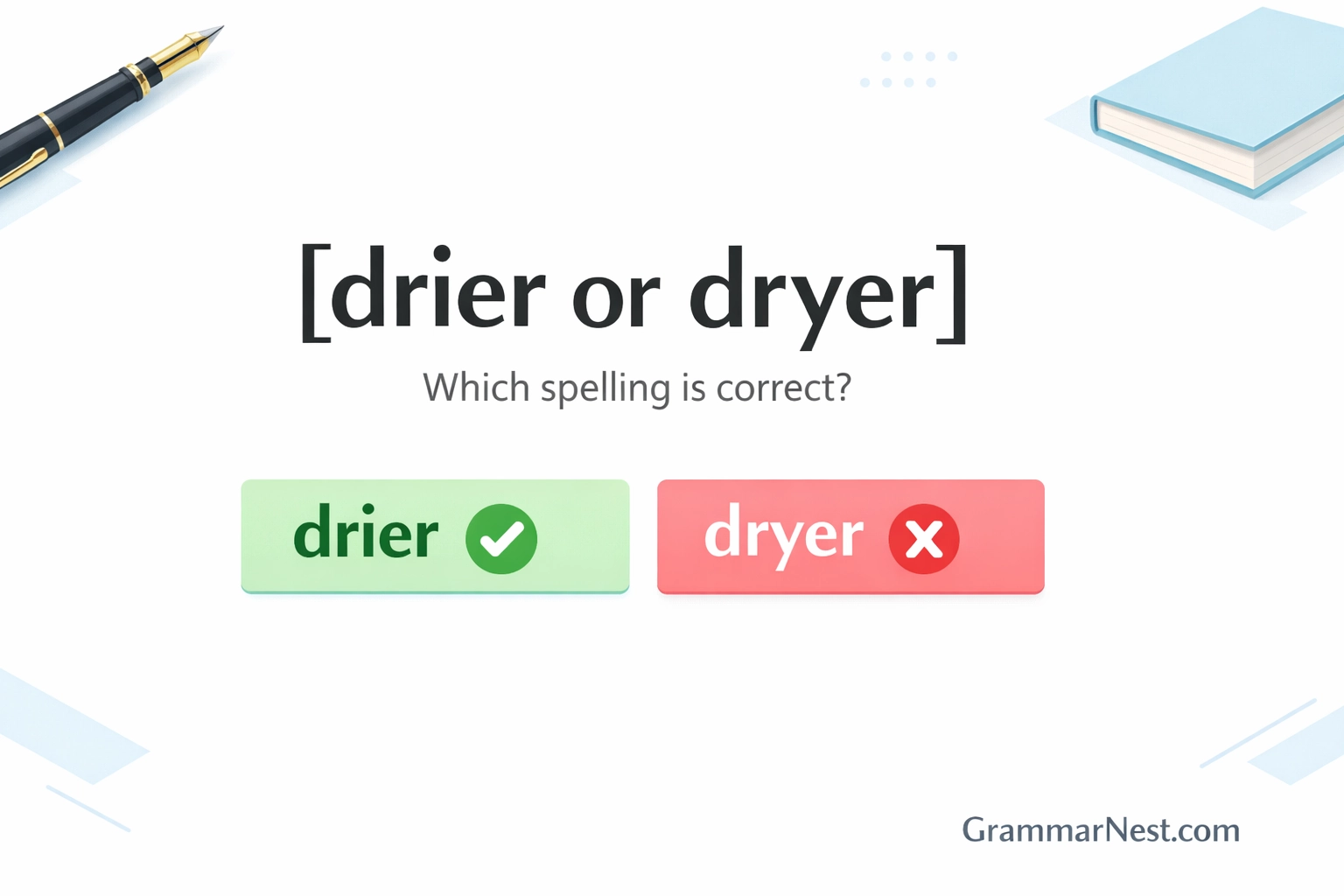
The confusion between drier and dryer is very common, even among fluent English speakers. At first glance, both words look almost identical and sound similar, which makes it easy to mix them up.
But here’s the truth: both words are correct, yet they are used in completely different contexts.
Understanding when to use drier or dryer can improve your writing clarity and help you avoid common grammar mistakes, especially in exams, blogs, or professional communication.
Quick Answer
Drier and dryer are both correct words, but they have different meanings:
- Drier → comparative form of dry (means “more dry”)
- Dryer → a machine or device used to dry something (like a hair dryer or clothes dryer)
👉 Example:
- This towel is drier than the other one.
- I put my clothes in the dryer.
Comparison Table
| Word | Correct or Incorrect | Meaning |
| Drier | ✅ Correct | Comparative form of “dry” (more dry) |
| Dryer | ✅ Correct | A machine used to dry things |
Meaning of Each Word
🔹 What Does “Drier” Mean?
Drier is the comparative form of the adjective dry. It means something has less moisture than before or compared to something else.
👉 Think of it like:
- Dry → Drier → Driest
✔ Used when comparing two things.
🔹 What Does “Dryer” Mean?
Dryer is a noun, not an adjective. It refers to a device or machine used for drying.
👉 Common examples:
- Hair dryer
- Clothes dryer
- Hand dryer
✔ Used for objects, not comparisons.
Grammar Rule Behind the Correct Word
Here’s the key grammar rule:
👉 Rule 1: Comparative Adjective
When forming the comparative of dry, you can spell it as:
- Drier (more traditional and preferred in formal writing)
- Dryer (less common as a comparative, can confuse)
✔ Most grammar experts recommend using “drier” for comparisons.
👉 Rule 2: Noun Form
- Dryer = always a noun (machine/device)
✔ Never use “drier” for machines.
💡 Quick Grammar Tip:
If you’re talking about comparison → use drier
Example Sentences
Here are clear examples to help you understand:
The weather today is much drier than yesterday.
This shirt feels drier after sitting in the sun.
My skin becomes drier in winter.
The desert air is far drier than coastal regions.
I prefer a drier climate.
She used a dryer to style her hair.
The clothes are still wet—put them in the dryer.
The hotel bathroom has a hand dryer.
He bought a new washing machine and dryer.
This towel is drier now, you can use it.
Common Mistakes People Make
Many learners confuse these words due to spelling similarity.
❌ Common Errors:
- Using dryer instead of drier in comparisons
❌ This cloth is dryer than that one
✔ This cloth is drier than that one - Using drier for machines
❌ Put the clothes in the drier
✔ Put the clothes in the dryer
⚠️ Why This Happens:
- Same pronunciation in many accents
- Both spellings look correct
- Lack of clarity between the noun and the adjective
Easy Trick to Remember the Difference
Here’s a simple memory trick:
👉 “E = Equipment”
- Dryer (E) → Equipment (machine)
- Drier (I) → Increasing dryness (comparison)
✔ If it’s a device → dryer
✔ If it’s a comparison → drier
When to Use Each Word
✅ Use “Drier” When:
- Comparing two things
- Talking about less moisture
- Using adjectives
👉 Example:
- This place is drier than before
✅ Use “Dryer” When:
- Referring to machines or devices
- Talking about appliances
👉 Example:
- I bought a new dryer
People Also Ask
❓ Is it drier or dryer for the weather?
✔ The correct word is drier (because it’s a comparison).
❓ Can dryer mean more dry?
Technically, yes, but it’s not recommended because it confuses. Use drier instead.
❓ Why are both spellings correct?
Because:
- One is a comparative adjective (drier)
- One is a noun (dryer)
❓ Which is more common in writing?
- Drier → preferred for grammar clarity
- Dryer → commonly used for machines
FAQs
1. Is “dryer” wrong?
❌ No, it’s correct, but only when referring to a machine.
2. Is “drier” always better?
✔ Yes, when making comparisons.
3. Can I use “dryer” for weather?
❌ Not recommended. Use drier.
4. What is a dryer in simple words?
A dryer is a machine that removes moisture (like a hair dryer or clothes dryer).
5. Which spelling is more formal?
✔ Drier is more formal and preferred in academic writing.
Related Grammar Mistakes
If you’re learning drier or dryer, you might also confuse these:
- Wacky vs Whacky
- Then vs Than
- Affect vs Effect
- Crowler or Growler
- Fewer vs Less
👉 These are common English mistakes that follow similar confusion patterns.
13. Final Summary
Let’s quickly wrap it up:
- Drier = comparative form of dry (means more dry)
- Dryer = a machine used for drying
✔ Use drier for comparisons
✔ Use dryer for devices
🎯 Final Tip:
If you can replace the word with “more dry,” use drier.
If you can replace it with “machine,” use dryer.
By mastering the difference between drier or dryer, you’ll write more clearly, avoid mistakes, and sound more professional in English.