If you’ve ever written an email like “In regards to your message…”, you’re not alone. Many English learners – and even native speakers – get confused between “in regard” and “in regards.”
The confusion happens because both phrases sound natural, and you’ll often see “in regards” used informally. But when it comes to correct grammar and professional writing, only one form is truly accepted.
In this guide, you’ll learn the correct usage, grammar rules, examples, and easy tricks so you never make this mistake again.
Quick Answer
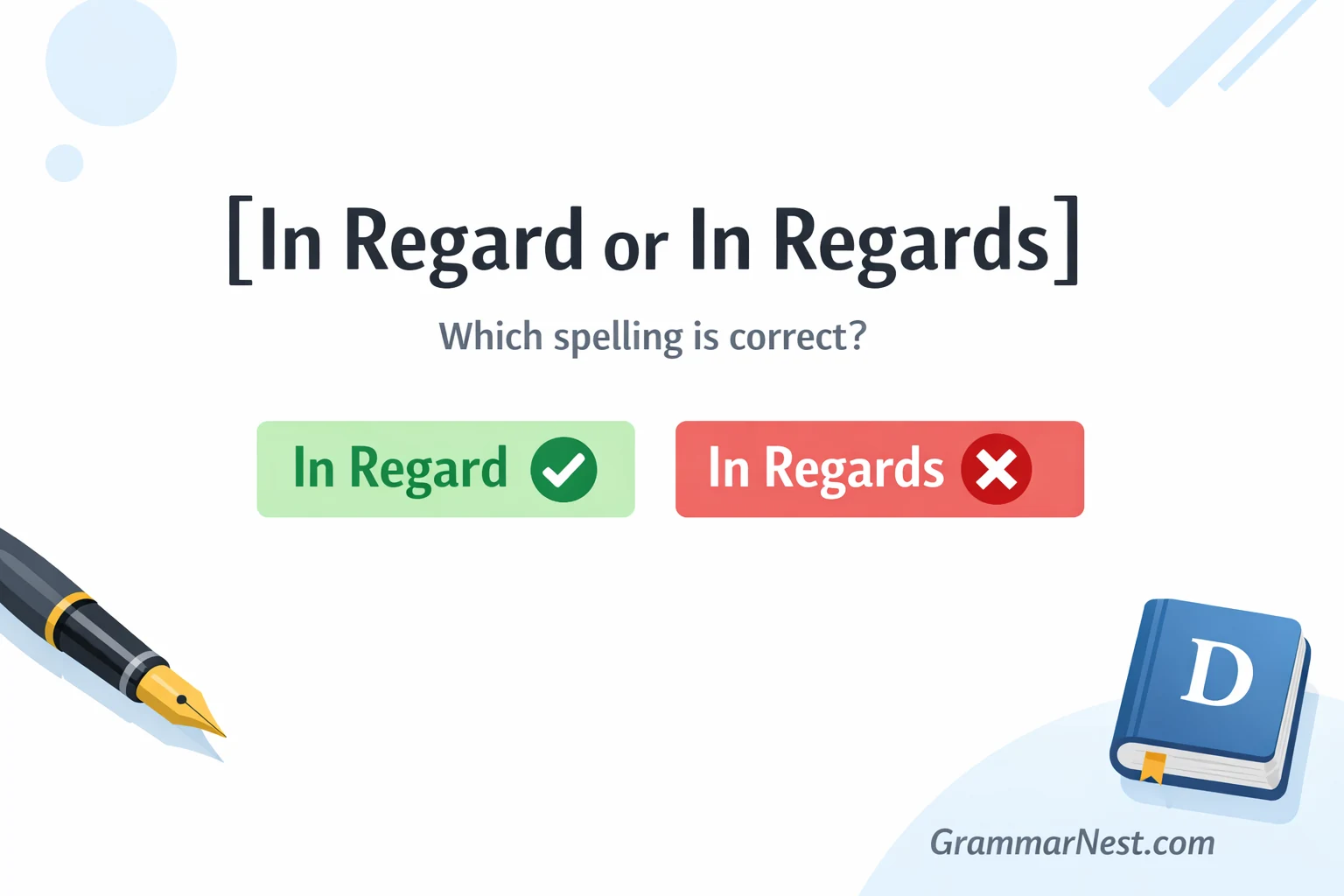
👉 The correct phrase is “in regard to.”
❌ “In regards to” is considered informal or incorrect in standard English.
✔ Use: In regard to your request…
❌ Avoid: In regards to your request…
Comparison Table
| Word/Phrase | Correct or Incorrect | Meaning |
| In regard to | ✅ Correct | Concerning or about something |
| In regards to | ❌ Incorrect (formal) | Informal version, not recommended |
Meaning of Each Word
✅ In Regard To
“In regard to” means “about” or “concerning.”
It is the standard and grammatically correct phrase used in both formal and informal writing.
✔ Example:
In regard to your application, we will respond soon.
❌ In Regards To
“In regards to” is often used in casual speech, but it is not grammatically correct in formal English.
It likely comes from confusion with phrases like:
- Give my regards to… (which is correct, but different)
👉 So while you might hear it often, it’s best to avoid it in professional writing.
Grammar Rule Behind the Correct Word
The correct phrase is based on the noun “regard”, which means attention or consideration.
- “In regard to” = In connection with / concerning
- “Regard” here is used as an uncountable noun
Adding “s” (regards) changes the meaning:
- “Regards” usually means good wishes (e.g., Best regards)
👉 That’s why “in regards to” doesn’t make grammatical sense.
✨ Quick Grammar Tip
✔ Use “regard” when talking about a topic
✔ Use “regards” when sending greetings
Example Sentences
Here are clear examples to help you understand:
In regard to your complaint, we are investigating the issue.
I’m writing in regard to the job opening.
In regard to your question, the answer is yes.
She spoke in regard to the new policy.
In regard to your order, it has been shipped.
We have updated the report in regard to recent changes.
In regard to your email, I will reply shortly.
He raised concerns in regard to safety measures.
In regard to your feedback, we appreciate your input.
In regard to the meeting, it has been postponed.
Common Mistakes People Make
Many writers make these common errors:
❌ Writing “in regards to” in emails
❌ Thinking both forms are interchangeable
❌ Confusing “regards” with greetings
❌ Using informal phrases in professional writing
👉 These mistakes can make your writing look less professional, especially in business communication.
Easy Trick to Remember the Difference
Here’s a simple trick:
👉 Think of “regard” as ONE topic
- You are talking about one subject, not multiple “regards.”
- So use: In regard to ✅
❌ If you see “regards,” think of emails like:
Best regards, John
When to Use Each Word
Use “In Regard To” When:
- Writing formal emails
- Academic writing
- Business communication
- Professional documents
✔ Example:
In regard to your proposal, we need more details.
Avoid “In Regards To” When:
- Writing professionally
- Preparing official documents
- Communicating with clients
👉 It may be acceptable in casual conversation, but not recommended.
People Also Ask
❓ Is “in regards to” ever correct?
No, it is considered nonstandard in formal English. Use “in regard to” instead.
❓ Why do people say “in regards to”?
It sounds natural and is commonly used in speech, but it’s not grammatically correct.
❓ Can I use “with regard to” instead?
Yes! ✔
“With regard to” is another correct and slightly more formal alternative.
❓ Is “regards” always wrong?
No. It’s correct when used in greetings like:
✔ Kind regards
✔ Best regards
FAQs
- What is the correct phrase: in regard or in regards?
The correct phrase is “in regard to.”
- Is “in regards to” acceptable in emails?
It’s commonly used but not recommended in professional emails.
- What can I use instead of “in regard to”?
You can use:
- Concerning
- About
- Regarding
- With regard to
4. Is “regarding” better than “in regard to”?
Yes, “regarding” is often simpler and more modern.
5. Is this a serious grammar mistake?
Not serious, but it can affect your professional impression, especially in business writing.
Related Grammar Mistakes
Here are similar commonly confused phrases:
- Affect vs Effect
- Happy New Year or Years
- Your vs You’re
- Its vs It’s
- Former vs Latter
👉 Learning these helps improve your overall writing clarity and professionalism.
Final Summary
Let’s quickly recap:
✔ “In regard to” is correct
❌ “In regards to” is incorrect in formal English
Key Takeaways:
- Use “in regard to” for professional writing
- Avoid adding “s” unless you mean greetings
- “With regard to” and “regarding” are great alternatives
👉 Mastering small grammar rules like this can make a big difference in your writing quality.