
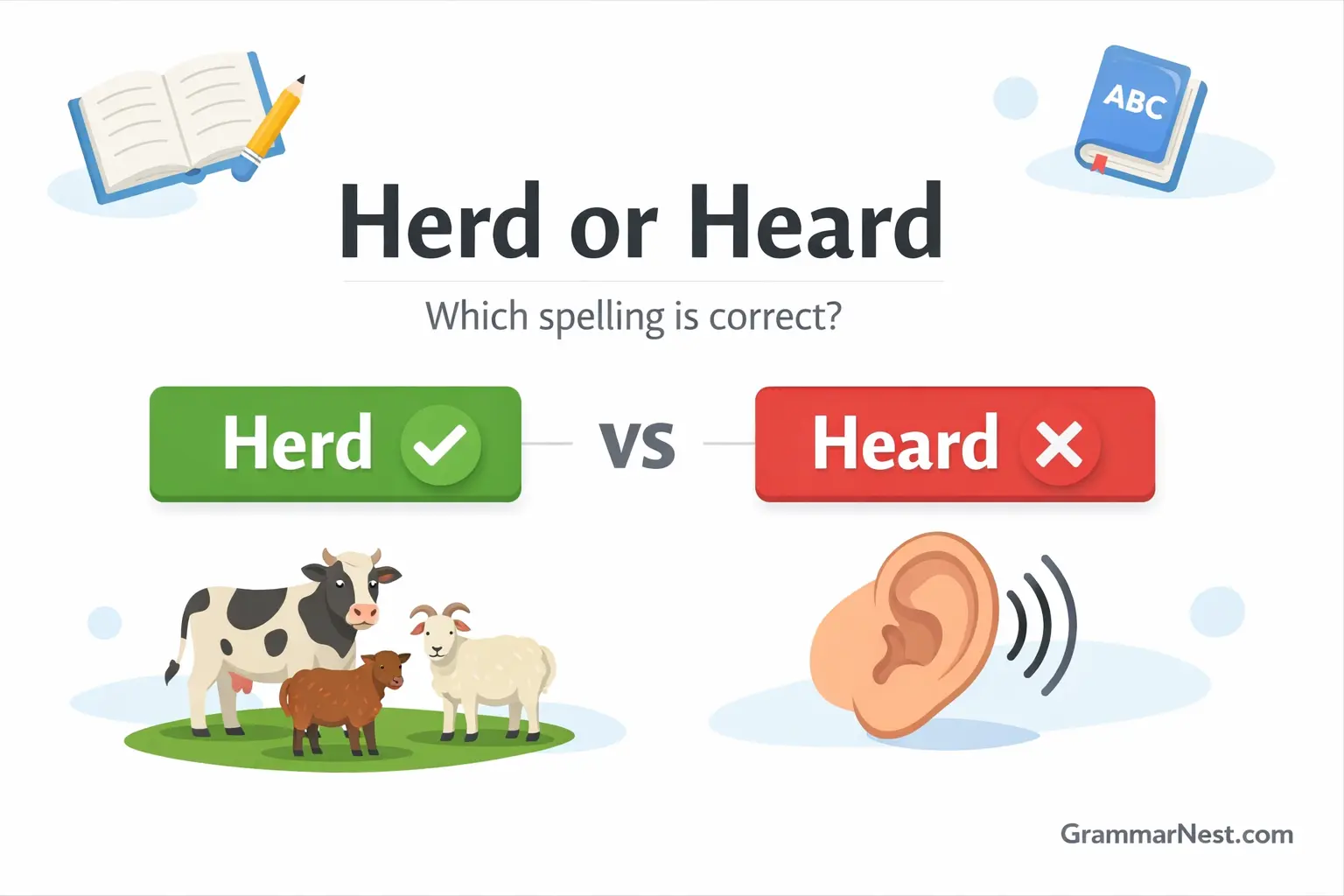
English learners and even native speakers often get confused between herd and heard. These two words sound exactly alike (they are homophones) but have completely different meanings and uses.
Using the wrong word can change the meaning of a sentence and make your writing look unprofessional.
In this guide, we’ll break down the difference between herd and heard, provide simple tricks to remember them, and give examples so you can use them correctly every time.
Quick Answer
- Herd – a noun or verb referring to a group of animals.
- Heard – the past tense of hear, meaning to perceive sound.
Example:
- I saw a herd of cows in the field.
- I heard a strange noise last night.
Comparison Table
| Word | Correct or Incorrect | Meaning |
| Herd | Correct | A group of animals; can also be a verb: to gather or lead animals |
| Heard | Correct | Past tense of hear, meaning perceived sound |
| Hird | Incorrect | Not a valid word |
| Herded | Correct | Past tense of the verb herd |
Meaning of Each Word
Herd
- Noun: Refers to a group of animals such as cows, elephants, or sheep.
- Example: The herd of elephants crossed the river.
- Verb: To gather or lead animals together.
- Example: The farmer herded the sheep into the barn.
Heard
- Past tense of hear: Refers to the act of perceiving sound.
- Example: I heard my favorite song on the radio.
Grammar Rule Behind the Correct Word
- Herd can be used as a noun or a verb, so pay attention to the sentence structure.
- Noun example: A herd of deer was grazing.
- Verb example: He herded the cows into the pen.
- Heard is always the past tense of hear. It cannot be used as a noun or a different verb form.
- Example: She heard the news yesterday.
Quick Grammar Tip: If you are talking about animals or a gathering, use herd. If you are talking about listening, use heard.
Example Sentences
A herd of horses ran across the meadow.
I heard a loud crash outside my window.
The farmer herded the sheep carefully into the pen.
Have you heard the latest news about the election?
The herd moved slowly through the valley.
She heard someone knocking at the door.
He herded the cattle towards the barn.
I heard a funny joke yesterday.
The herd of buffalo was massive and intimidating.
Did you hear the birds singing this morning?
Common Mistakes People Make
- Writing herd when they mean heard:
- ❌ I herd a strange noise.
- ✅ I heard a strange noise.
- Writing heard when they mean herd:
- ❌ A heard of cows crossed the field.
- ✅ A herd of cows crossed the field.
- Confusing past tense forms:
- ❌ She herded the music loudly.
- ✅ She heard the music loudly.
Easy Trick to Remember the Difference
- Herd → Think animals (both have “a” in the word animal).
- Heard → Think listening (both have “ear” inside the word).
Visual cue: If you can see a group of animals, it’s a herd. If you perceive a sound, it’s heard.
When to Use Each Word
- Use Herd:
- Talking about cows, sheep, elephants, or any animal group.
- Talking about guiding or gathering animals.
- Use Heard:
- Describing the past act of listening.
- Talking about music, voices, sounds, or announcements.
FAQs
Q: Are herd and heard pronounced the same?
- Yes, they are homophones, meaning they sound the same but are spelled differently.
Q: Can herd be used for humans?
- Rarely, but sometimes in figurative language, e.g., a herd of shoppers.
Q: Is “herd” always singular?
- No, it refers to a group, so it can take plural verbs depending on style: The herd is moving, or The herd is moving (British vs. American English).
Q: What part of speech is heard?
- Heard is the past tense of the verb hear.
Q: How can I remember the difference quickly?
- Think animals = herd and ear = heard.
Related Grammar Mistakes
Final Summary
Confusing herd and heard is common, but it’s easy to avoid once you know their meanings and functions.
- Herd → a group of animals or the act of gathering them.
- Heard → past tense of hear; listening to sounds.
Use the simple trick: animals = herd, ear = heard. With practice and careful attention, you’ll master these words and write confidently.
Now you can use herd and heard correctly in your sentences and avoid common mistakes that confuse beginners and even advanced English users.
✅ GrammarNest Tip: Keep a small list of homophones, like herd/heard, their/there/they’re, to check quickly before writing. It improves clarity and professionalism in your writing.