
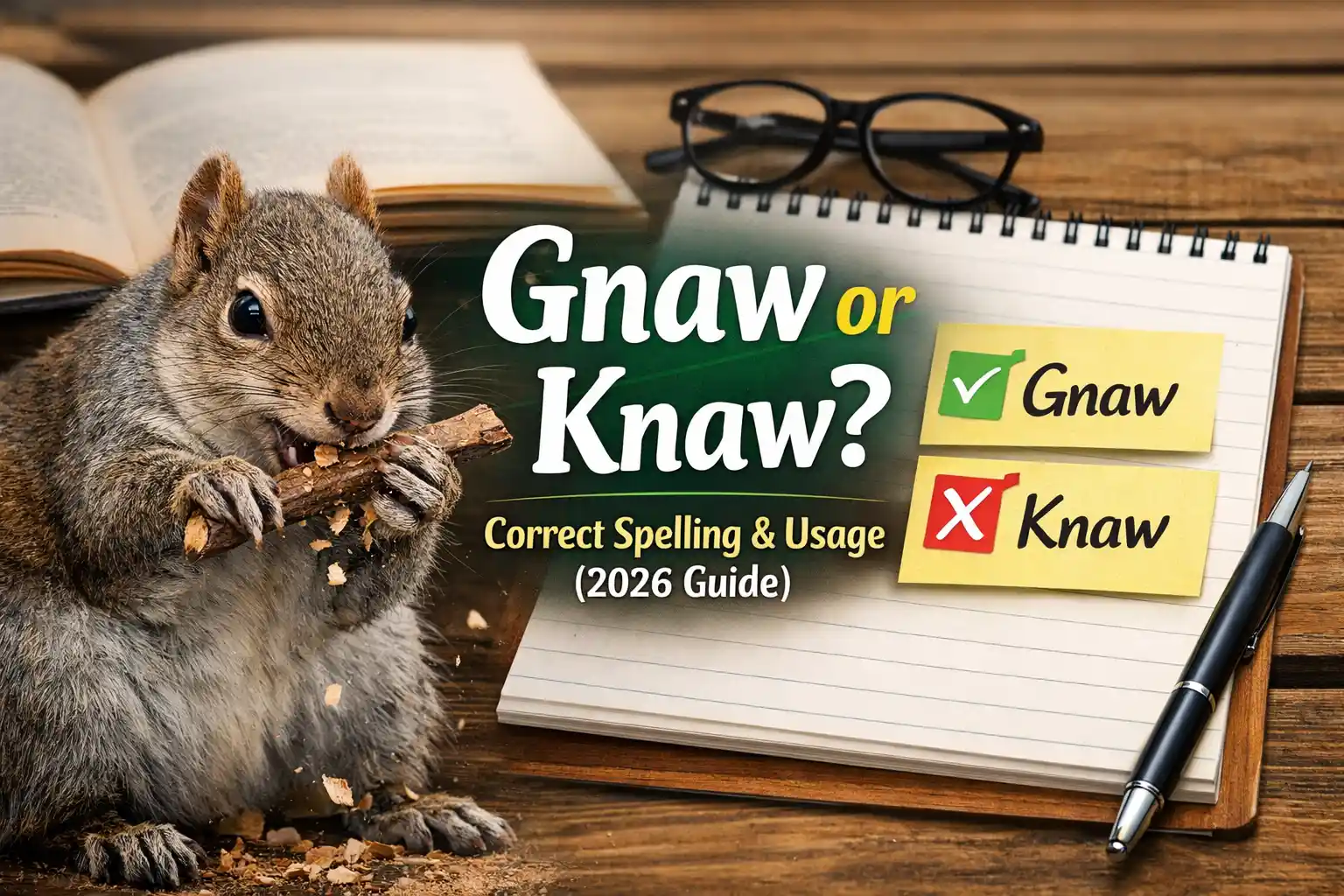
Many people get confused between gnaw and knaw because they sound similar. However, only one of these spellings is correct.
Mistakes like this are common in writing, especially for beginners and even native speakers.
Understanding the proper spelling and usage will help you write more confidently.
Quick Answer
✅ Correct Word: Gnaw
❌ Incorrect Word: Knaw
Gnaw means to bite, chew, or erode gradually.
Example: The dog loves to gnaw on bones.
Comparison Table
| Word | Correct or Incorrect | Meaning |
| Gnaw | ✅ Correct | To bite or chew something repeatedly |
| Knaw | ❌ Incorrect | Not a valid English word |
Meaning of Each Word
- Gnaw:
Verb – To bite or chew persistently, often causing wear or damage.
Examples:- Rats gnaw at the wooden beams.
- Worry can gnaw at your mind all day.
- Knaw:
❌ Not recognized in standard English dictionaries. Using it is always considered a spelling mistake.
Grammar Rule Behind the Correct Word
The confusion arises because the ‘g’ in gnaw is silent, making it sound like “naw.” This silent g is similar to words like gnome and gnash.
Rule:
- When a word starts with gn-, the g is silent.
- Always use gnaw for the meaning “to bite or chew.”
- Avoid replacing g with k, as knaw is never correct.
Example Sentences
The rabbit loves to gnaw on fresh carrots
Anxiety can gnaw at your confidence.
Beavers gnaw on tree trunks to make their dams.
The old chair was gnawed by mice.
A persistent worry can slowly gnaw at your peace of mind.
Children often gnaw on pencils while thinking.
The dog began to gnaw on the toy until it broke.
Feelings of guilt can gnaw at a person’s conscience.
Rodents gnaw through wires, causing damage.
He could hear the mouse gnawing on the cupboard corner.
Common Mistakes People Make
- Writing knaw instead of gnaw.
- Confusing gnaw with similar-sounding words like gaw or naw.
- Forgetting that the g is silent.
Easy Trick to Remember the Difference
💡 Memory Tip:
- Think of gnaw as “bite slowly” – the g is silent, just like in gnome.
- Always imagine an animal gnawing a bone – it helps fix the correct spelling.
When to Use Each Word
- Gnaw: Use when describing:
- Animals chewing something
- Mental or emotional wear, like anxiety or guilt
- Knaw: Never use – it’s a spelling error.
People Also Ask
What is the correct spelling: gnaw or knaw?
✅ Gnaw is correct.
How do you pronounce gnaw?
It is pronounced /nɔː/ – the “g” is silent.
Can gnaw be used metaphorically?
Yes, e.g., “Worry gnaws at me.”
Is knaw a real word?
❌ No, it’s incorrect.
What is the past tense of gnaw?
Gnawed.
FAQs
Q: Can I write “knaw” in informal writing?
No, it’s always considered a spelling mistake.
Q: Is gnaw used only for animals?
No, it can also describe worries or thoughts slowly affecting someone.
Q: How do I remember the silent “g”?
Link it with words like gnome and imagine the gnawing action.
Q: What is the gerund form of gnaw?
Gnawing. Example: The mouse is gnawing the cheese.
Q: Are there similar confusing words in English?
Yes, e.g., gnash, gnat, gnome.
Related Grammar Mistakes
Final Summary
In English, the correct spelling is always gnaw. The silent g makes it tricky for many learners. Remember, it means “to bite or chew” and can be used literally (for animals) or metaphorically (for worries). Avoid knaw entirely. Use the tricks, examples, and grammar rules from this guide, and you’ll never confuse them again