
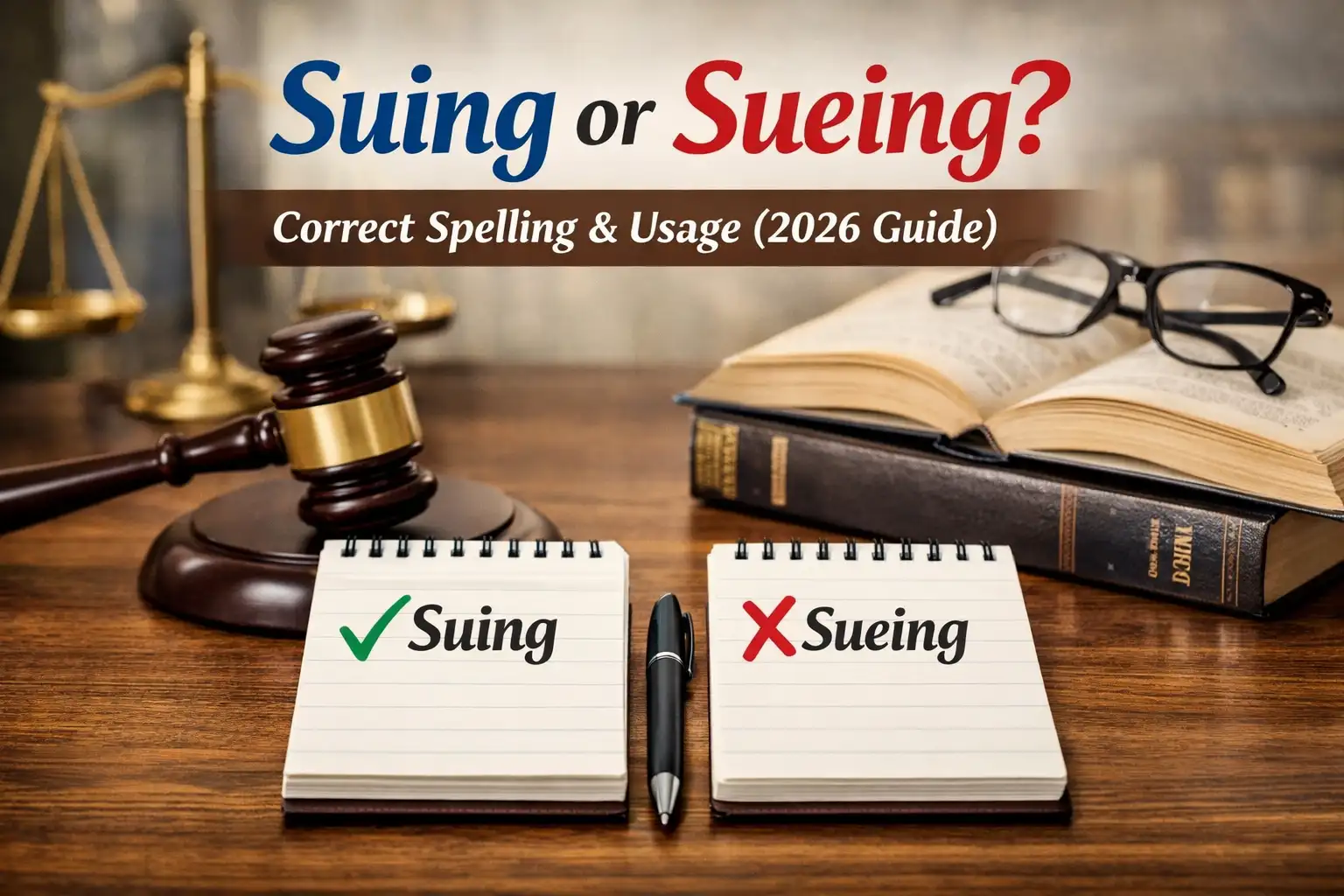
Many English learners and even native speakers often get confused between “Suing” and “Sueing.” The confusion arises because both words sound similar, and people naturally assume that adding an extra “e” may be correct, just like in some verbs such as “freeing” or “agreeing.”
However, only one form is grammatically correct in standard English when referring to taking legal action against someone.
Understanding the proper spelling, meaning, and usage can save you from common writing mistakes and help your writing appear professional and polished.
Quick Answer
The correct spelling is “Suing.”
- Suing: Present participle of the verb “sue”, meaning to take legal action.
- Sueing: Incorrect spelling and should be avoided.
✅ Example: She is suing her former employer for breach of contract.
Comparison Table
| Word | Correct or Incorrect | Meaning |
| Suing | ✅ Correct | Taking legal action against someone |
| Sueing | ❌ Incorrect | Not recognized in standard English |
Meaning of Each Word
Suing
- Definition: “Suing” is the present participle of the verb sue.
- Usage: Used when someone is actively initiating a legal case.
- Example: They are suing the company for damages.
Sueing
- Definition: Incorrect form; not accepted in formal English.
- Usage: Avoid using this spelling, even in informal writing.
- Tip: Always drop the extra “e” when adding “-ing” to verbs ending in “e” like sue.
Grammar Rule Behind the Correct Word
The rule for forming the present participle of verbs ending in “-e” is simple:
- Drop the “e” and add “-ing.”
- Example: make → making, bake → baking, sue → suing
Common exception: Verbs ending in “-ee” retain both “e” letters:
- see → seeing, free → freeing
Since sue ends with a single “e,” we drop the “e” and add “-ing”: sue → suing.
Example Sentences
Here are 10+ examples using “suing” correctly:
He is suing the company for wrongful termination.
The famous actor is suing the magazine for defamation.
We are suing the landlord for not fixing the broken elevator.
She is suing her neighbor over property damage.
They are suing the government for environmental violations.
The startup is suing its former partner for stealing trade secrets.
After the accident, the family began suing the manufacturer.
The consumer is suing the brand for misleading advertising.
He is considering suing his former business partner.
Suing someone without evidence is risky and costly.
Common Mistakes People Make
- Writing “Sueing” instead of “Suing.”
- Confusing sue with seeing because of the double “e” pattern in other verbs.
- Using informal spellings in emails or reports can reduce credibility.
Easy Trick to Remember the Difference
Memory Tip:
- Think: “I SUe → I am SUing” → drop the “e” before adding “-ing.”
- If a verb ends in a single “e” (except -ee), always drop it before adding “-ing.”
✅ Quick test: Sue + ing = Suing
❌ Don’t write: Sueing
When to Use Each Word
- Suing: Use in legal contexts or any sentence referring to legal action.
- Example: She is suing the restaurant for food poisoning.
- Sueing: Never use in standard English. Only appears in common misspellings.
FAQs)
Q: Can “sueing” ever be correct?
No, “sueing” is always incorrect in standard English.
Q2: Is “suing” used only in legal contexts?
Primarily, yes, when referring to taking someone to court.
Q: How do I form other “-ing” verbs like “sue”?
Drop the final “e” and add “-ing” unless the verb ends in “-ee.”
Q: Can I say “He is sueing the company” in an email?
No, use “He is suing the company.”
Q: Why do some dictionaries list “sueing”?
Some informal sources may mention it, but it’s not accepted in formal writing.
Related Grammar Mistakes
Quick Grammar Tip: Always check whether your verb ends with single e or double e before adding -ing.
Final Summary
In conclusion:
- Correct spelling: Suing ✅
- Incorrect spelling: Sueing ❌
- Meaning: Taking legal action against someone.
- Grammar rule: Drop the final “e” before adding -ing, except for verbs ending in -ee.
- Tip: Remember: “I Sue → I am SUing” to avoid mistakes.
By following this simple guide, you’ll never confuse suing with sueing, making your writing accurate, professional, and clear.