
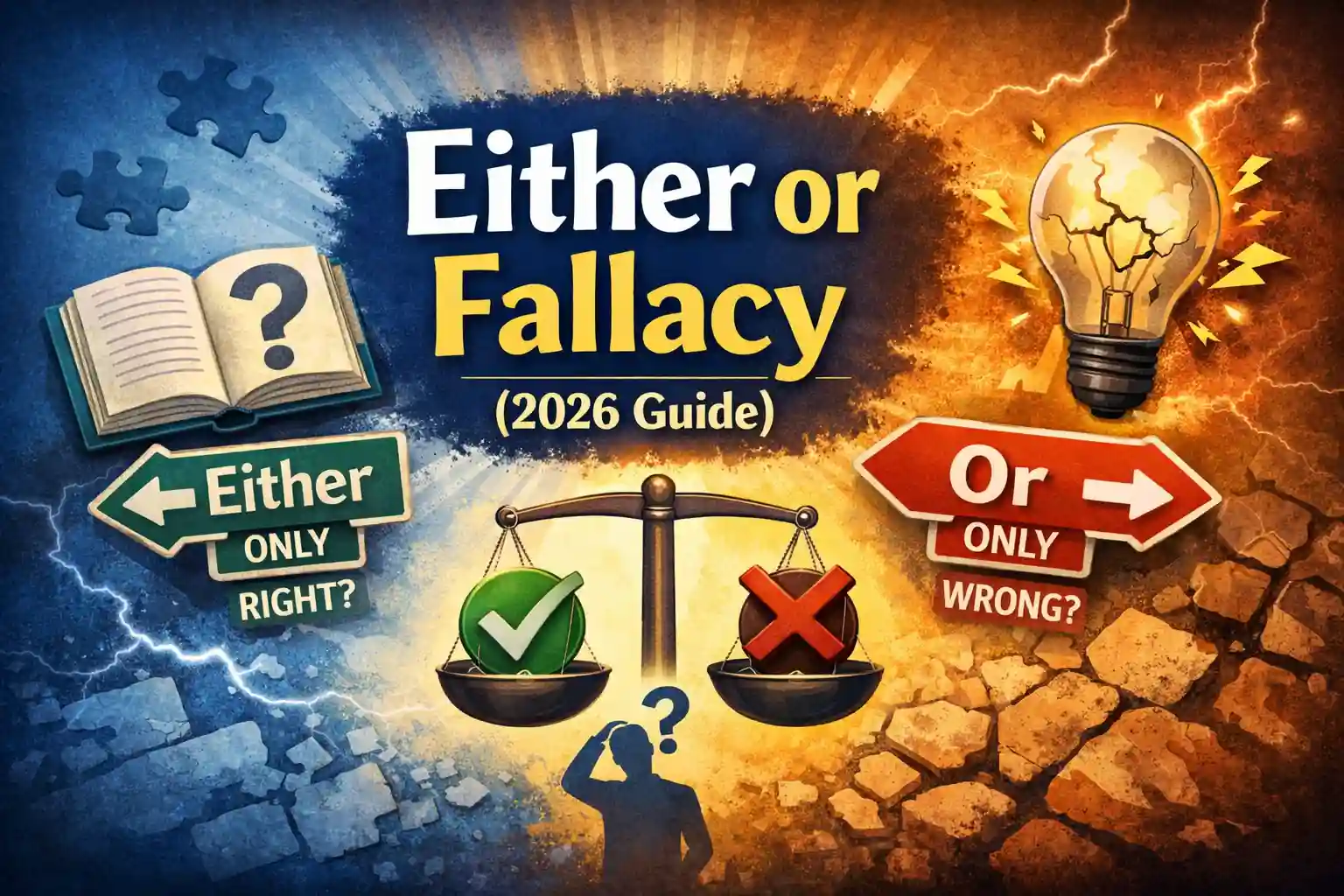
Have you ever been faced with a choice that seemed limited to just two options and thought it was a grammar rule or a logic rule? That’s where the Either-or Fallacy comes in. Many people confuse this concept because it sounds simple: “either this or that.” However, it’s not just about choices-it’s about faulty reasoning.
Understanding the Either-or Fallacy helps you write and speak more clearly, avoid common logic mistakes, and improve your critical thinking skills.
In this article, we’ll explain everything about it in simple, easy-to-understand language with examples, tricks, and grammar rules.
Quick Answer
The Either-or Fallacy occurs when someone wrongly assumes that only two options exist in a situation, ignoring other possible alternatives.
Example:
- ❌ “You’re either with us or against us.”
- ✅ “You can support us, stay neutral, or give constructive feedback.”
Comparison Table
| Term | Correct or Incorrect | Meaning |
| Either or Fallacy | Correct | A logical error assumes only two options exist |
| “Either this or that” (when limiting choices incorrectly) | Incorrect | Misleading simplification of available choices |
| False Dilemma | Correct | Another name for either or fallacy in logic |
| “You must do this or fail.” | Incorrect | Ignores other potential solutions |
Meaning of Each Word
- Either – One of two choices. Example: Either tea or coffee is fine.
- Or – Connects alternatives, options, or choices. Example: We can go to the park or stay home.
- Fallacy – A mistake in reasoning or logic. Example: Believing something is true just because many people say so is a fallacy.
When combined, Either or Fallacy means assuming there are only two possible outcomes when there might be more.
Grammar Rule Behind the Correct Use
- Use either…or to present two genuine alternatives.
- Do not limit options artificially when there are more than two.
- Avoid overgeneralization; check if other alternatives exist before using “either or.”
Quick Grammar Tip:
- ✅ Correct: “You can either call me or email me.”
- ❌ Incorrect: “You either like math, or you’re useless.”
Example Sentences
Either you take the train, or you take the bus.
She can either attend the meeting or watch the recording.
He believes you’re either rich or poor, ignoring middle-class options.
The manager says either we meet the deadline or face penalties.
You can either eat now or save the food for later.
Don’t fall into the trap of thinking that either you succeed or fail.
You can either read a book or listen to an audiobook.
The politician framed it as either support this law or oppose progress.
Either you join the team or stay at home.
Avoid thinking in extremes-life is rarely just either or.
Common Mistakes People Make
- Limiting options unnecessarily: “Either you love it or hate it.”
- Use either when multiple alternatives exist.
- Confusing either with whether or not, which has a different meaning.
- Presenting false dilemmas in writing or arguments.
Easy Trick to Remember the Difference
- Ask yourself: Are there only two real choices?
- If yes → Use either or.
- If no → Consider alternatives, rephrase, or avoid limiting the options.
Memory Tip:
- “Either or = exact two choices. Anything more = fallacy trap.”
When to Use Each Word
- Either – When presenting two clear options.
- Or – When connecting alternatives.
- Fallacy – When highlighting a reasoning mistake.
Usage Example:
- Correct: “The Either or Fallacy assumes only two solutions exist, which is rarely true.”
- Incorrect: “You either fail or succeed in everything, no exceptions.”
FAQs
Q: Is “Either or Fallacy” a grammatical mistake?
- Not a grammar mistake, but a logic mistake in reasoning.
Q: Can “either or” be used in formal writing?
- Yes, but only when there are exactly two valid alternatives.
Q: What is the difference between the Either-Or Fallacy and the False Dilemma?
- They are essentially the same concept. Both present limited options incorrectly.
Q: How can I fix an Either-Or Fallacy in writing?
- Include all possible alternatives or rephrase without forcing two options.
Q: Are Either or Fallacies common in arguments?
- Yes, especially in debates, politics, and persuasive writing.
Related Grammar Mistakes
. Final Summary
The Either-or Fallacy is a common logic and grammar mistake that assumes only two possible outcomes when more exist. By understanding its meaning, grammar rules, and common mistakes, you can avoid misleading statements, improve your writing, and think more critically. Always ask yourself whether you are presenting only two real options before using either or-this simple trick keeps your sentences clear, precise, and logical.
Remember: Either or = two true choices. Anything beyond that = fallacy.