
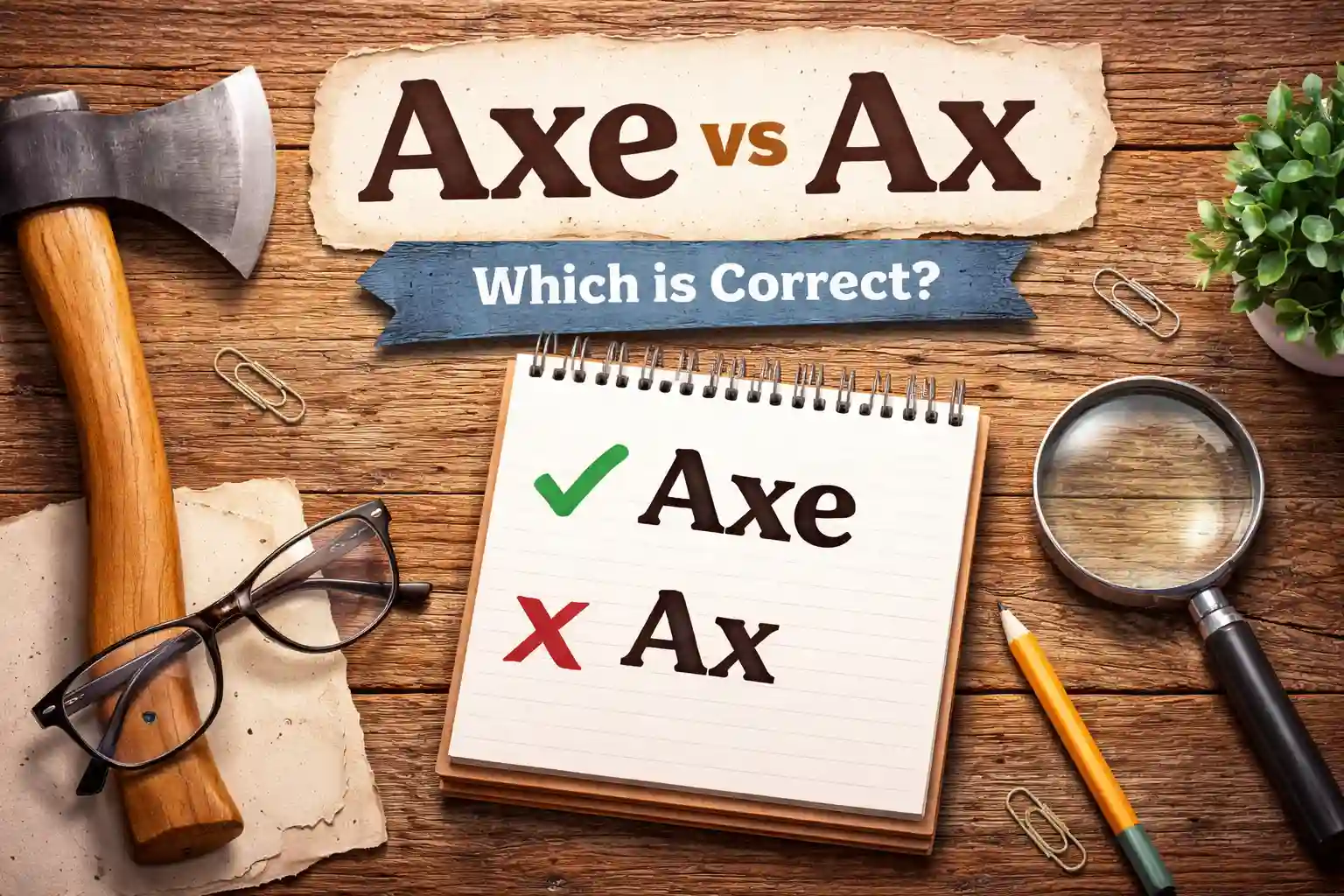
The words “axe” and “ax” refer to the same tool used for chopping, splitting, or hewing wood. The confusion arises because of their different spellings, and many people are unsure which one is correct.
While both spellings exist, they are used in different contexts, regions, and even personal preferences.
Understanding the difference is essential for effective writing, and we’re here to clear it up for you!
Quick Answer
The correct spelling of the word depends on the region. “Axe” is the preferred spelling in British English, while “ax” is commonly used in American English. Both terms refer to the same tool used for chopping or splitting wood.
Comparison Table
| Word | Correct or Incorrect | Meaning |
| Axe | Correct (British) | A tool with a heavy-bladed head used for chopping wood or other materials. |
| Ax | Correct (American) | Same as “axe,” but the preferred spelling in American English. |
Meaning of Each Word
Both “axe” and “ax” refer to a tool that has a sharp blade attached to a handle, commonly used for cutting, chopping, and splitting wood. In modern contexts, it can also refer to a symbolic tool for cutting or removing something, such as “getting the axe” in a workplace scenario.
Axe (British English)
In British English, “axe” is the standard spelling, and it is widely used across the UK and many other parts of the world. It is the more traditional and older form of the word.
Ax (American English)
“Ax” is the Americanized spelling of the word. It became popular in the United States during the 18th century and has remained the dominant form in American English ever since.
Grammar Rule Behind the Correct Word
The difference between “axe” and “ax” boils down to regional spelling preferences:
- Axe is the British form.
- Ax is the American form.
Both spellings are technically correct, but their usage depends on where you are writing. The key takeaway is that if you are writing for an American audience, “ax” is the way to go, while “axe” should be used for a British audience.
Example Sentences
Here are ten examples to show how “axe” and “ax” can be used in sentences:
She used an axe to chop the wood. (British English)
The lumberjack grabbed his ax and headed into the forest. (American English)
After hours of work, the axe finally split the log in two. (British English)
He carried his ax with great pride. (American English)
The blacksmith sharpened the axe until it gleamed. (British English)
The carpenter picked up his ax to begin the work. (American English)
They wielded the axe with precision. (British English)
He knew how to use an ax properly. (American English)
The axe was buried in the wood after the last strike. (British English)
I saw a man swinging an ax as I walked by. (American English)
Common Mistakes People Make
Some common mistakes people make when using “axe” and “ax” include:
- Using “ax” in British English writing: If you’re writing for a British audience, “ax” is incorrect. Stick to “axe” for accuracy.
- Confusing the spelling in formal writing: Always double-check the spelling based on the audience you’re writing for. This is particularly important in professional and academic contexts.
- Overusing one version inappropriately: Remember that both spellings are correct, but it’s important to choose the one that aligns with your target audience.
Easy Trick to Remember the Difference
An easy way to remember when to use “axe” or “ax” is to think of the location where you’re writing:
- Axe = Britain
- Ax = America
This simple association can help you choose the correct form based on your writing audience.
When to Use Each Word
- Use “axe” when writing for British English audiences or in more formal contexts.
- Use “ax” when writing for American English readers, especially in casual contexts or personal writing.
People Also Ask
1. Which is correct: “axe” or “ax”?
Both “axe” and “ax” are correct spellings, but the preferred form depends on whether you’re using British or American English.
2. What does the word “axe” mean?
An “axe” is a tool with a sharp blade used for chopping, splitting, or hewing wood and other materials.
3. Is “ax” a misspelling of “axe”?
No, “ax” is simply the American English spelling, while “axe” is the British version.
4. Why is there a difference between “axe” and “ax”?
The difference is due to regional spelling conventions. “Ax” is more common in American English, while “axe” is standard in British English.
5. Can I use “ax” in British English?
No, “ax” is typically reserved for American English. In British English, “axe” is the correct spelling.
FAQs
1. Can I use “axe” in American English?
It is correct to use “axe” in American English, but “ax” is more commonly used.
2. What’s the origin of “axe” vs “ax”?
The word “axe” has Old English origins, while “ax” became a simplified version used more frequently in America over time.
3. Is it okay to use “ax” in formal writing?
Yes, “ax” is acceptable in American formal writing. However, it is essential to match your spelling with the region you’re addressing.
4. Which spelling is used in Canada?
In Canada, both “axe” and “ax” are used, but “axe” is more common.
5. Is there a difference in pronunciation between “axe” and “ax”?
No, the pronunciation of “axe” and “ax” is the same, regardless of spelling.
Related Grammar Mistakes
Final Summary
In conclusion, “axe” vs “ax” is a simple case of regional preference. Both words mean the same thing, but “axe” is used in British English, while “ax” is the preferred spelling in American English. By understanding the context and knowing which audience you’re writing for, you can easily choose the correct form. Use our tricks and tips to avoid common mistakes, and your writing will be as sharp as the tool you’re describing!