
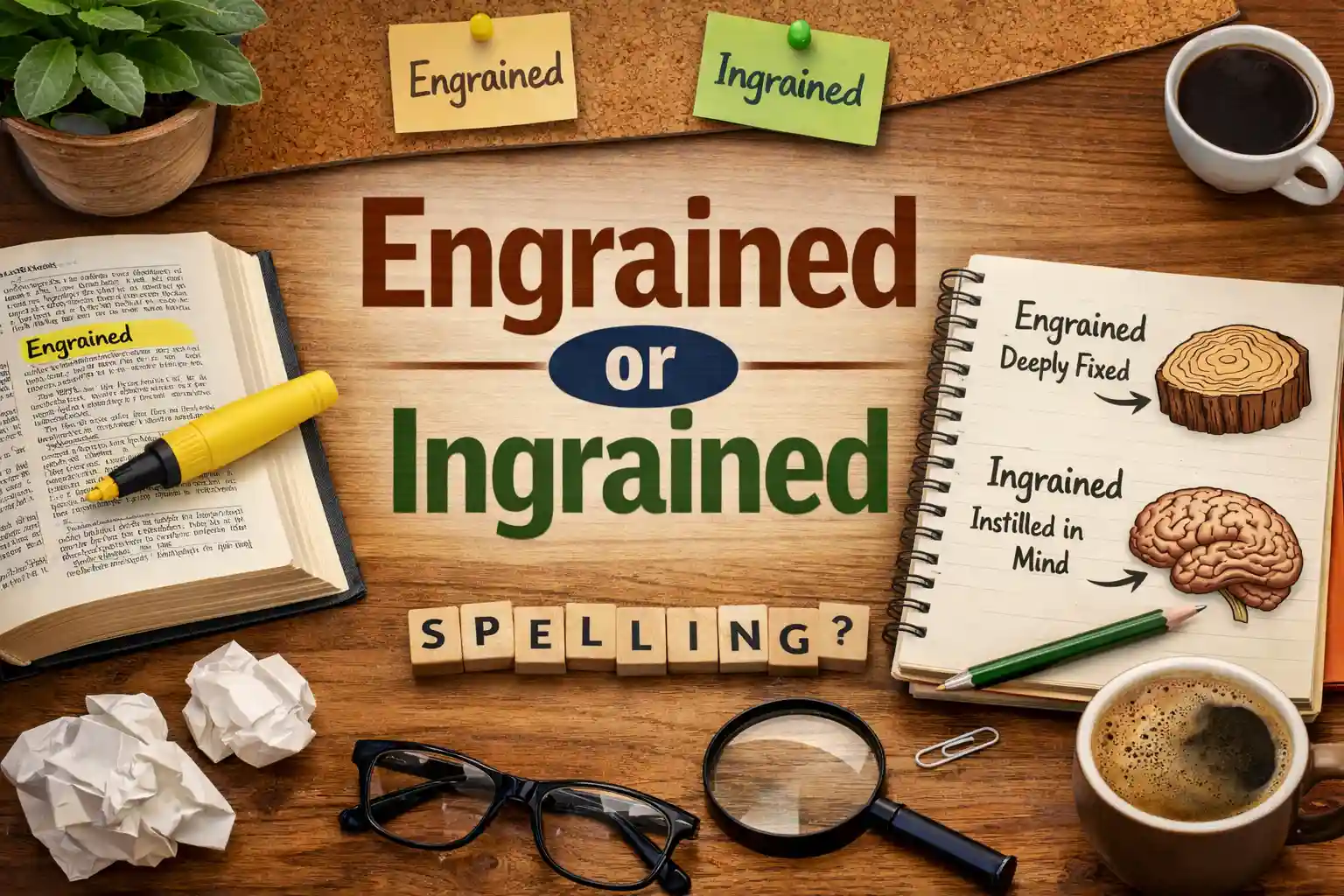
Many English learners and even native speakers often get confused between engrained and ingrained. Both words sound similar and relate to something deeply fixed or firmly established. However, only one of these forms is widely considered correct in modern English.
Understanding the difference is crucial for writing professionally and avoiding subtle mistakes that can affect clarity and credibility.
This guide will explain the correct usage, meaning, and grammar rules, and provide practical examples to make it easy to remember.
Quick Answer
The correct word is “ingrained.”
It means something deeply rooted, fixed, or firmly established, often referring to habits, beliefs, or characteristics.
Example: Her sense of honesty is deeply ingrained.
While engrained is sometimes seen in older texts, it is now largely considered a variant or incorrect spelling in modern English. Always prefer ingrained in professional and academic writing.
Comparison Table
| Word | Correct or Incorrect | Meaning |
| Ingrained | ✅ Correct | Firmly fixed or deeply rooted, especially habits or beliefs |
| Engrained | ❌ Incorrect | Older variant; not recommended in modern English |
Meaning of Each Word
Ingrained
- Deeply fixed or established
- Often used for habits, values, attitudes, or traditions
- Suggests permanence or resistance to change
Example: Patience is ingrained in her character.
Engrained
- Historically used as a variant of “ingrained”
- Rare in modern usage
- Avoid in professional writing
Example (older text): The superstition was engrained in village life.
Grammar Rule Behind the Correct Word
Rule: When describing something deeply fixed or established, use ingrained.
- Adjective: Always used as a descriptive word, not a verb.
- Do not confuse it with “engrave,” which is a verb meaning to carve or etch.
Correct: He has an ingrained habit of reading every night.
Incorrect: He has an engrained habit of reading every night.
Example Sentences
Her love for classical music is ingrained from childhood.
An ingrained sense of responsibility shapes his daily routine.
Laziness can become ingrained if not addressed early.
Cultural traditions are deeply ingrained in the community.
His ingrained optimism helped him overcome setbacks.
Some fears are ingrained in people through experience.
Honesty is an ingrained trait in her personality.
Prejudices can be difficult to remove once they are ingrained.
Ingrained habits take time and effort to change.
The practice of teamwork is ingrained in our company culture.
Common Mistakes People Make
- Writing engrained instead of ingrained
- Confusing ingrained with engrave
- Using “ingrained” for temporary or superficial habits (it implies deep-rootedness)
Wrong: He has an engrained interest in football.
Correct: He has an ingrained interest in football.
Easy Trick to Remember the Difference
Think of “in” + “grained”:
- “In” → inside, deep, internal
- “Grained” → like the grain of wood, something fixed and firm
Mnemonic: “Ingrained means inside and firmly fixed.”
When to Use Each Word
- Ingrained → Use for habits, beliefs, traditions, values, or personality traits that are deeply established.
- Engrained → Avoid in modern writing; only for historical or literary context.
FAQs
Q: Can I use engrained in American English?
Technically, yes, but it is outdated. Use ingrained for modern and formal writing.
Q: Is ingrained only used for habits?
No, it can describe any deeply fixed trait, belief, or characteristic.
Q: Are engrained and ingrained pronounced differently?
They are usually pronounced the same, but ingrained is the preferred spelling.
Q: Can ingrained be used in positive and negative contexts?
Yes. For example, ingrained honesty (positive) or ingrained prejudice (negative).
Q: Is there a verb form of ingrained?
No. The verb is ingrain, meaning to implant or establish.
Related Grammar Mistakes
Quick Grammar Tip: Always ask, “Is this deeply fixed or just temporary?” Use ingrained only for deep-rooted traits.
Final Summary
In modern English, ingrained is the correct and widely accepted form. It describes something firmly established, such as habits, beliefs, and personality traits. Avoid using engrained, which is largely outdated. Remember the mnemonic: “Ingrained = inside and firmly fixed” to never forget the correct usage.
With this guide, you can confidently write and speak without confusing engrained and ingrained, making your English more polished, professional, and precise.