
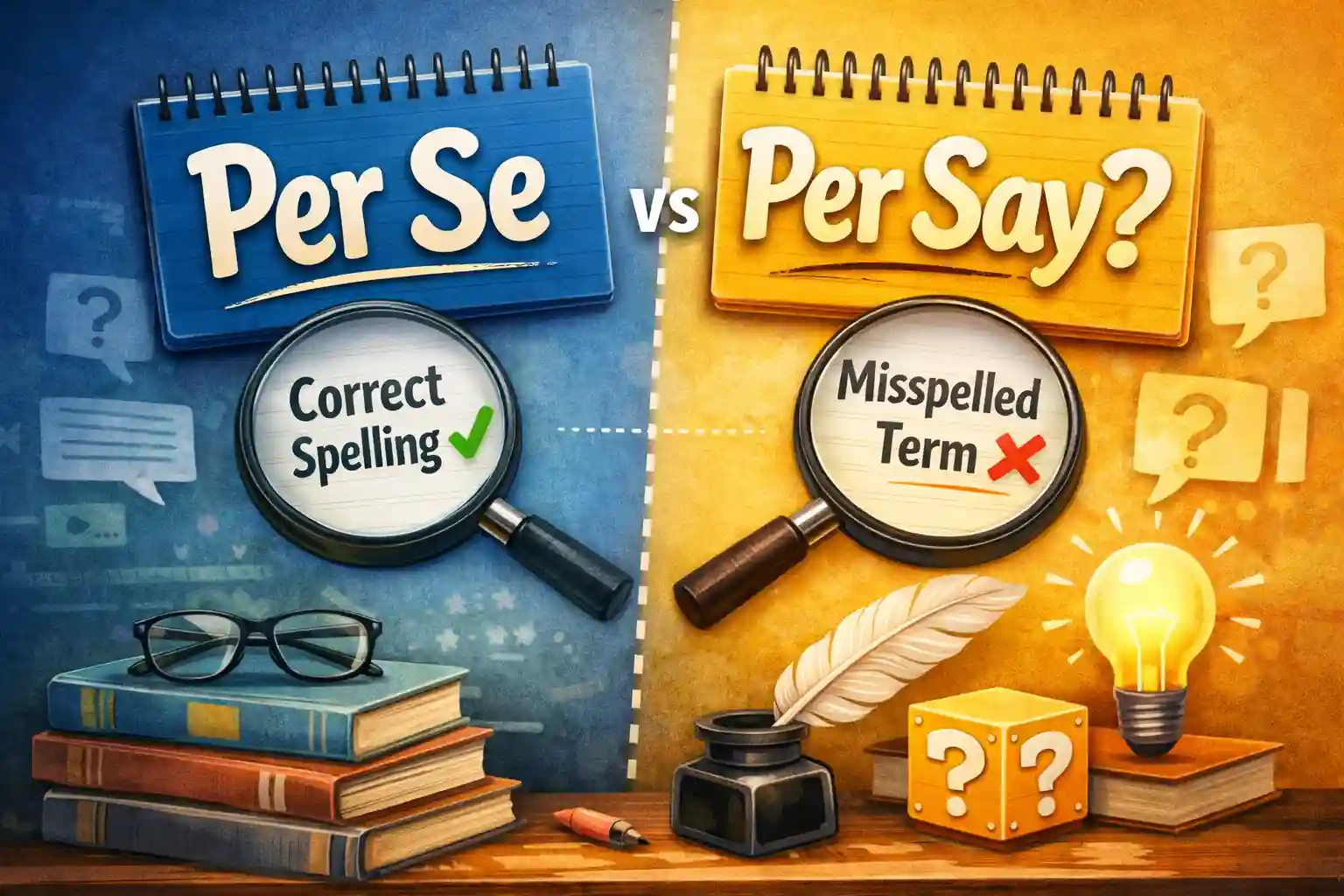
Many English learners and even native speakers often confuse “per se” and “per say”. This confusion arises because the phrases sound similar when spoken, but only one is correct.
Understanding the correct spelling and meaning is essential for professional writing, academic work, and casual communication.
In this guide, we’ll break down the difference clearly, provide examples, explain the grammar rules, and give you tips to remember which one to use.
Quick Answer
Correct Phrase: per se
Incorrect Phrase: per say
Definition: “Per se” is a Latin phrase meaning “by itself” or “intrinsically”. It is used to emphasize the essence of something rather than its context or surroundings.
Example:
- The plan isn’t bad per se, but it needs more details.
Remember: “Per say” is incorrect and should never appear in formal writing.
Comparison Table
| Word | Correct or Incorrect | Meaning |
| Per Se | ✅ Correct | Common misspelling of “per se.” |
| Per Say | ❌ Incorrect | Common misspelling of “per se” |
Meaning of Each Word
- Per Se: A Latin phrase used to indicate something in its own right. It’s formal and often appears in academic, legal, or professional contexts.
- Example: This law isn’t unfair per se, but its application is questionable.
- Per Say: This is a misspelling of “per se” and has no meaning in English. Using it can make your writing look unprofessional.
Grammar Rule Behind the Correct Word
- Origin: “Per se” comes from Latin:
- per = by
- se = itself
- Usage: It functions as an adverb or prepositional phrase in English.
Grammar Rule:
- Place per se after the noun or adjective you want to emphasize.
- It should never replace the word “say” or be used as a verb.
Correct:
- The issue isn’t difficult per se, but it is time-consuming.
Incorrect: - The issue isn’t difficult per say. ❌
Example Sentences
The movie wasn’t boring per se, but it lacked a strong plot.
He isn’t lazy per se; he just needs motivation.
This approach isn’t wrong per se, yet it could be improved.
The food isn’t unhealthy per se, but eating too much is risky.
The book isn’t confusing per se; it’s just very detailed.
This software isn’t expensive per se, but licensing fees add up.
The comment isn’t rude per se, but it could be interpreted badly.
The proposal isn’t illegal per se; enforcement is another matter.
Her style isn’t outdated per se; it’s just not modern.
The idea isn’t impossible per se, though it’s challenging.
Common Mistakes People Make
- Writing “per say” instead of “per se”.
- Using per se incorrectly as a verb: “I per se the solution” ❌
- Confusing “per se” with “by the way” or casual expressions.
Easy Trick to Remember the Difference
- Think Latin origin: per se → “by itself.”
- Say = verbal → If you see “say,” it’s wrong.
- Quick memory hack: “Se” = self → Only the original Latin phrase is correct.
When to Use Each Word
- Use “per se” when highlighting the intrinsic quality of something:
- The software isn’t bad per se, but it lacks key features.
- Never use “per say.”
- Optional tip: In casual speech, people might say “per say” incorrectly, but always correct it in writing.
FAQs
- Can I use “per se” in casual writing?
- Yes, but it’s more formal and often appears in professional or academic contexts.
- Why do people confuse it with “per say”?
- Because they sound similar when spoken, and “say” is common in English.
- Is “per se” always Latin?
- Yes, it is a Latin phrase adopted into English usage.
- Can “per se” be placed at the beginning of a sentence?
- Yes, for emphasis: Per se, the method is effective.
- Is “per se” interchangeable with “in itself”?
- Yes, it often means the same as “in itself” or “intrinsically.”
Related Grammar Mistakes
Final Summary
Per se is the correct Latin phrase meaning “by itself” or “intrinsically.” It is widely used in English to highlight the essence of something without context. Per say is incorrect and should be avoided.
Remember:
- ✅ Correct: per se
- ❌ Incorrect: per say
By understanding its meaning, using proper examples, and practicing the memory trick (“Se = self”), you can confidently write per se correctly in any context. Quick Tip: Whenever you’re tempted to write “per say,” pause and replace it with “per se.” Your writing will instantly look more professional.