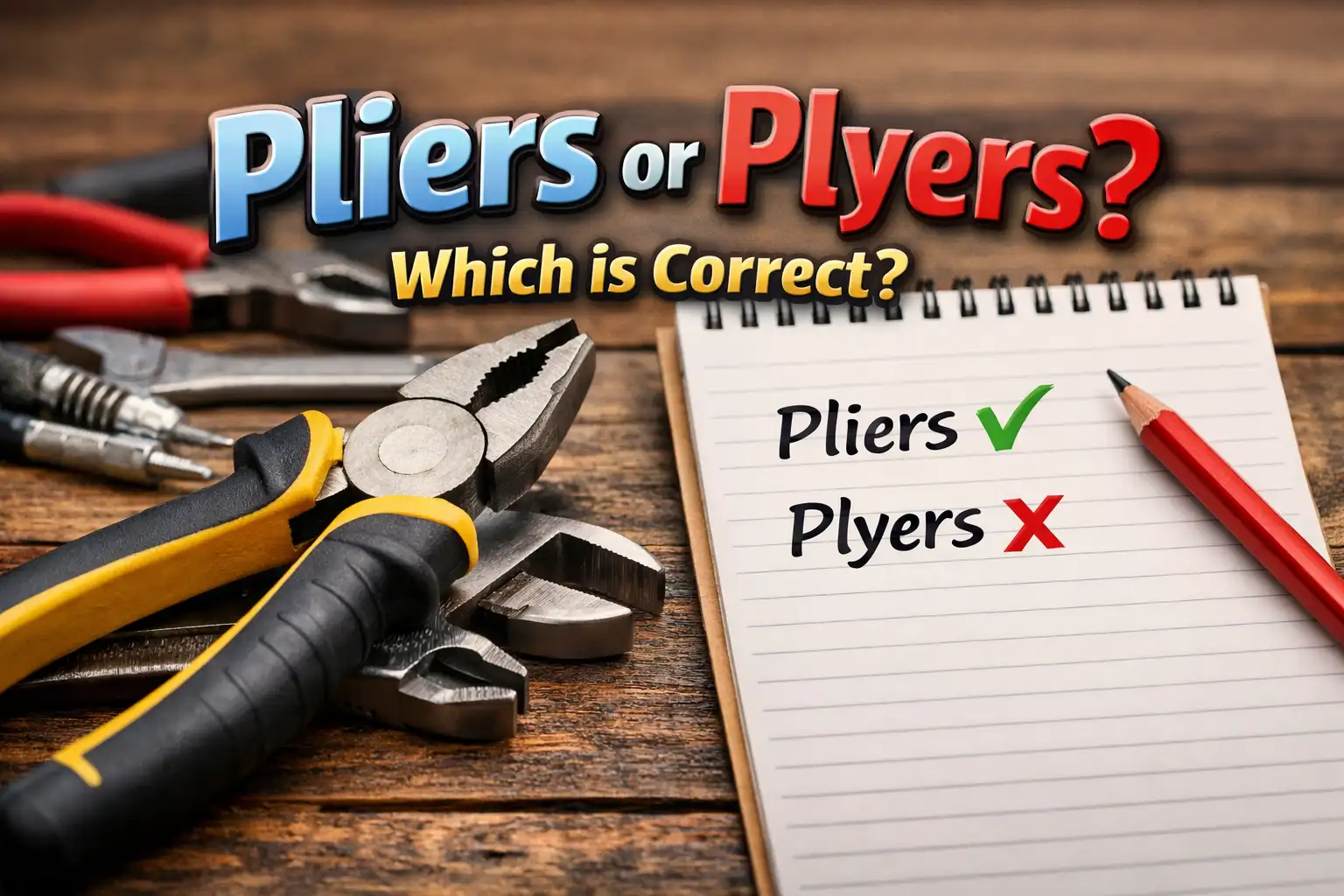
Many English learners and writers often wonder whether the correct word is “pliers” or “plyers.” This confusion is common because both spellings sound similar when spoken, and typing mistakes are frequent.
Understanding the correct spelling and usage is essential to maintain clarity and professionalism in writing, especially in technical, DIY, or educational contexts.
In this article, we will break down the difference, explain grammar rules, give practical examples, and provide easy tips to remember the correct form.
Quick Answer
Correct Spelling: Pliers
Incorrect Spelling: Plyers
Quick Explanation: “Pliers” is the correct word used to refer to a hand tool with two metal jaws for gripping, bending, or cutting. “Plyers” is a common misspelling and should be avoided in both writing and professional contexts.
Comparison Table
| Word | Correct or Incorrect | Meaning |
| Pliers | ✅ Correct | A hand tool used for gripping, bending, or cutting objects. |
| Plyers | ❌ Incorrect | Misspelling of “pliers.” Not recognized in standard English. |
Meaning of Each Word
- Pliers:
Pliers are a type of hand tool that usually has two metal arms connected with a pivot. They are widely used in electrical work, jewelry making, and household repairs for gripping, bending, or cutting wires. - Plyers:
Plyers is simply a misspelling of pliers. It has no meaning in English and should be avoided.
Grammar Rule Behind the Correct Word
The confusion arises due to phonetics. English words ending in -ers often represent tools (e.g., scissors, tweezers, pliers). The correct spelling “pliers” follows this pattern.
Quick Grammar Tip: Tools ending in ers are almost always plural nouns, even if they refer to a single object:
- A pair of pliers (singular in usage, plural in form)
- Scissors (same rule applies)
Example Sentences
Here are 10+ correct examples using pliers:
I used pliers to twist the wires together.
The electrician grabbed a pair of pliers from his toolbox.
Be careful while using pliers to avoid pinching your fingers.
These pliers are perfect for bending small metal rods.
A good set of pliers is essential for every DIY project.
He reached for the pliers to remove the stubborn nail.
She held the bolt firmly with the pliers.
My toolbox is incomplete without a pair of pliers.
You should never use pliers as a hammer.
The jeweler used precision pliers to shape the ring.
❌ Avoid: “I used plyers to twist the wires.” → incorrect.
Common Mistakes People Make
- Writing “plyers” instead of “pliers.”
- Treating “pliers” as singular without “a pair of” → correct: “a pair of pliers,” not “a plier.”
- Confusing it with other tools like tweezers or scissors.
Easy Trick to Remember the Difference
Mnemonic: “Tools ending with ers grip or cut.”
- Scissors, Tweezers, Pliers → all correct, all end in -ers.
- If you type “plyers,” think: ❌ “Not in my toolbox, spell it right!”
When to Use Each Word
- Pliers: Use this when referring to the hand tool in any context—DIY, engineering, electrical work, or household repairs.
- Players: Never use. Always correct it to pliers in writing and documentation.
FAQs
Q: Can I write “plier” in the singular?
Technically, yes, but standard usage prefers “a pair of pliers.”
Q: Are there different types of pliers?
Yes, common types include needle-nose, lineman’s, and cutting pliers.
Q: Is “plyers” ever correct?
No, “plyers” is always a misspelling.
Q: Why does English use plural forms for some tools?
Historical usage and functionality tools with two jaws often take plural forms like scissors and tweezers.
Q: How do I pronounce pliers?
/plaɪərz/ → sounds like “pli-ers.”
Related Grammar Mistakes
Final Summary
- ✅ Correct Word: Pliers
- ❌ Incorrect Word: Plyers
- Meaning: A hand tool for gripping, cutting, or bending.
- Grammar Rule: Always use a pair of pliers for singular reference; ends in ers like other tools.
- Tip: Remember -ers = tool that grips or cuts.
By remembering these simple rules, you can confidently write pliers correctly every time and avoid common spelling mistakes.
Pro Tip: Whenever writing DIY guides, manuals, or technical content, double-check your spelling-your readers, and Google will appreciate the professionalism!