
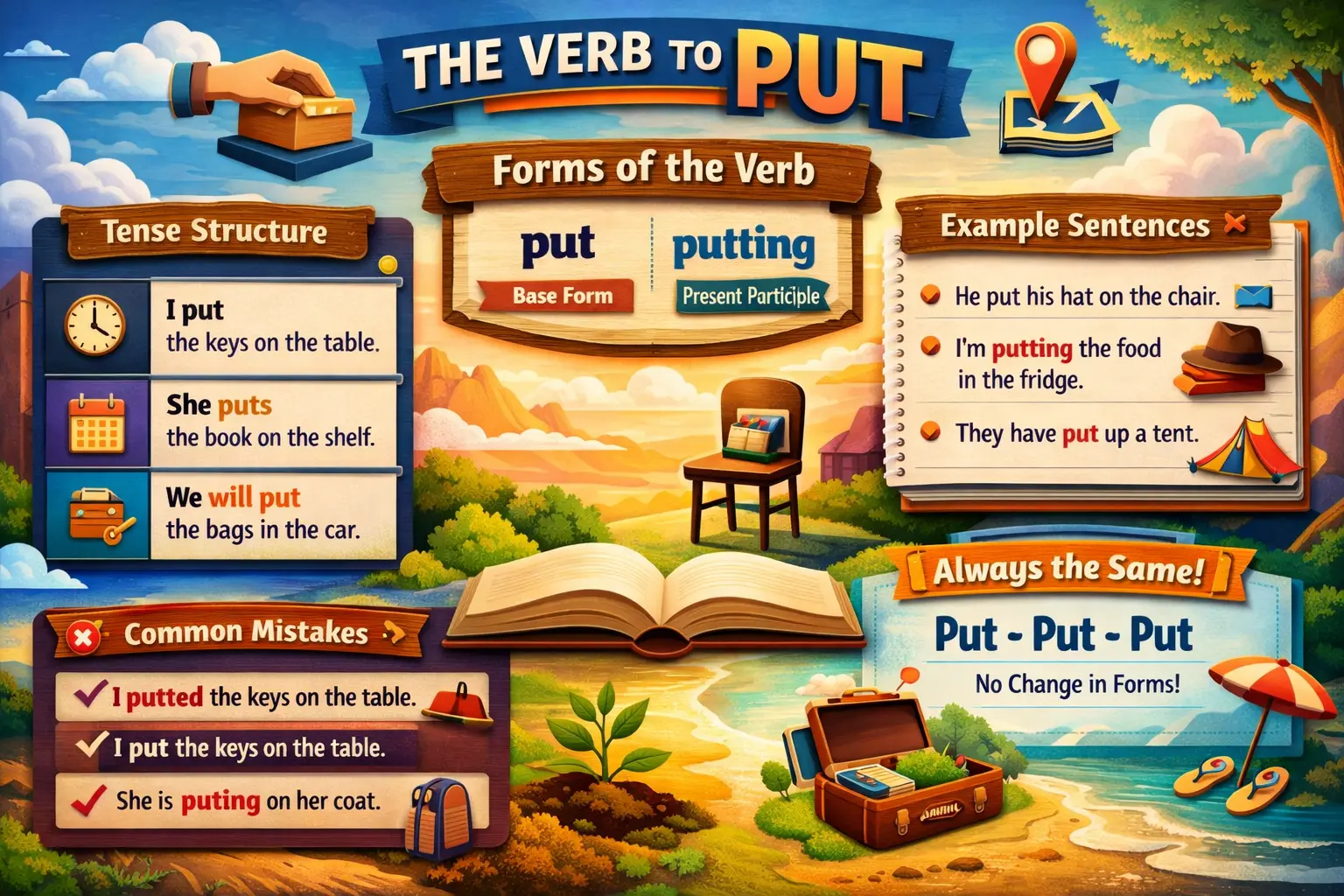
Understanding put and putting is one of the most important steps in mastering everyday English. These words may look simple, but they appear in countless real-life conversations, writing, and grammar structures.
Many learners feel confused because put stays the same in many tenses, while putting changes depending on the sentence.
In this complete English grammar guide, you’ll learn the meaning, rules, examples, mistakes, and practice exercises to use put and putting correctly and confidently.
What Does Put and Putting Mean?
The verb put means to place something somewhere. It is one of the most common action verbs in English.
Putting is the -ing form of put, used when the action is happening now or is continuous.
Warm Explanation:
In daily life, we constantly “put” things somewhere – putting a phone on the table, putting books in a bag, or putting keys in a drawer.
Simple Meaning Examples
- I put my bag on the chair.
- She is putting the dishes in the sink.
- They put the baby to sleep early.
Grammar Rules of Put and Putting
The grammar rules of put and putting are special because put is an irregular verb.
Warm Explanation:
Unlike many verbs, put does not change in the past tense. Only the form putting changes when used in continuous tenses.
Rule Table (Put Forms)
| Verb Form | Word Used |
| Base Form | put |
| Past Simple | put |
| Past Participle | put |
| Present Participle (-ing) | putting |
Key Grammar Rules
- Use put for the present simple:
- I put my shoes here.
- I put my shoes here.
- Use put for past simple:
- Yesterday, I put my shoes here.
- Yesterday, I put my shoes here.
- Use putting for continuous actions:
- I am putting my shoes away.
- I am putting my shoes away.
Put and Putting With Simple Examples
Examples make learning faster and clearer.
Warm Explanation:
The best way to master putting is to see it in everyday situations.
Real-Life Example Sentences
Please put the milk in the fridge.
She put her jacket on the sofa.
I always put my phone on silent.
They put the chairs outside for the party.
He put the keys in his pocket.
I am putting my books into my backpack.
She is putting on her makeup.
We are putting the groceries away.
The kids were putting toys everywhere.
Are you putting sugar in your tea?
Don’t put your feet on the table.
I put the letter in the mailbox.
He is putting a lot of effort into his work.
She put the baby in bed gently.
They are putting up decorations for Eid.
When to Use Put in Different Tenses
Warm Explanation:
Because put stays the same in present, past, and perfect tenses, learners must focus on sentence structure instead of verb spelling.
Tense Rule Table
| Tense | Correct Form | Example Sentence |
| Present Simple | put | I put my bag here. |
| Past Simple | put | I put my bag here yesterday. |
| Present Perfect | have/has put | She has put the files away. |
| Future | will put | I will put it on the shelf. |
More Examples
- He has put a lot of money into savings.
- We will put the meeting on Monday.
When to Use Putting (-ing Form)
Warm Explanation:
Putting is used when an action is in progress, repeated over time, or used as a gerund (noun form).
Continuous Tense Examples
| Structure | Example |
| Present Continuous | I am putting the food on the table. |
| Past Continuous | She was putting the baby to sleep. |
| Future Continuous | They will be putting up new signs. |
Putting as a Noun (Gerund)
- Putting too much salt ruins the dish.
- Putting effort into learning pays off.
Common Mistakes Students Make
Warm Explanation:
Many English learners make small but common mistakes with put and putting rules, especially with tense confusion.
Correct vs Incorrect Table
| Mistake Type | Wrong Sentence | Correct Sentence |
| Wrong past form | I putted it there. | I put it there. |
| Wrong tense use | I am put it here. | I am putting it here. |
| Missing object | I put on the table. | I put it on the table. |
Common Errors to Avoid
- ❌ Saying putted (never correct)
- ❌ Forgetting an object after put
- ❌ Mixing continuous structure incorrectly
Difference Between Put and Similar Verbs
Warm Explanation:
Sometimes learners confuse put with verbs like place, set, or keep. Let’s clarify the differences.
Comparison Table
| Verb | Meaning | Example |
| Put | General placing action | Put the cup on the desk. |
| Place | More formal word for put | Place the book carefully. |
| Set | Put something in a fixed position | Set the glass down gently. |
| Keep | Leave something in a place | Keep your passport safe. |
Key Tip
Use put for everyday English because it is the most natural and common.
Table Summary of Put and Putting Rules
Warm Explanation:
A quick summary helps you remember everything easily.
Quick Summary Table
| Form | Use Case | Example |
| put | Present or past action | I put my bag down. |
| put | Past tense (same form) | Yesterday, I put it here. |
| putting | Ongoing action | She is putting the baby to bed. |
| have put | Completed action | I have put the files away. |
Practice Exercises (Mandatory)
Warm Explanation:
Now it’s your turn! Practice is the fastest way to master put and putting examples.
A) Fill in the Blanks
Please ______ your shoes near the door.
She is ______ the dishes in the sink.
Yesterday, I ______ the book on the shelf.
They are ______ up a new tent.
He has ______ the keys in his bag.
B) Correct the Sentence
I putted my phone on the table.
She putting the baby to sleep now.
He put on the desk.
They was putting the chairs outside.
I am put my jacket in the closet.
Answer Key
Fill in the blanks answers:
put
putting
put
putting
put
Correct the sentence answers:
I put my phone on the table.
She is putting the baby to sleep now.
He put it on the desk.
They were putting the chairs outside.
I am putting my jacket in the closet.
FAQs
Q: What is the difference between put and putting?
Answer: Put is the base/past form, while putting is used for continuous actions happening now or over time.
Q: Is “putted” ever correct?
Answer: No. The past tense of put is always put, never putted.
Q: Can put be used in the past tense?
Answer: Yes. The past form is still put (example: I put it there yesterday).
Q: When do we use putting in grammar?
Answer: Use putting in continuous tenses or when the verb acts as a noun (gerund).
Q: Is put a regular or irregular verb?
Answer: Put is an irregular verb because it does not change in the past tense.
Final Tips for Learners
Warm Explanation:
Learning put and putting rules becomes easy when you focus on tense structure rather than memorizing forms.
Best Tips
- Remember: put = put = put (present, past, participle)
- Use putting when the action is ongoing
- Always include an object:
- Put something somewhere
- Put something somewhere
- Practice daily with real-life sentences
Conclusion
Mastering put and putting is essential for clear and natural English communication. Because put stays the same in many tenses and putting is used for continuous actions, learners often confuse them, but now you have a complete grammar guide with rules, tables, examples, FAQs, and exercises. Keep practicing these structures, and soon you’ll use put and putting examples confidently in both speaking and writing