
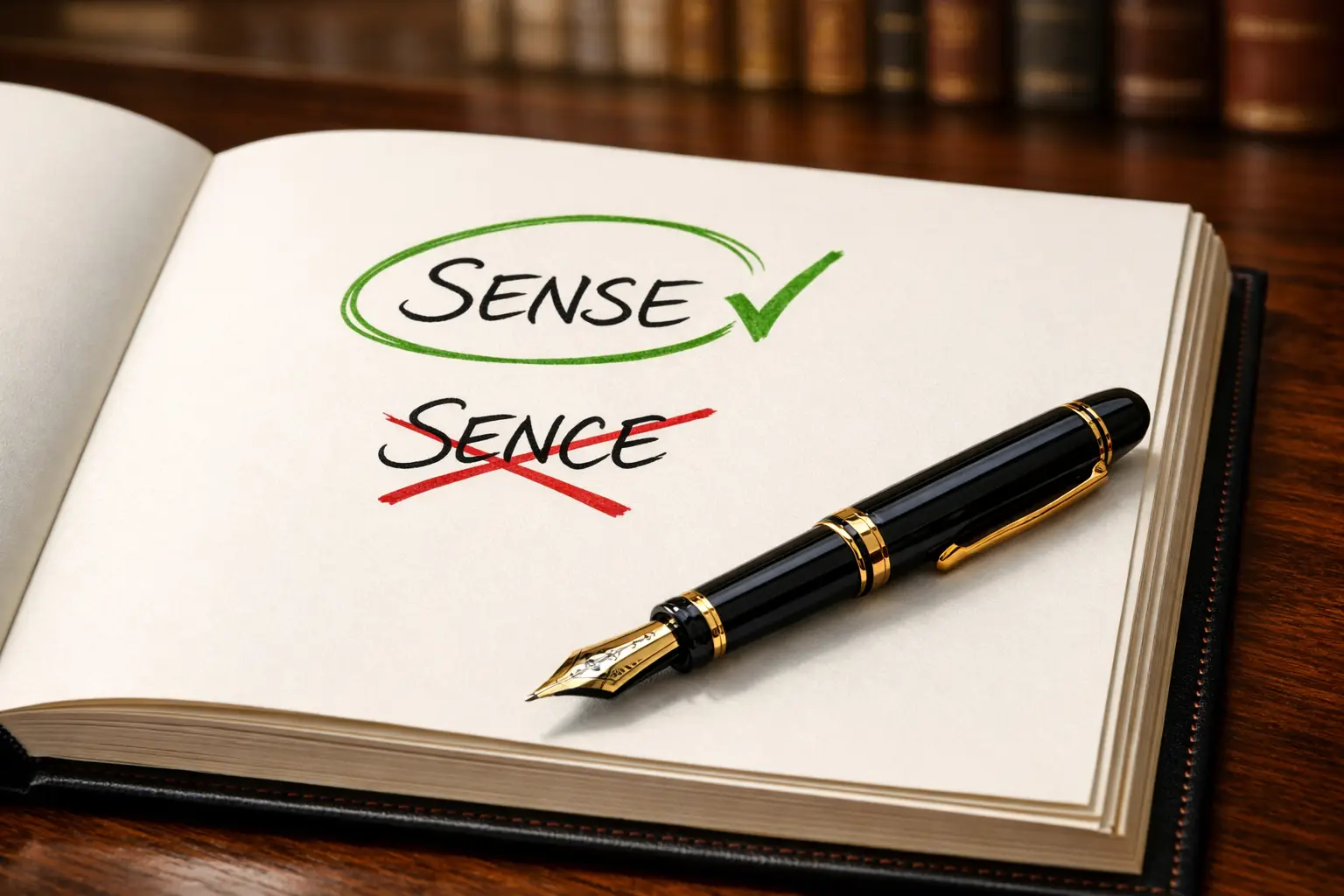
English spelling can sometimes be confusing, especially when words sound similar but are written differently. One common question many learners ask is whether “sence” or “sense” is the correct spelling.
The truth is simple: “sense” is the correct English word, while “sence” is a common spelling mistake. Despite sounding similar, only one of these forms exists in standard English.
Understanding the difference between sence or sense is important for writing clearly and professionally. In this complete English grammar guide, you will learn the meaning, grammar rules, examples, common mistakes, and practical exercises to master this topic easily.
What Does Sense Mean?
The word sense is a common noun and verb in English. It refers to the ability to perceive, understand, or feel something.
There are several meanings of sense, depending on the context in which it is used.
Main Meanings of Sense
• A physical ability to perceive things
• Understanding or logic
• A feeling or awareness
• A particular meaning or interpretation
Examples of “Sense” in Sentences
Humans have five basic senses.
This explanation makes perfect sense.
I had a strange sense that something was wrong.
She used her sense of smell to identify the perfume.
He has a strong sense of responsibility.
That decision shows good sense.
Types of Human Senses
| Sense | Function |
| Sight | Seeing objects |
| Hearing | Detecting sounds |
| Smell | Detecting odors |
| Taste | Identifying flavors |
| Touch | Feeling textures and temperature |
These examples show how commonly the word sense appears in everyday English.
Is “Sence” a Correct English Word?
Many learners type “sence” because it sounds similar to sense. However, sence is not a real English word.
It is simply a spelling mistake.
Why People Write “Sence”
Several reasons cause this error:
• Pronunciation confusion
• Typing mistakes
• Lack of spelling awareness
• Influence of phonetic spelling
Correct vs Incorrect Spellings
| Word | Correct or Incorrect | Explanation |
| Sense | ✅ Correct | Proper English spelling |
| Sence | ❌ Incorrect | Common spelling mistake |
Whenever you are writing, remember that only “sense” is correct.
Grammar Rules of Sence or Sense
Understanding the grammar rules of sence or sense helps learners avoid mistakes.
The key rule is simple:
Rule: Always use “sense.” Never use “sence.”
The word sense can function as both a noun and a verb.
Sense as a Noun
When used as a noun, sense refers to perception, understanding, or feeling.
Examples:
• She has a great sense of humor.
• There was a sense of excitement in the room.
• His explanation made sense.
Sense as a Verb
As a verb, sense means to detect or feel something.
Examples:
• I sense danger in this situation.
• Dogs can sense fear.
• She could sense his disappointment.
Grammar Usage Table
| Usage | Example Sentence |
| Sense as a noun | This plan makes sense. |
| Sense as feeling | I felt a sense of calm. |
| Sense as a verb | I sense trouble coming. |
These grammar rules clarify the correct usage of sense in English.
Sence or Sense With Simple Examples
The best way to learn grammar is through examples. Below are clear comparisons showing the correct usage.
Correct vs Incorrect Sentence Table
| Correct Sentence | Incorrect Sentence |
| This idea makes sense. | This idea makes sence. |
| I sense something strange. | I sence something strange. |
| She has good sense. | She has good sence. |
| That explanation makes sense to me. | That explanation makes sence to me. |
| He sensed danger immediately. | He senced danger immediately. |
More Example Sentences
It makes sense to save money early.
I could sense tension in the meeting.
Her advice showed great sense.
He lost his sense of direction.
The teacher explained the topic so it made sense.
By practicing these examples, you can avoid the sence or sense confusion easily.
Common Mistakes Students Make
Many English learners struggle with spelling mistakes. The sence vs sense error is extremely common.
Here are the most frequent mistakes.
Mistakes to Avoid
• Writing sence instead of sense
• Confusing sense with similar-sounding words
• Using incorrect past tense forms
• Assuming pronunciation equals spelling
Incorrect Past Forms
Another mistake occurs with past tense spelling.
| Correct Form | Incorrect Form |
| sensed | senced |
| sensing | sencing |
Examples:
• I sensed danger immediately.
• She is sensing a problem in the plan.
Avoid writing incorrect forms such as senced or sencing.
Difference Between Sense and Similar Words
Sometimes learners confuse sense with other similar-sounding words.
Understanding the differences helps avoid grammar mistakes.
Sense vs Since
| Word | Meaning | Example |
| Sense | Understanding or perception | This makes sense. |
| Since | From a past time until now | I have lived here since 2020. |
Example sentences:
• That explanation makes sense.
• I have known her since childhood.
Sense vs Cents
| Word | Meaning |
| Sense | Understanding |
| Cents | Units of money |
Example:
• This plan makes sense.
• The candy costs 50 cents.
Quick Summary Table of Sence or Sense Rules
Here is a quick summary to help learners remember the key grammar rules.
| Rule | Explanation |
| Correct spelling | Sense |
| Incorrect spelling | Sence |
| Part of speech | Noun and verb |
| Meaning | Perception, understanding, feeling |
| Common mistake | Writing sence |
Quick Tip
If you ever wonder “sence or sense?”, remember:
Only “sense” is correct.
Practice Exercises
Practicing grammar helps reinforce learning. Try these exercises to test your understanding.
Fill in the Blanks
Choose sense or sence.
This explanation makes ______.
I could ______ something unusual.
She has a strong ______ of duty.
That plan does not make ______.
Dogs can ______ fear easily.
Correct the Sentence
Each sentence contains a mistake. Correct it.
That idea makes sence.
I can sence danger nearby.
She has good sence of humor.
This decision makes no sence.
He senced a problem in the system.
Answers
Fill in the blanks:
sense
sense
sense
sense
sense
Correct the sentence:
That idea makes sense.
I can sense danger nearby.
She has a good sense of humor.
This decision makes no sense.
He sensed a problem in the system.
FAQs
Q: Is “sence” ever correct in English?
Answer: No. Sence is always incorrect. The correct spelling is sense.
Q: Why do people write “sence” instead of “sense”?
Answer: This happens mainly because of pronunciation confusion and typing mistakes.
Q: What does “sense” mean?
Answer: Sense refers to perception, understanding, awareness, or logical meaning.
Q: Can sense be used as both a noun and a verb?
Answer: Yes. It can mean understanding (noun) or detecting something (verb).
Q: What is the past tense of sense?
Answer: The correct past tense is sensed.
Example: I sensed danger immediately.
Final Tips for Learners
Mastering English spelling requires attention to detail. Small mistakes like sence vs sense can affect the clarity of your writing.
Here are some useful tips:
• Always double-check spelling when writing
• Read sentences aloud to test if they make sense
• Practice grammar exercises regularly
• Learn common spelling errors in English
Using the correct spelling will make your writing appear more professional and accurate.
Conclusion
The confusion between sence or sense is very common among English learners, but the rule is simple: “sense” is the correct spelling, while “sence” is incorrect.
The word sense refers to perception, understanding, awareness, or logic, and it can function as both a noun and a verb. By learning the grammar rules, studying examples, and practicing exercises, you can easily avoid this mistake.
Always remember this key rule:
Correct spelling → Sense
Incorrect spelling → Sence
Improving small grammar details like this can greatly strengthen your English writing skills.