
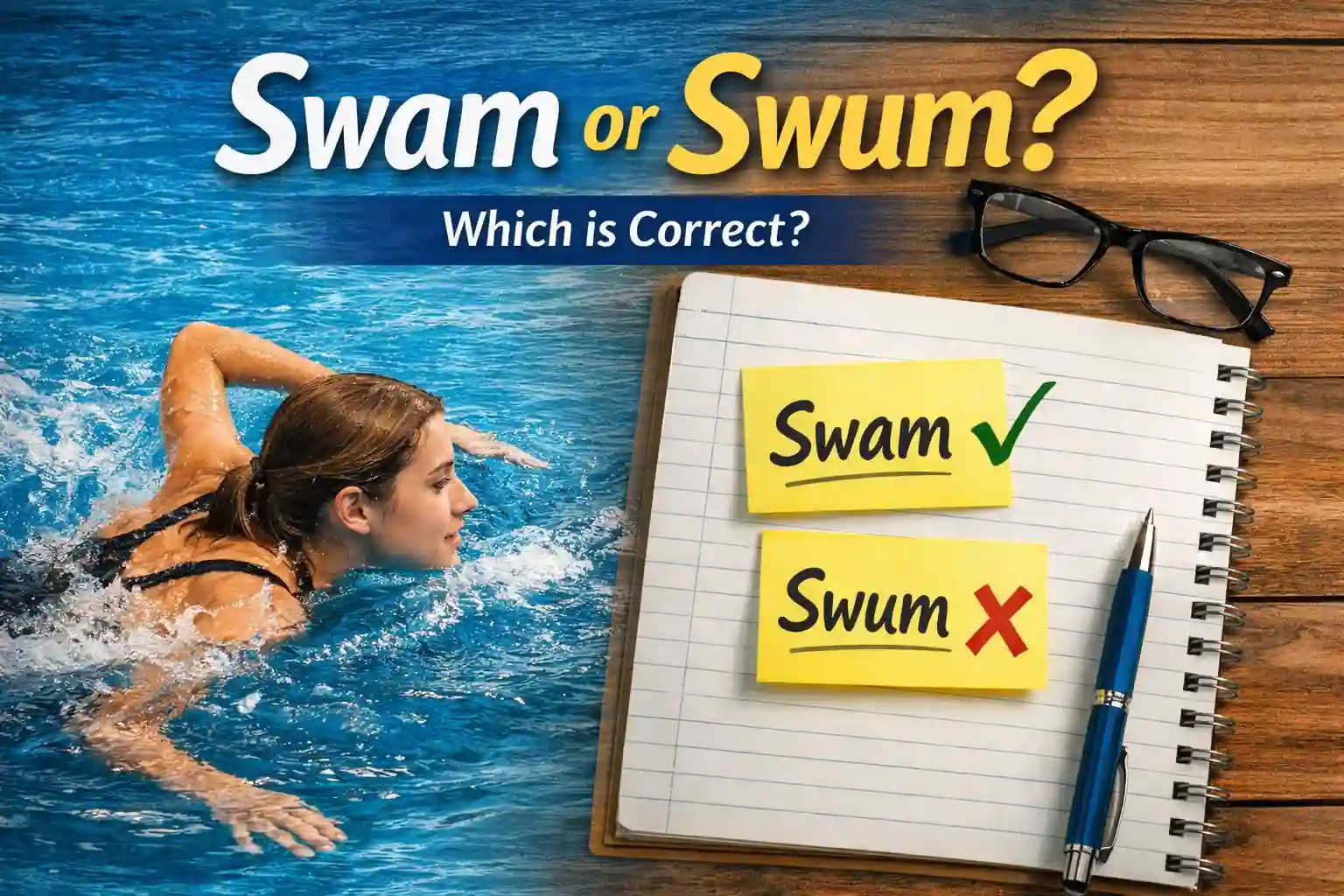
Many English learners often get confused between swam and swum. Both are related to the verb swim, but they are used differently depending on tense and sentence structure.
This confusion arises because irregular verbs in English don’t follow simple rules. Using the wrong form can make your sentence sound unprofessional or grammatically incorrect.
Understanding the difference between swam and swum is essential for writing and speaking English correctly.
Quick Answer
- Swam – correct past tense form of swim. Example: I swam in the pool yesterday.
- Swum – correct past participle form of swim, used with auxiliary verbs like have, has, or had. Example: I have swum across the lake.
Comparison Table
| Word | Correct or Incorrect | Meaning |
| Swam | Correct | Past tense of swim |
| Swum | Correct | Past participle of swim, used with have/has/had |
| Swimed | Incorrect | Nonexistent form; incorrect usage |
| Swimmed | Incorrect | Nonexistent form; incorrect usage |
Meaning of Each Word
Swam
- Definition: The simple past tense of swim. It is used when describing an action that happened in the past.
- Usage Example: She swam across the river last summer.
Swum
- Definition: The past participle of swim, always used with an auxiliary verb (have/has/had).
- Usage Example: They have swum in every ocean around the world.
Grammar Rule Behind the Correct Word
- Swam → past tense.
- Form: Subject + swam + object.
- Example: He swam 500 meters yesterday.
- Swum → past participle.
- Form: Subject + have/has/had + swum.
- Example: I had swum in that lake before moving to the city.
Key Point: Never use swum alone without have, has, or had. Similarly, swam cannot be used after have, has, or had.
Example Sentences
I swam in the sea during my vacation.
She swam faster than anyone else in the class.
We swam across the lake last weekend.
He has swum in this pool many times before.
They have swum across three different rivers.
By the time I arrived, she had swum to the other side.
Did you know he swam 2 miles without stopping?
I have never swum in cold water before.
She had swum in every major ocean before turning 30.
We swam together every summer when we were kids.
Common Mistakes People Make
- Using swum instead of swam for past tense: Yesterday I have swum in the pool ❌
- Using swam after auxiliary verbs: I have swam 3 kilometers ❌
- Inventing forms like swimed or swimmed ❌
Easy Trick to Remember the Difference
- Swam = Simple Past → Think “Yesterday I swam”. No auxiliary verbs.
- Swum = Past Participle → Think “I have swum”. Always follows have/has/had.
Memory Tip: If there’s a helping verb (have, has, had), use swum. If the action is simply in the past without a helper, use swam.
When to Use Each Word
| Situation | Correct Word | Example |
| Past tense action | Swam | I swam for an hour yesterday. |
| Present perfect | Swum | I have swum every morning this week. |
| Past perfect | Swum | She had swum before breakfast. |
| Simple past with no helper | Swam | We swam across the lake last weekend. |
FAQs
. Can I say “I swum in the pool yesterday”?
No. The correct form is I swam in the pool yesterday.
. Is “swum” ever used alone?
No. It always follows auxiliary verbs: have, has, or had.
. What is the past tense of swim?
The past tense is swam.
. How do you use swum in a sentence?
Example: I have swum in the lake before.
. Are “swimmed” and “swimed” correct?
No, these are incorrect. Only swam (past tense) and swum (past participle) are correct.
Related Grammar Mistakes
Final Summary
- Swam is the simple past tense of swim.
- Swum is the past participle and must be used with have, has, or had.
- Avoid incorrect forms like swimmed or swimed.
- Use the simple memory trick: helper verb → swum; no helper → swam.
Mastering swam vs swum will improve your grammar and help you write and speak English confidently. Remember, correct usage shows professionalism and clarity.