
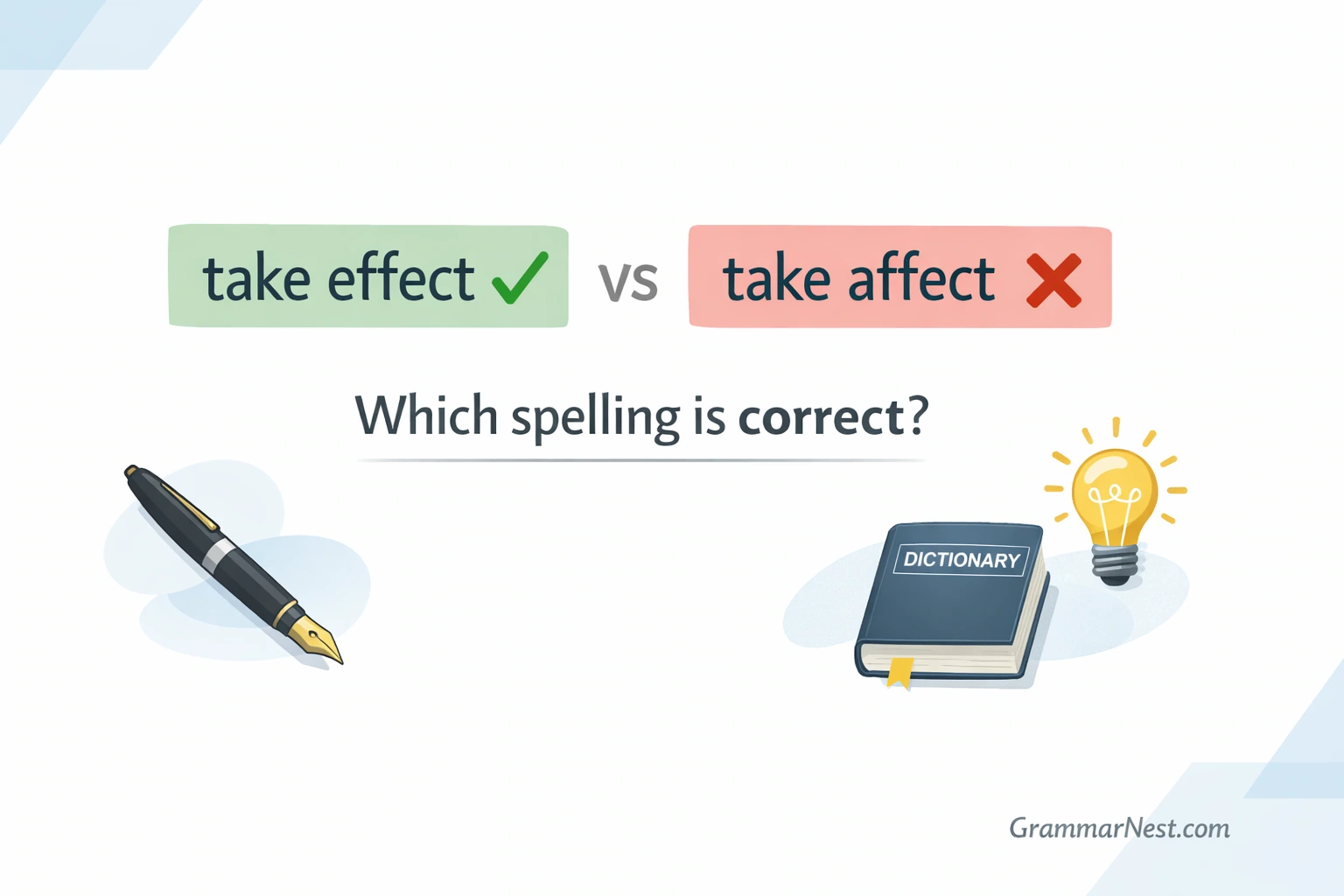
Many English learners and even native speakers get confused between “take affect” and “take effect.” At first glance, the two phrases look very similar. The only difference is one letter: a and e.
However, in standard English grammar, only “take effect” is correct.
The confusion usually happens because of the words affect and effect, which are often mistaken for each other. Both words sound similar and are related in meaning, but they play different roles in grammar.
Understanding the correct phrase will help you write more clearly and professionally, especially in formal writing, legal documents, policies, and academic work.
Let’s break it down step by step so the difference becomes easy to remember.
Quick Answer
✅ The correct phrase is “take effect.”
❌ “Take affect” is incorrect in standard English.
Take effect means to start working or become active.
Example:
The new law will take effect next month.
People often mistakenly write take affect because they confuse affect with effect, but the correct expression always uses effect.
Comparison Table
| Word | Correct or Incorrect | Meaning |
| Take affect | ❌ Incorrect | Not a correct English phrase |
| Take effect | ✅ Correct | To begin working or become active |
Meaning of Each Word
To understand the phrase fully, we must first understand the individual words affect and effect.
Affect (Verb)
Affect is usually used as a verb.
It means to influence or change something.
Examples:
- The weather can affect your mood.
- Lack of sleep can affect your health.
- Stress may affect productivity.
Effect (Noun)
Effect is typically used as a noun.
It means a result or outcome caused by something.
Examples:
- The medicine had a strong effect.
- The new policy had a positive effect on employees.
- Pollution has harmful effects on the environment.
Grammar Rule Behind the Correct Word
The phrase “take effect” uses effect as a noun.
Here is the grammar rule:
Take effect = begin producing results or become operational
The word take combines with the noun effect to create an idiomatic expression.
Examples of similar expressions:
- take action
- take responsibility
- take control
- take effect
Because effect is a noun meaning “result,” the phrase means:
“to start producing results.”
This is why “take affect” is grammatically incorrect.
Quick Grammar Tip
A simple grammar rule to remember:
- Affect = Action (verb)
- Effect = result (noun)
Example Sentences
Here are practical examples showing how take effect is used in real sentences.
The new company policy will take effect on Monday.
The price increase will take effect next year.
The medication will take effect within 30 minutes.
The updated rules will take effect immediately.
The government announced that the tax law will take effect in July.
The agreement will officially take effect after both parties sign it.
The new safety measures will take effect next week.
The software update will take effect after you restart the system.
The changes will take effect at the beginning of the semester.
The new regulations will take effect starting January 1st.
Incorrect example:
❌ The new law will take affect next month.
Correct version:
✅ The new law will take effect next month.
Common Mistakes People Make
Many writers accidentally use take affect because of these reasons:
Confusing Affect and Effect
These two words sound similar but have different grammatical roles.
Spelling Similarity
The words differ by only one letter, which makes them easy to mix up.
Autocorrect Errors
Sometimes typing tools incorrectly replace effect with affect.
Lack of Grammar Awareness
Some writers do not realize that take effect is a fixed phrase.
Easy Trick to Remember the Difference
A simple memory trick can help you avoid this mistake forever.
Affect = Action
Effect = End Result
Now think about the phrase:
Take effect → Start producing results
Another trick:
The word effect starts with E, just like event.
When something takes effect, it starts happening.
This simple trick helps many writers remember the correct phrase.
When to Use Each Word
Use “Take Effect”
Use takes effect when something starts working or becomes active.
Common situations include:
- laws
- policies
- rules
- agreements
- medicines
- updates
- regulations
Examples:
- The new law will take effect in June.
- The contract will take effect once signed.
- The medication will take effect quickly.
Use “Affect”
Use affect when something influences or changes something else.
Examples:
- Stress can affect sleep quality.
- The weather may affect travel plans.
- Technology can affect productivity.
People Also Ask
Is it take affect or take effect?
The correct phrase is take effect.
It means to begin working or become active.
“Take affect” is incorrect in standard English.
What does take effect mean?
Take effect means to start operating or producing results.
Example:
The new rule will take effect tomorrow.
Why do people say take affect?
People mistakenly say take affect because they confuse the words affect and effect, which sound similar.
Is affect ever correct in this phrase?
No. In this expression, only take effect is correct.
When do laws take effect?
Laws take effect when they officially begin to apply, usually on a specified date.
FAQs
Is “take affect” ever correct?
No. Take affect is not considered correct in standard English grammar.
What does “take effect” mean?
It means to begin working, applying, or producing results.
Can affect be a noun?
In rare psychological contexts, affect can be a noun meaning emotional expression, but this is uncommon in everyday writing.
Is affect always a verb?
Most of the time, yes. Affect is typically used as a verb meaning to influence something.
Why do people confuse affect and effect?
Because the words sound similar and are related in meaning, many writers accidentally mix them up.
Related Grammar Mistakes
Writers often confuse other similar word pairs in English.
Some common grammar mistakes include:
- Affect vs Effect
- Then vs Than
- Your vs You’re
- Freshmen vs Freshman
- Cosy vs Cozy
- Complement vs Compliment
Learning these differences improves both writing clarity and professionalism.
Common Writing Errors
Some incorrect sentences include:
❌ The policy will take affect next week.
❌ The new rule takes affect tomorrow.
Correct versions:
✅ The policy will take effect next week.
✅ The new rule takes effect tomorrow.
Final Summary
The confusion between take affect or take effect is very common, but the rule is simple once you understand the grammar.
Here is the key takeaway:
- Take effect → Correct phrase
- Take affect → Incorrect phrase
Take effect means to begin working, applying, or producing results. It is commonly used when discussing laws, policies, agreements, medications, and updates.
To remember the difference:
- Affect = Action (verb)
- Effect = result (noun)
Whenever something starts working, it takes effect.
Mastering this small grammar rule can greatly improve your writing accuracy and help you avoid one of the most common English mistakes.