
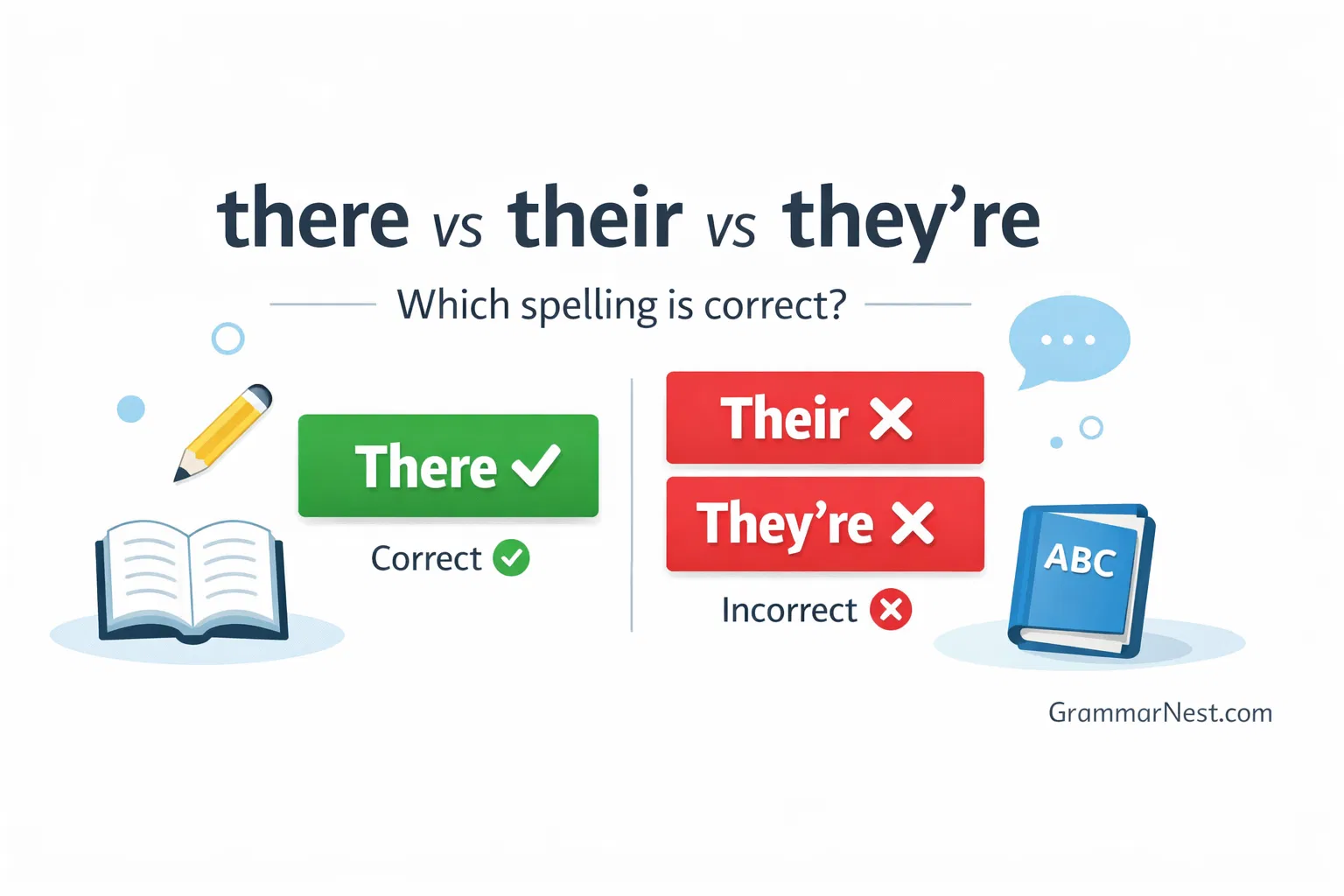
Many English learners and even native speakers often confuse there, their, and they’re. These three words sound the same but have completely different meanings and functions in a sentence.
Misusing them can make your writing look careless or unprofessional.
In this guide, we will break down the differences clearly, provide easy tricks to remember them, and give plenty of examples so you’ll never mix them up again.
Quick Answer
- There → refers to a place or position. Example: “The books are over there.”
- Their → shows possession; belongs to them. Example: “That is their car.”
- They’re → contraction of they are. Example: “They’re going to the park.”
Comparison Table
| Word | Correct or Incorrect | Meaning |
| There | Correct | Refers to a place, position, or existence |
| Their | Correct | Shows possession or ownership |
| They’re | Correct | Contraction of they are |
| There | Incorrect | When used for possession or contraction |
| Their | Incorrect | When used to indicate location or state |
| They’re | Incorrect | When used for possession or location |
Meaning of Each Word
1. There
There is used to indicate a location, position, or the existence of something.
- Example meanings: “in that place,” “at that point,” or “exists.”
2. Their
Their is a possessive adjective, used to show that something belongs to someone.
- Example meanings: “belonging to them,” “their house,” “their opinions.”
3. They’re
They’re is a contraction of they are. Use it when you can replace it with they are, and the sentence still makes sense.
Grammar Rule Behind the Correct Word
- There → adverb/pronoun for place or existence
- Rule: Use for locations or when introducing a subject.
- Example: “There is a cat on the roof.”
- Their → possessive adjective
- Rule: Use before a noun to show ownership.
- Example: “Their dog is very friendly.”
- They’re → contraction of they are
- Rule: Use in a sentence where “they are” fits naturally.
- Example: “They’re planning a surprise party.”
Example Sentences
There is a beautiful garden behind the house.
I left my keys over there.
Their car is parked outside.
The children put on their coats before leaving.
They’re excited about the school trip tomorrow.
I can’t believe they’re already finished with the project!
There are many books on the shelf.
Please sit there until I call you.
Their teacher praised them for their hard work.
They’re always late to meetings, but today they’re on time.
Common Mistakes People Make
- Writing their instead of there: “Their is a problem with the computer.” ❌
- Writing there instead of they’re: “There going to the concert.” ❌
- Writing they’re instead of their: “They’re house is big.” ❌
Mistakes usually happen because all three words sound the same (homophones).
Easy Trick to Remember the Difference
- There → Place or Existence → Think “here and there.”
- Their → Possession → Think “their stuff” or “belongs to them.”
- They’re → They are → Replace it in your sentence with they are. If it works, it’s correct.
When to Use Each Word
- There → Use for locations, positions, or existence.
- Example: “There is a spider on the wall.”
- Their → Use to show ownership.
- Example: “Their house is painted blue.”
- They’re → Use as a contraction of they are.
- Example: “They’re coming to dinner tonight.”
FAQs
Q: Can “they’re” be used for possession?
No, “they’re” is always a contraction of they are. Use “their” for possession.
Q2: Is “there” always a place?
Mostly yes, but it can also indicate existence. Example: There is a chance of rain.
Q: How can I avoid mixing these words in writing?
Read your sentence aloud. Replace “they’re” with they are. If it fits, it’s correct.
Q: Are there any mnemonic tricks?
Yes! “There → place, Their → belongs to them, They’re → they are.”
Q: Can “their” be used at the start of a sentence?
Yes, but it must be followed by a noun. Example: Their house is beautiful.
Related Grammar Mistakes
Final Summary
Mastering there, their, and they’re is essential for clear, professional writing. Remember:
- There → place or existence
- Their → possession
- They’re → they are
By using the tricks, examples, and rules in this guide, you can avoid common mistakes and write with confidence. Practice these words in daily writing, and soon you’ll never confuse them again!