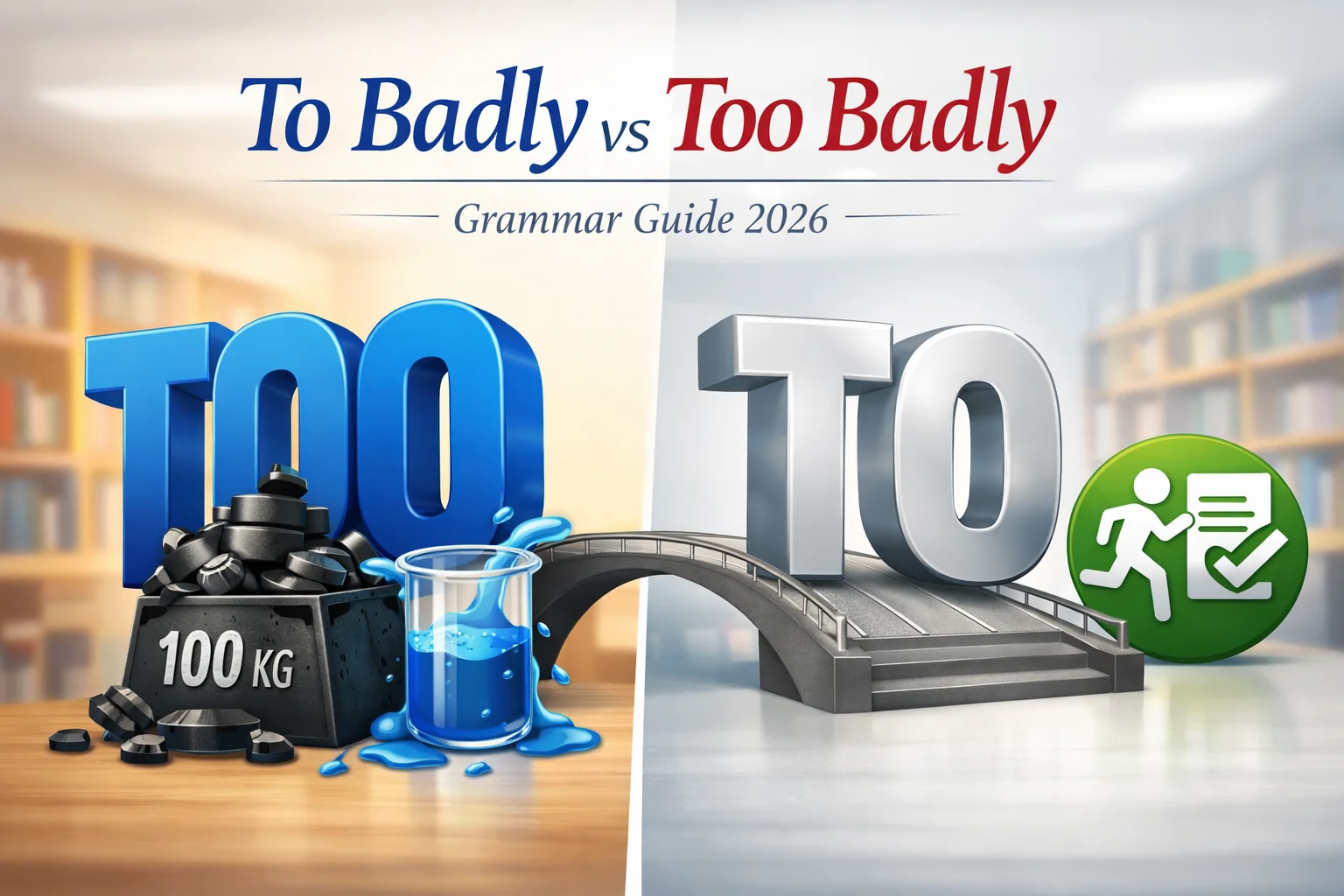
English learners often struggle with small words that change the meaning of a sentence. One such confusing pair is “to badly or too badly.” Although they look very similar, their meanings and grammatical roles are completely different.
Understanding the difference between to badly or too badly is important because a small spelling mistake can make your sentence grammatically incorrect. Many learners accidentally write “to badly” when they actually mean “too badly.”
In this complete English grammar guide, you will learn the correct rules, examples, common mistakes, and practice exercises to fully master to badly or too badly.
What Does To Badly or Too Badly Mean?
When discussing to badly or too badly, the main point to remember is that “too badly” is usually the correct phrase, while “to badly” is almost always incorrect in standard English grammar.
The confusion happens because “to” and “too” sound the same when spoken. However, they have very different grammatical meanings.
Meaning of “Too Badly”
The phrase “too badly” means excessively, very much, or more than desired. It emphasizes the degree of something.
Example meanings:
- Extremely
- More than necessary
- Excessively
Meaning of “To Badly”
The phrase “to badly” is rarely correct because “to” usually needs to be followed by a verb, not an adverb like badly.
Quick Meaning Comparison
| Phrase | Meaning | Correct Usage |
| Too badly | Very much / excessively | Correct |
| To badly | Grammatically incorrect in most cases | Usually wrong |
Simple Examples
- I wanted the job too badly, so I felt nervous.
- She needed help too badly to ignore the problem.
- ❌ He tried to badly explain the situation. (Incorrect)
Grammar Rules of To Badly or Too Badly
To properly understand to badly or too badly rules, we must examine how “to” and “too” function in English grammar.
Rule 1: “Too” Shows Excess or Degree
The word too means more than necessary or extremely.
Examples:
- She wanted success too badly.
- He needed money too badly to refuse the offer.
- They tried too badly to impress everyone.
Rule 2: “To” Is Usually a Preposition or Infinitive Marker
The word to is commonly used:
- Before verbs (to run, to eat)
- As a preposition (go to school)
Because badly is an adverb, it normally cannot follow to directly.
Rule Table
| Grammar Rule | Correct Example | Wrong Example |
| Use too for excess | I wanted it too badly. | I wanted it to badly. |
| Use to before verbs | I want to succeed. | I want to badly succeed. |
| Avoid splitting infinitives incorrectly | I want to explain it badly. | I want to badly explain it. |
To Badly or Too Badly With Simple Examples
Learning grammar becomes easier when you see real-life examples. Below are common sentences showing the correct usage of too badly.
Correct Example Sentences
She wanted the promotion too badly.
He needed help too badly to stay silent.
They wanted victory too badly, which made them nervous.
I wanted the opportunity too badly to miss it.
The team needed a win too badly this season.
She wanted to prove herself too badly.
He tried too badly to impress everyone.
The child wanted the toy too badly and started crying.
I needed sleep too badly after working all night.
They wanted success too badly, which caused pressure.
Incorrect Examples
❌ I wanted to badly succeed.
❌ She tried to badly explain the problem.
❌ He hoped to badly win the competition.
Correct Alternatives
✔ I wanted to succeed badly.
✔ She tried to explain the problem badly.
✔ He hoped to win the competition badly.
Common Mistakes Students Make
Many English learners accidentally confuse to badly or too badly because of pronunciation. Since they sound identical, writing mistakes are very common.
Here are the most frequent grammar mistakes.
Mistake 1: Using “To” Instead of “Too”
Incorrect:
- I wanted it to badly.
Correct:
- I wanted it too badly.
Mistake 2: Splitting Infinitives Incorrectly
Incorrect:
- She tried to explain the issue badly.
Correct:
- She tried to explain the issue badly.
Mistake 3: Using “Too” When Meaning “Very”
Sometimes learners misuse too when they actually mean very.
Incorrect:
- I am too happy today. (Implies excessive happiness)
Correct:
- I am very happy today.
Correct vs Incorrect Table
| Incorrect Sentence | Correct Sentence |
| I wanted it to badly | I wanted it too badly |
| He tried to badly explain | He tried to explain badly |
| She hoped to badly win | She hoped to win badly |
Difference Between Too, To, and Very
To fully understand to badly or too badly, learners must also understand the difference between too, to, and very.
Key Differences
| Word | Meaning | Example |
| To | Direction or infinitive | I want to learn English |
| Too | Excess or also | I wanted it too badly |
| Very | High degree | I was very happy |
Example Sentences
- I want to learn English grammar.
- I wanted success too badly.
- I am very excited about the opportunity.
Understanding these differences helps avoid grammar mistakes in writing and speaking.
Table Summary of To Badly or Too Badly Rules
Below is a quick summary table that simplifies the rules for learners.
| Situation | Correct Phrase | Example |
| Expressing strong desire | Too badly | She wanted the job too badly |
| Showing excessive need | Too badly | He needed help too badly |
| After the infinitive “to” | Not badly | I want to win badly |
| Avoid grammar errors | Do not use “to badly” | ❌ I wanted to badly win |
Quick Tip
If you mean “very much” or “excessively,” use “too badly.”
Practice Exercises for To Badly or Too Badly
Practicing grammar helps you remember rules better. Try these exercises to test your understanding of to badly or too badly.
Fill in the Blanks
Choose to or too.
She wanted the scholarship ___ badly.
He needed help ___ badly to refuse.
I wanted ___ badly impress my teacher.
They wanted victory ___ badly.
She tried ___ badly explain the problem.
Correct the Sentence
Rewrite the sentences correctly.
I wanted it to badly.
She tried to badly explain the answer.
He hoped to badly win the race.
They wanted success to badly.
I needed sleep to badly.
Answers
Fill in the Blanks
too
too
to
too
to
Correct the Sentence
I wanted it too badly.
She tried to explain the answer badly.
He hoped to win the race badly.
They wanted success too badly.
I needed sleep too badly.
FAQs About To Badly or Too Badly
Q: Is “to badly” ever correct?
Answer:
In most cases, “to badly” is grammatically incorrect because the infinitive marker to should usually be followed by a verb, not an adverb like badly.
Q: What does “too badly” mean?
Answer:
“Too badly” means excessively or very much, often describing a strong desire or need.
Example:
She wanted the opportunity too badly.
Q: Why do people confuse “to badly or too badly”?
Answer:
The confusion happens because to and too sound the same in spoken English.Q: Is “too badly” common in everyday English?
Answer:
Yes, it is quite common when expressing a strong desire.
Example:
He wanted the promotion too badly.
Q: How can I remember the difference easily?
Answer:
Remember this simple trick:
- Too = extra/excessive
- To = direction or verb marker
If you mean “very much,” use “too badly.”
Final Tips for Learners
Mastering grammar rules like to badly or too badly becomes easier with practice and awareness. Small spelling differences can change the meaning and correctness of a sentence.
Here are a few helpful tips:
- Always check if you mean excess or strong desire – if yes, use too badly.
- Remember that to usually introduces verbs, not adverbs.
- Read your sentence aloud to check if it sounds natural.
- Practice writing sentences using too badly correctly.
Conclusion
Understanding the difference between to badly or too badly is an important step toward improving your English grammar skills. While too badly is commonly used to express strong desire or excessive need, to badly is usually incorrect in standard English usage.
By learning the grammar rules, studying real examples, and practicing regularly, you can avoid this common mistake and write more confidently. Small grammar improvements like this can greatly enhance your communication, whether you are writing emails, essays, or professional content.