
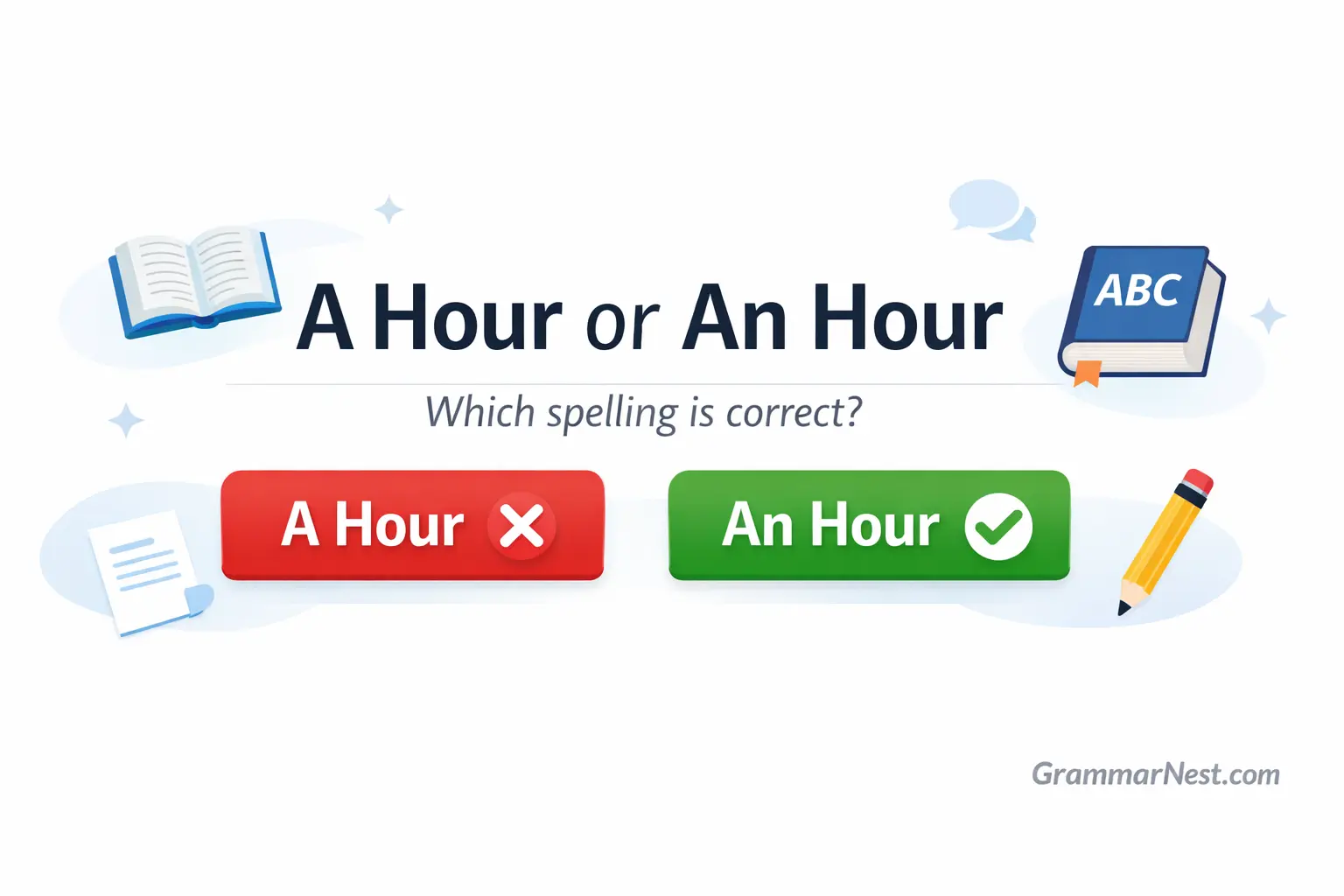
Many English learners and even native speakers often stumble over “a hour” and “an hour.” At first glance, it might seem simple-just choose one article-but there’s a subtle grammar rule that can make the difference between correct and incorrect usage.
Understanding this will improve your writing, speaking, and exam performance.
In this guide, we’ll break down everything you need to know, including grammar rules, examples, common mistakes, and easy tricks to remember.
Quick Answer
✅ Correct: An hour
❌ Incorrect: A hour
Use “an” before words that begin with a vowel sound, not just a vowel letter. Even though “hour” starts with “h,” the “h” is silent, so the word begins with a vowel sound /aʊ/.
Comparison Table
| Word | Correct or Incorrect | Meaning |
| A hour | ❌ Incorrect | Wrong article usage |
| An hour | ✅ Correct | One hour (60 minutes) |
Meaning of Each Word
- A hour – ❌ This is incorrect because English grammar requires an article that matches the sound, not the spelling.
- An hour – ✅ Correct usage, meaning one hour (60 minutes). The “h” is silent, so it sounds like “our.”
Grammar Rule Behind the Correct Word
English has two indefinite articles: a and an.
- Use “a” before words that start with a consonant sound.
- Examples: a book, a cat, a university (sounds like “yoo-ni…” → consonant sound).
- Use “an” before words that start with a vowel sound.
- Examples: an apple, an elephant, an hour (silent “h” → vowel sound /aʊ/).
Key tip: It’s the sound, not the first letter, that determines which article to use.
Example Sentences
I will wait for an hour before leaving.
She studied for an hour every morning.
It takes an hour to get there by car.
We need an hour to complete the assignment.
He spent an hour reading his favorite book.
The meeting lasted an hour longer than expected.
Can you give me an hour to finish this task?
They walked for an hour in the park.
I slept for an hour after lunch.
The doctor said the procedure would take an hour.
Common Mistakes People Make
- Writing a hour because they see the letter “h.”
- Assuming all words starting with “h” use “a.” (Some have silent “h” → use “an”)
- Forgetting that it’s the sound, not spelling, that matters.
Easy Trick to Remember
Think of the sound at the beginning:
- If it sounds like a vowel, use an.
- If it sounds like a consonant, use a.
Example:
- Hour → sounds like “our” → an hour
- House → sounds like “house” → a house
When to Use Each Word
- Use an hour whenever you are talking about time, and the “h” is silent.
- Never write a hour; it’s grammatically incorrect.
People Also Ask
- Should I say a hour or an hour?
- ✅ Correct: an hour because the “h” is silent.
- Why do we say an hour and not a hour?
- The article an is used before vowel sounds, and “hour” begins with a vowel sound /aʊ/.
- Is a hour ever correct?
- ❌ No, it is always incorrect in standard English.
- How do I remember when to use “a” or “an”?
- Listen to the first sound of the next word. Vowel sound → “an,” consonant sound → “a.”
- Are there other words like hour with a silent “h”?
- Yes! Examples: honor → an honor, heir → an heir, honest → an honest person.
FAQs
Q: Can “hour” ever be preceded by “a”?
- No, always use an hour because the “h” is silent.
Q: What about “historic” or “hotel”?
- Depends on pronunciation. “Historic” → sometimes a historic event (h pronounced lightly). “Hotel” → a hotel (h pronounced).
Q: Why do native speakers use “an” before “hour”?
- Because the h is silent, making the word start with a vowel sound.
Q: Does this rule apply to numbers or acronyms?
- Yes. Example: an MBA (sounds like “em-bee-ay”).
Q: How to teach children this rule?
- Focus on sounds rather than letters. Let them repeat and listen: “an hour,” “an apple.”
Related Grammar Mistakes
- A honest an honest
- Former vs Latter
- A honor an honor
- laid out vs layed out
Final Summary
- Correct usage: an hour
- Incorrect usage: a hour
- Remember: the first sound of the word, not the letter, determines the article.
- Silent “h” words → use an.
- This simple rule will improve your writing, grammar, and speaking instantly.
With this knowledge, you’ll confidently write and speak “an hour” correctly every time, avoiding a common grammar mistake that even advanced learners make.