Many English learners and even native speakers often struggle with similar-looking words like “mistakingly” and “mistakenly.”
This confusion arises because the words look almost identical and both relate to errors or wrong actions.
Understanding which one is correct can improve your writing, make you sound professional, and help you avoid common mistakes in essays, emails, and social media posts.
Quick Answer
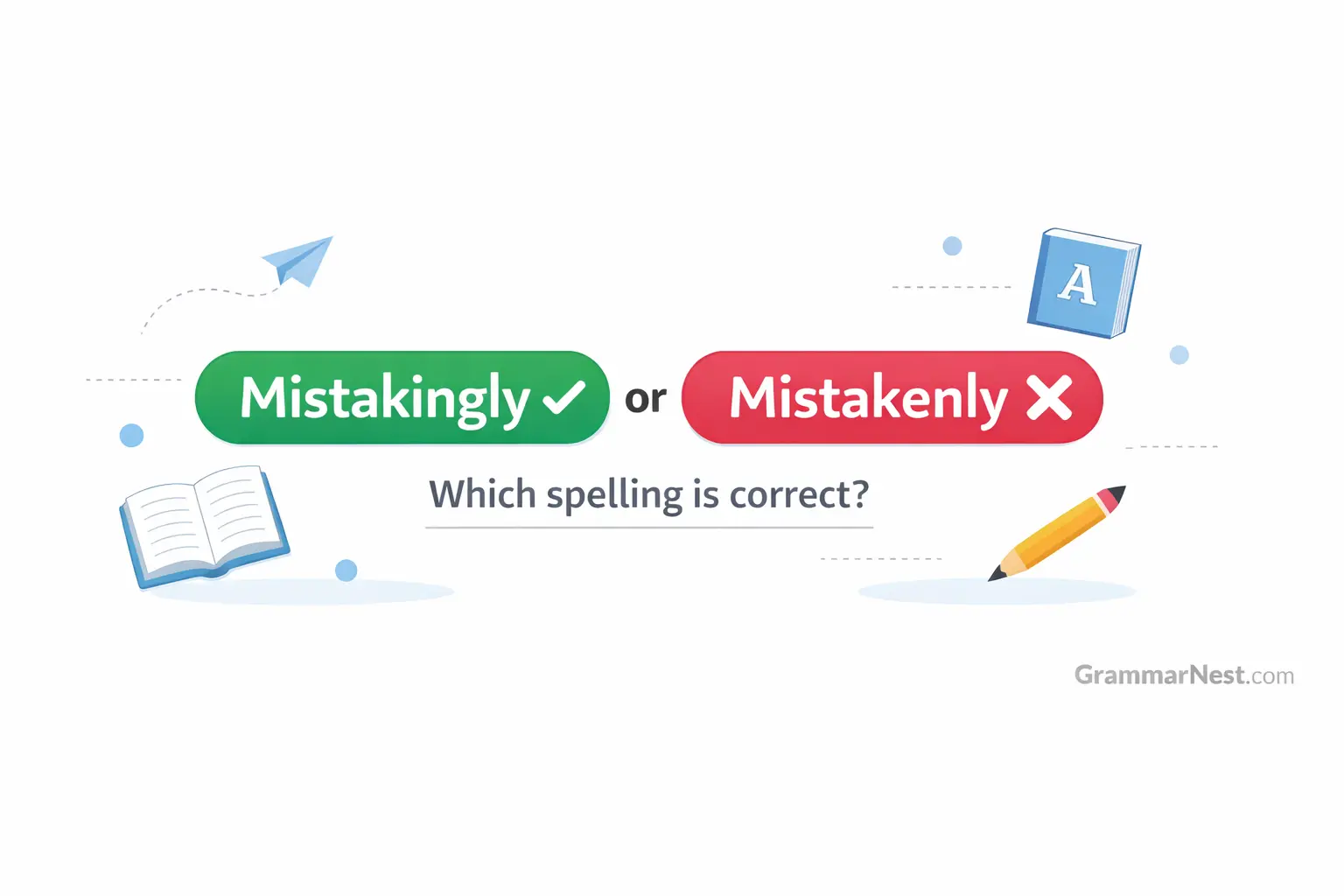
✅ Correct Word: Mistakenly
❌ Incorrect Word: Mistakingly
Explanation: The word “mistakenly” is the proper adverb used to describe an action done in error. “Mistakingly” is a common misspelling and is not recognized in standard English dictionaries.
Comparison Table
| Word | Correct or Incorrect | Meaning |
| Mistakenly | Correct | Done in error; unintentionally |
| Mistakingly | Incorrect | Not a valid English word |
Meaning of Each Word
- Mistakenly: Refers to acting by mistake or error. For example, “She mistakenly sent the email to the wrong person.”
- Mistakingly: This is a frequent typo or misheard version of “mistakenly.” It is not correct in standard English.
Grammar Rule Behind the Correct Word
- Mistakenly is an adverb, derived from the adjective “mistaken.”
- Adverbs modify verbs, adjectives, or other adverbs, often ending in -ly.
- Example structure: Subject + Verb + Mistakenly + Object.
- ✅ Correct: “He mistakenly deleted the file.”
- ❌ Incorrect: “He mistakingly deleted the file.”
Rule: Always use mistakenly to describe an unintentional action. Avoid using mistakingly as it is considered a spelling error.
Example Sentences
I mistakenly thought the meeting was at 10 AM.
She mistakenly called her teacher by the wrong name.
The money was mistakenly transferred to the wrong account.
He mistakenly assumed she agreed with his plan.
The document was mistakenly marked as confidential.
I mistakenly deleted the photo from my phone.
They mistakenly entered the wrong room.
She mistakenly wore two different shoes to the party.
The system mistakenly logged me out.
He mistakenly believed the rumor without checking the facts.
Common Mistakes People Make
- Writing “mistakingly” instead of “mistakenly.”
- Confusing mistakenly with by mistake or accidentally (all are similar but slightly different in tone).
- Using mistakenly as an adjective instead of an adverb.
Easy Trick to Remember the Difference
Tip: Think of “mistaken” + -ly → mistakenly.
- Mistaken is correct; simply add -ly to turn it into an adverb.
- Avoid inserting an extra -ing, which creates the incorrect mistakingly.
When to Use Each Word
- Use mistakenly when you want to express that an action was done in error or unintentionally.
- Examples:
- “The teacher mistakenly gave the wrong homework.”
- “He mistakenly called me yesterday.”
Never use mistakingly in formal writing, emails, essays, or professional documents.
FAQs
Q: Can “mistakenly” be used in spoken English?
Yes, it is commonly used in both spoken and written English.
Q: Are “mistakenly” and “by mistake” the same?
They are similar, but “mistakenly” is more formal.
Q: Can “mistakenly” modify nouns?
No, it modifies verbs, adjectives, or other adverbs, not nouns.
Q: Is “mistakingly” ever acceptable?
No, it is considered a spelling error.
Q5 Can I replace “mistakenly” with “accidentally”?
Often yes, but “accidentally” is slightly less formal than “mistakenly.”
Related Grammar Mistakes
Correctly using mistakenly will reduce errors in writing similar to the ones above.
Final Summary
Mistakenly is the correct spelling and usage when describing an action done in error. Avoid mistakingly, which is a common typo. Remember: mistaken + ly = mistakenly. Use it in emails, essays, and professional writing to convey clarity and precision. With practice, this small correction can significantly improve your English writing skills and help you sound more confident and professional.
✅ Pro Tip: Whenever you are unsure, quickly test if the word exists in a dictionary- mistakenly will always appear; mistakingly will not.
By following this guide, you can now confidently use mistakenly in your writing and avoid a common grammar trap that confuses many English learners in 2026.