
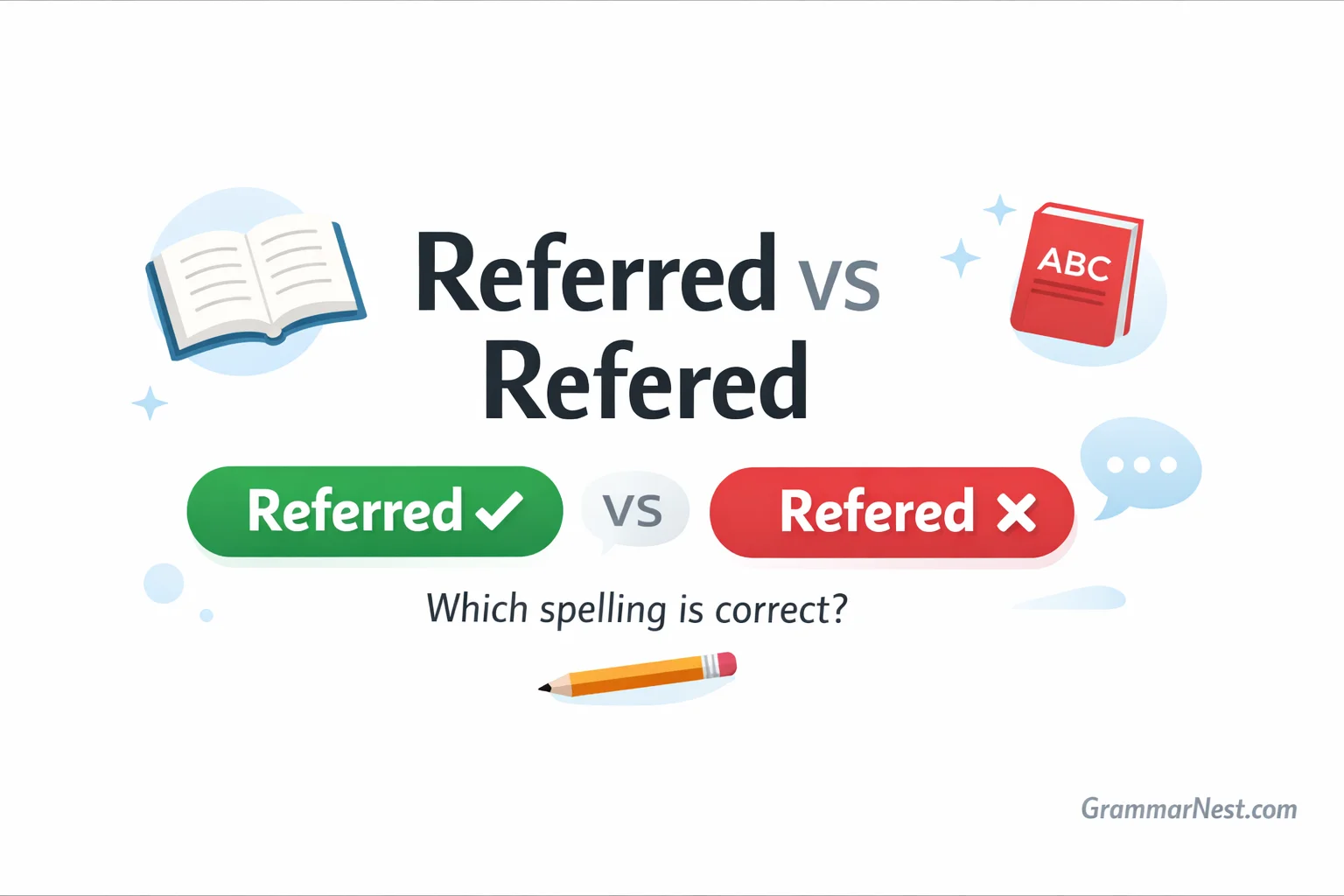
The words “referred” and “refered” are commonly confused because they sound almost the same when spoken. However, only “referred” is correct in standard English.
The incorrect spelling, “refered”, is often seen in emails, social media posts, and informal writing, which can make professional or academic writing look careless.
Understanding the difference is essential for writing accurately, especially in business, education, or formal communication.
Quick Answer
- Correct: Referred ✅
- Incorrect: Refered ❌
Short Explanation: Use “referred” with a double “r” because verbs ending in “-er” usually double the final consonant before adding “-ed” in the past tense.
Comparison Table
| Word | Correct or Incorrect | Meaning |
| Referred | ✅ Correct | Past tense of “refer”; to direct someone to a person, place, or resource for information or help |
| Refered | ❌ Incorrect | Misspelling of “referred.” |
Meaning of Each Word
- Referred: The proper past tense of the verb “refer.”
- Example meanings:
- To direct someone to a resource: “She referred me to the doctor.”
- To mention or allude to something: “He referred to the new policy in his speech.”
- Example meanings:
- Refered: This is not a valid English word. It’s a common misspelling of “referred.”
Grammar Rule Behind the Correct Word
When a verb ends with a single vowel + consonant and is stressed on the last syllable, you double the consonant before adding “-ed” or “-ing.”
- Refer → Referred
- Refer ends with -er and is stressed on the second syllable, so we double the “r.”
Rule Summary:
- Verb ending in vowel + consonant → Double the consonant → Add -ed
- Examples:
- Stop → Stopped
- Admit → Admitted
- Refer → Referred
Example Sentences
I was referred to a specialist for my back pain.
She referred me to a trusted lawyer.
The teacher referred to the textbook during the lecture.
Have you referred anyone to our company recently?
He was referred by a colleague for the promotion.
The article referred to several studies on climate change.
We were referred to the customer support team.
Can you refer me to someone who knows Excel well? → Past tense: “referred.”
They referred the case to the legal department for review.
She often referred to her notes while preparing the presentation.
Quick Tip: Whenever you see refer, always check if the past tense requires a double “r” → “referred.”
Common Mistakes People Make
- Writing “refered” instead of “referred”.
- Forgetting to double the consonant in the past tense or past participle.
- Confusing “referred” with similar words like “referred to” vs “refer to.”
Easy Trick to Remember the Difference
- Referred has two “r”s. Think of “re-R-R-eferred” – the extra “r” is like a reminder that you’re sending someone again or directing attention.
- If you hear it spoken, spell it with double “r” every time.
When to Use Each Word
- Use referred:
- In professional emails, letters, and reports: “I was referred to your department for further assistance.”
- Academic writing: “The author referred to multiple studies on the topic.”
- Everyday conversation (formal and semi-formal): “He referred me to a good dentist.”
- Never use refered, as it is incorrect and unprofessional.
FAQs
Q: Is “refered” correct?
A: No, it is a misspelling. The correct form is referred to.
Q: Why do we double the “r” in referred?
A: Because verbs ending in a vowel + consonant and stressed on the last syllable double the consonant before adding -ed.
Q: Can “referred” be used in informal writing?
A: Yes, it can, but the spelling must always be correct.
Q: Is “referred” the same as “mentioned”?
Similar, but “referred” often implies directing someone to information or a resource.
Q: Can I write “referral” instead?
“Referral” is a noun form. “I got a referral from my doctor” is correct, but “referred” is the verb form.
Related Grammar Mistakes
Final Summary
In English, “referred” is the correct past tense of “refer,” and “refered” is always wrong. Always remember the double “r” rule for verbs ending in a vowel + consonant and stressed on the last syllable.
By using the tips, examples, and tricks in this guide, you can confidently write referred in any context-formal, academic, or casual-without making mistakes.
Mastering small spelling differences like this can significantly improve your writing and make it look professional and polished.