It’s a common mistake many people make: confusing “grateful” and “greatful.” At first glance, they might seem like they could be interchangeable, but there’s a clear difference in how and when they should be used.
Whether you’re writing a thank-you note or crafting a formal email, understanding the correct spelling and meaning of these two words can help you avoid embarrassing errors.
In this guide, we’ll dive into the nuances of both terms, breaking down the correct usage, meanings, and common mistakes people make. Let’s make sure you never mix them up again!
Quick Answer
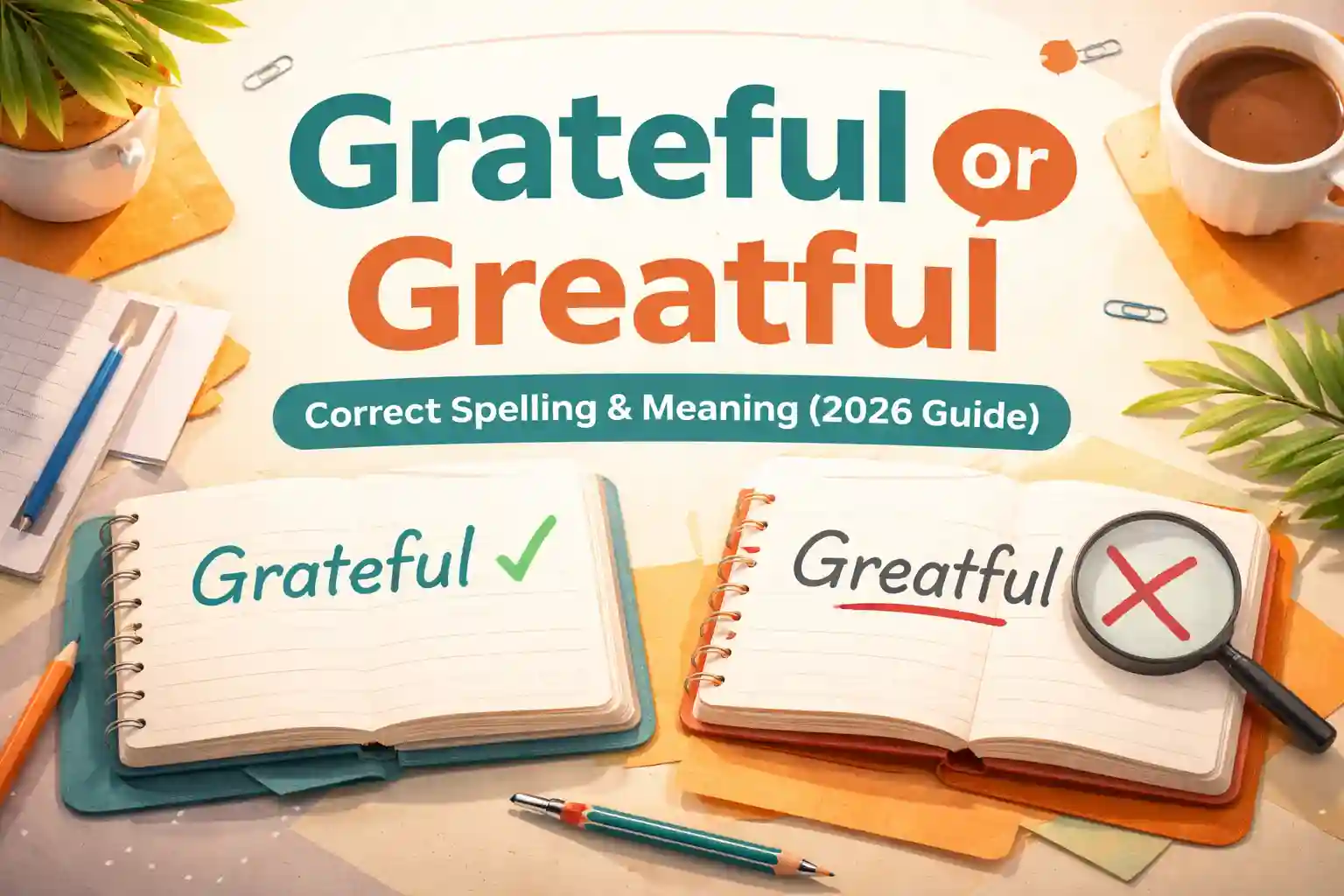
“Grateful” is the correct spelling and refers to feeling thankful or appreciative. “Greatful” is a common misspelling and is not considered a valid word in the English language.
Comparison Table
| Word | Correct or Incorrect | Meaning |
| Grateful | Correct | Feeling thankful or appreciative of someone or something. |
| Greatful | Incorrect | A misspelling of “grateful.” It is not a recognized word. |
Meaning of Each Word
Grateful
“Grateful” is an adjective used to express thankfulness or appreciation for something received or for someone’s actions. It’s a positive emotion typically felt when you recognize someone’s kindness or when you’ve been given a gift, favor, or service.
Example:
- “I’m so grateful for your help today.”
- “She felt grateful for the opportunity to study abroad.”
Greatful
“Greatful” is not a correct word in the English language. It’s a common spelling mistake that arises due to its phonetic similarity to “grateful.” Despite sounding like it could be a legitimate word, “greatful” is incorrect and should be avoided in both formal and informal writing.
Grammar Rule Behind the Correct Word
In English, when expressing gratitude, the word “grateful” is the proper choice. The confusion often comes from the fact that the word “great” exists in English, which might lead to the erroneous spelling of “greatful.”
Why “Grateful” is Correct
- Grateful is formed by adding the suffix “-ful” to “grate” (a variation of “gratia,” meaning thanks). The structure follows a typical English pattern where adjectives formed with “-ful” imply possessing a quality, in this case, the quality of thankfulness.
So, the correct form is always grateful.
Example Sentences
Here are 10 examples to help you understand how to use “grateful” correctly:
“I am grateful for all the support you’ve given me.”
“After receiving the gift, she felt truly grateful.”
“He was grateful for the opportunity to speak at the conference.”
“They were grateful for the kindness shown during the difficult time.”
“I’m grateful for your patience and understanding.”
“We are grateful to have such a strong community.”
“She felt grateful for the time spent with her family.”
“The team was grateful for the leadership of their coach.”
“I’m grateful for the lessons I learned from this experience.”
“He couldn’t be more grateful for the scholarship.”
Common Mistakes People Make
Mistake #1: Using “Greatful” Instead of “Grateful”
This is the most common error. Due to the similarity in pronunciation, many people mistakenly write “greatful” when they mean to say “grateful.” Always remember that “greatful” is not a word.
Mistake #2: Mixing “Grateful” with “Thankful”
While both words are related to expressing gratitude, there is a slight difference in usage:
- “Grateful” is more formal and is used when you want to show deep appreciation.
- “Thankful” is slightly more casual and is often used for everyday expressions of gratitude.
Example:
- “I am grateful for your generous donation.” (formal)
- “I’m so thankful for my friends.” (casual)
Easy Trick to Remember the Difference
Here’s an easy way to remember the correct spelling:
- “Grateful” contains “grate” (as in a “grate” of a fireplace, which gives warmth or comfort, symbolizing the warmth of gratitude). So, grateful is the word you want when expressing appreciation.
When to Use Each Word
- Grateful: Use this word when expressing a deep sense of thankfulness for something important or significant.
- Example: “I’m grateful for all the opportunities I’ve had in life.”
- Greatful: Since this is an incorrect word, it should never be used in formal or informal contexts.
People Also Ask
- Is “grateful” the only correct spelling?
Yes, “grateful” is the only correct spelling when expressing thankfulness. “Greatful” is a misspelling.
- What’s the difference between “grateful” and “thankful”?
Both words express gratitude, but “grateful” is slightly more formal, while “thankful” is often used in casual situations.
- How do you pronounce “grateful”?
“Grateful” is pronounced as “grayt-fuhl,” with emphasis on the first syllable.
- Can you use “grateful” in a sentence?
Yes, for example: “I am grateful for the love and support of my family.”
- Why is it “grateful” and not “greatful”?
The word “grateful” follows a standard English pattern where “-ful” is added to a root word to express a quality (in this case, the quality of thankfulness).
FAQs
1. What is the correct way to use “grateful” in a sentence?
“Grateful” should be used to express thankfulness. Example: “I am grateful for your guidance.”
2. Can “greatful” ever be correct?
No, “greatful” is always incorrect. The correct spelling is “grateful.”
3. Why do people confuse “grateful” with “greatful”?
The similarity in pronunciation leads to this confusion, but “greatful” is not an accepted spelling.
4. Can “grateful” be used in formal writing?
Yes, “grateful” is appropriate in both formal and informal writing, such as letters, emails, and essays.
5. Are there other words like “greatful” that are commonly misspelled?
Yes, some common examples include “definitely” (definitely), “receive” (receive), and “separated” (separated).
Related Grammar Mistakes
Final Summary
In this guide, we’ve learned that “grateful” is the correct spelling when expressing thankfulness, while “greatful” is an incorrect misspelling. We explored how to use “grateful” in various contexts, shared some common mistakes, and provided an easy way to remember the correct form.
Next time you need to express gratitude, remember to use grateful! Keep practicing, and you’ll soon master these common spelling pitfalls.