
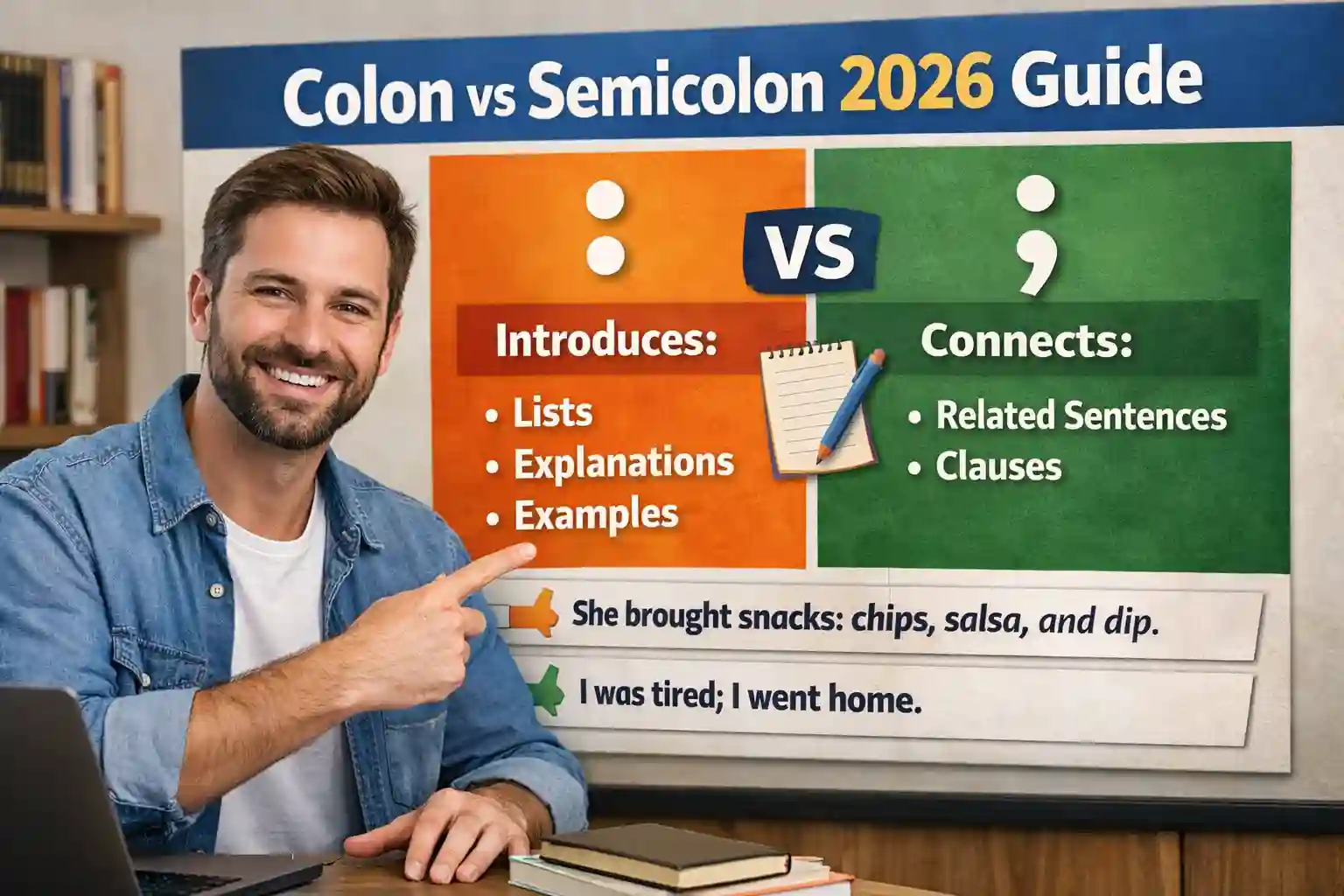
Many English learners (and even native speakers) get confused between a colon vs semicolon. Both punctuation marks look similar and are used to connect ideas, but they serve very different purposes.
A colon (:) often introduces something, while a semicolon (;) connects closely related sentences. The confusion happens because both can appear between independent clauses.
In this guide, you’ll learn the exact difference, simple rules, and practical examples to master them easily.
Quick Answer
Colon vs Semicolon: What’s the difference?
- Use a colon (:) to introduce a list, explanation, or result.
- Use a semicolon (;) to connect two closely related independent sentences.
Example:
- Colon → She brought three things: bread, milk, and eggs.
- Semicolon → I was tired; I went to bed early.
Comparison Table
| Word | Correct or Incorrect | Meaning |
| Colon (:) | Correct | Introduces lists, explanations, or emphasis |
| Semicolon (;) | Correct | Connects closely related independent clauses |
Meaning of Each Word
What is a Colon (:)?
A colon is a punctuation mark used to introduce something important-like a list, explanation, quote, or result.
👉 Think of it as saying: “Here it comes!”
Example:
- He had one goal: to succeed.
What is a Semicolon (;)?
A semicolon connects two complete sentences that are closely related in meaning.
👉 Think of it as a stronger comma but weaker than a full stop.
Example:
- She loves reading; he prefers watching movies.
Grammar Rule Behind the Correct Word
Colon Rules
Use a colon when:
- Introducing a list
- Explaining something
- Giving emphasis
- Introducing a quote
✔ The part before the colon must be a complete sentence.
Semicolon Rules
Use a semicolon when:
- Connecting two independent clauses
- Avoiding comma splices
- Linking ideas without conjunctions (and, but, so)
✔ Both sides of the semicolon must be complete sentences.
Quick Grammar Tip 💡
- Colon = “Look ahead”
- Semicolon = “Link ideas”
Example Sentences
Colon Examples
She bought everything she needed: fruits, vegetables, and bread.
There is only one option: leave now.
He had a dream: to become a doctor.
She whispered one word: run.
The reason is simple: we were late.
Semicolon Examples
I wanted to go outside; it was raining heavily.
She studied hard; she passed the exam.
He is very rich; he lives a simple life.
The movie was boring; we left early.
I like tea; she prefers coffee.
He didn’t call; I got worried.
Common Mistakes People Make
Here are the most common errors in colon vs semicolon usage:
❌ Using a semicolon for lists
Wrong:
- I bought apples, bananas, and oranges
Correct:
- I bought apples, bananas, and oranges
❌ Using a colon after an incomplete sentence
Wrong:
- My favorite food is: pizza
Correct:
- My favorite food is pizza
OR - I love many foods: pizza is my favorite
❌ Using a semicolon like a comma
Wrong:
- I went home, and I slept
Correct:
- I went home, and I slept
OR - I went home; I slept
Easy Trick to Remember the Difference
Here’s a simple trick:
👉 Colon = “Because or For Example”
👉 Semicolon = “And/But without writing it”
Example:
- Colon → He was late: he missed the bus. (because)
- Semicolon → He was late; he missed the bus. (and/because)
When to Use Each Word
Use Colon (:) when:
- You want to introduce a list
- You want to explain something
- You want to emphasize a point
- You are introducing a quote
Use a semicolon (;) when:
- You join two related sentences
- You don’t want to use a conjunction
- You want a smoother flow between ideas
People Also Ask
❓ What is the difference between a colon and a semicolon?
A colon introduces information, while a semicolon connects related sentences.
❓ Can a semicolon replace a colon?
No. A semicolon connects sentences, but a colon introduces something.
❓ When should I use a colon?
Use a colon before lists, explanations, or emphasis.
❓ Can I use a semicolon before “and”?
Usually no. Semicolons replace conjunctions like “and” or “but.”
❓ Is a semicolon stronger than a comma?
Yes. It is stronger than a comma but weaker than a full stop.
FAQs
1. Is a colon or a semicolon more formal?
Both are formal, but semicolons are more common in academic writing.
2. Can I use a colon in casual writing?
Yes, especially for lists and emphasis.
3. Do both sides of a semicolon need full sentences?
Yes, both must be complete sentences.
4. Can a colon join two sentences?
Yes, if the second explains the first.
5. Which is easier to use?
Colon is easier because it mostly introduces lists or explanations.
Related Grammar Mistakes
If you’re learning colon vs semicolon, you might also confuse:
👉 These are common punctuation problems that affect writing clarity.
Final Summary
Understanding colon vs semicolon is easier than it seems:
- Use a colon (:) to introduce lists, explanations, or emphasis
- Use a semicolon (;) to connect closely related sentences
Final Tip ✔
- Colon = introduce
- Semicolon = connect
Master these two punctuation marks, and your writing will instantly become more professional, clear, and powerful.