
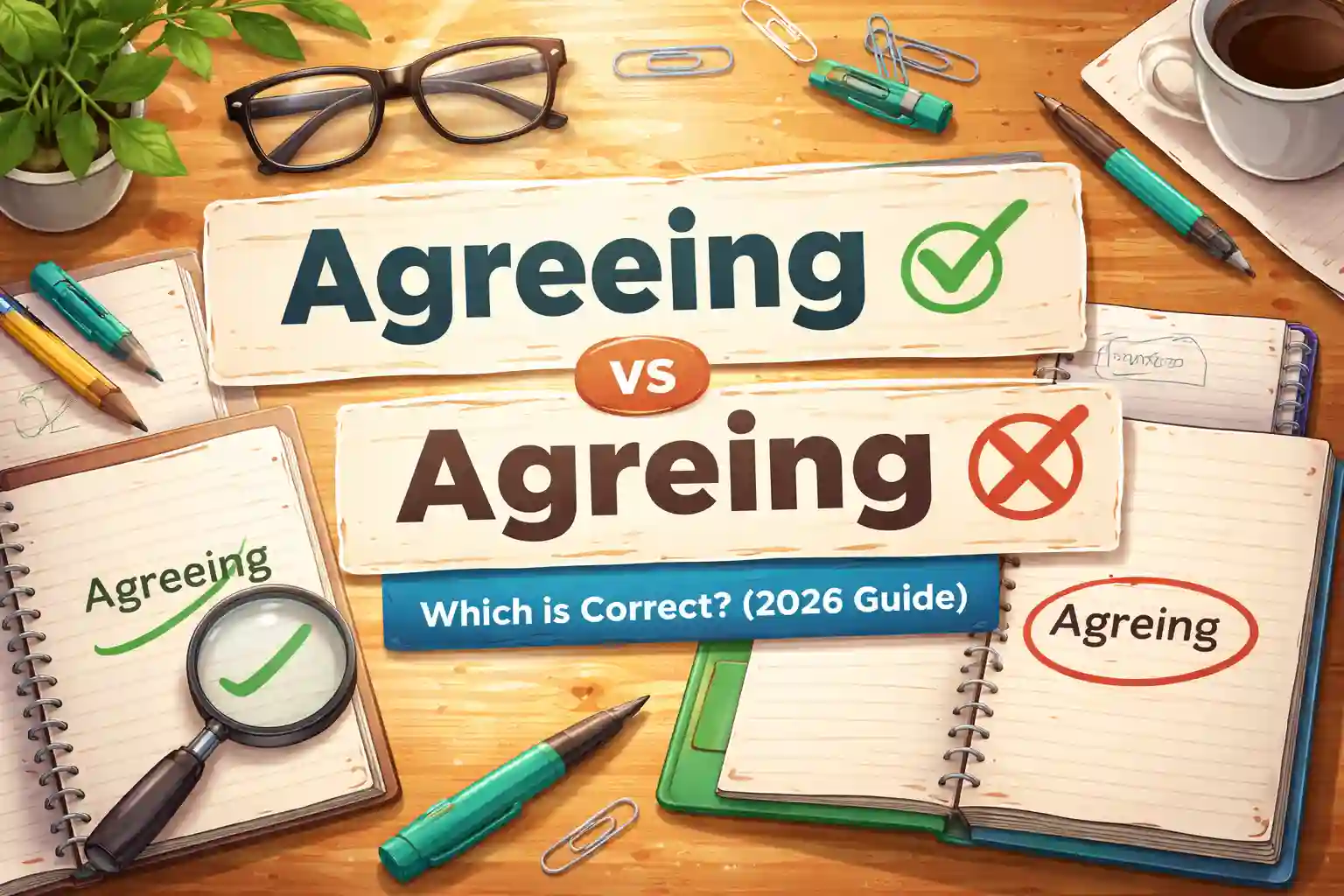
When it comes to English spelling and grammar, small mistakes can make a big difference, and the confusion between agreeing and agreing is a perfect example.
While both words look similar, only one of them is correct. If you’ve found yourself unsure about which one to use, you’re not alone! Many people get caught in this common trap. But don’t worry, we’re here to clear up the confusion once and for all.
In this 2026 guide, we’ll explain the meaning of both words, provide example sentences, share grammar rules, and offer easy tips for remembering the difference.
Quick Answer
- Agreeing is the correct word.
- Agreing is a common misspelling.
- Agreeing means agreeing with something.
Comparison Table
| Word | Correct or Incorrect | Meaning |
| Agreeing | Correct | Agreeing with someone or something. |
| Agreing | Incorrect | A misspelling of “agreeing,” with an incorrect form of the verb. |
Meaning of Each Word
Agreeing (Correct)
“Agreeing” is the present participle of the verb “agree.” It refers to the action of giving your consent or expressing a positive response to something. When you’re “agreeing,” you’re indicating that you share the same opinion, idea, or feeling as someone else.
- Example: “I agree with your proposal.”
In some contexts, “agreeing” can also describe an action that is happening at the moment or an ongoing state of consent.
Agreing (Incorrect)
“Agreing” is a common misspelling of “agreeing.” The word “agreing” is not recognized as a standard word in English, and it’s simply an error made by dropping one “e” from “agreeing.” Therefore, “agreing” should always be corrected to “agreeing” in writing.
Grammar Rule Behind the Correct Word
The word “agreeing” is formed from the verb “agree” by adding the suffix “-ing,” which is commonly used to form present participles or gerunds.
- Present Participle: “Agreeing” is used to describe an action that is happening right now.
Example: “She agrees with the terms of the contract.” - Gerund: “Agreeing” can also act as a noun in a sentence, referring to the act of agreement.
Example: “Agreeing is important in any partnership.”
The incorrect form, “agreing,” lacks one of the required “e”s and is simply a spelling mistake.
Example Sentences
I agree with your suggestion to improve the plan.
She is agreeing to help with the fundraising event.
We were agreeing on the new project deadlines.
After much discussion, the team finally started agreeing on the direction of the project.
I couldn’t believe she was agreeing to the terms so quickly.
The board members have agreed to hold another meeting next week.
They will agree to the terms after reviewing the contract.
By the end of the meeting, everyone was agreeing on the new strategy.
The employees are still agreeing on the changes to the policy.
Agreeing to work together was the first step towards completing the project.
Common Mistakes People Make
- Agreing instead of Agreeing: This is the most common mistake and involves omitting one of the “e”s in the verb “agree.” It’s important to remember that the correct spelling is “agreeing,” with two “e”s.
- Confusing Agreeing with other words like agree and agreed: Make sure you use “agreeing” only when referring to an ongoing action, not when discussing past actions (which would require “agreed”).
Easy Trick to Remember the Difference
To easily remember that the correct word is agreeing, think of the word “agree” and add “ing” just like you would for any verb in the present participle form. If you ever catch yourself wondering whether to use “agreing,” just recall that there are two “e”s in the correct word, just like how you would “agree” with someone—you’d never just “agre”!
When to Use Each Word
- Agreeing should be used when expressing consent or approval in the present tense.
- Example: “I am agreeing to the terms of the contract.”
- Agreing is never correct and should be avoided entirely. Always use agreeing instead.
People Also Ask
- Is it “agreeing” or “agreing”?
- The correct spelling is agreeing. “Agreing” is a common misspelling.
- What does “agreeing” mean?
- “Agreeing” means to express consent, approval, or share the same opinion as someone else.
- Why is “agreing” wrong?
- “Agreing” is incorrect because it is missing one of the “e”s in the word “agreeing,” making it a misspelling.
- How do you use “agreeing” in a sentence?
- Example: “She is agreeing with the new proposal.”
- What is the past tense of “agreeing”?
- The past tense of “agreeing” is agreed.
FAQs
1. Why do people misspell “agreeing” as “agreing”?
People often drop the second “e” in “agreeing” because they are influenced by the pattern of shortening words, but this is a spelling mistake.
2. Can “agreeing” be used in the past tense?
No, “agreeing” is in the present participle form. The past tense of “agree” is agreed.
3. Is “agreing” ever acceptable?
No, “agreing” is never correct. Always use “agreeing.”
4. How can I remember to use “agreeing” correctly?
A simple trick is to think of the word “agree,” then add “ing.” If you remember to keep the double “e,” you’ll never go wrong.
5. Is “agreeing” a formal word?
“Agreeing” can be used in both formal and informal settings. It’s simply a way to express consent or approval, so it’s suitable for professional and casual conversations.
Related Grammar Mistakes
Final Summary
In summary, agreeing is the correct spelling when expressing consent or approval, while agreing is simply a misspelling. By following the simple rule of adding “ing” to the verb “agree,” you’ll avoid this common mistake. Remember, proper spelling and grammar help ensure clarity and professionalism in your writing, whether you’re drafting an email, a report, or simply chatting with friends.