
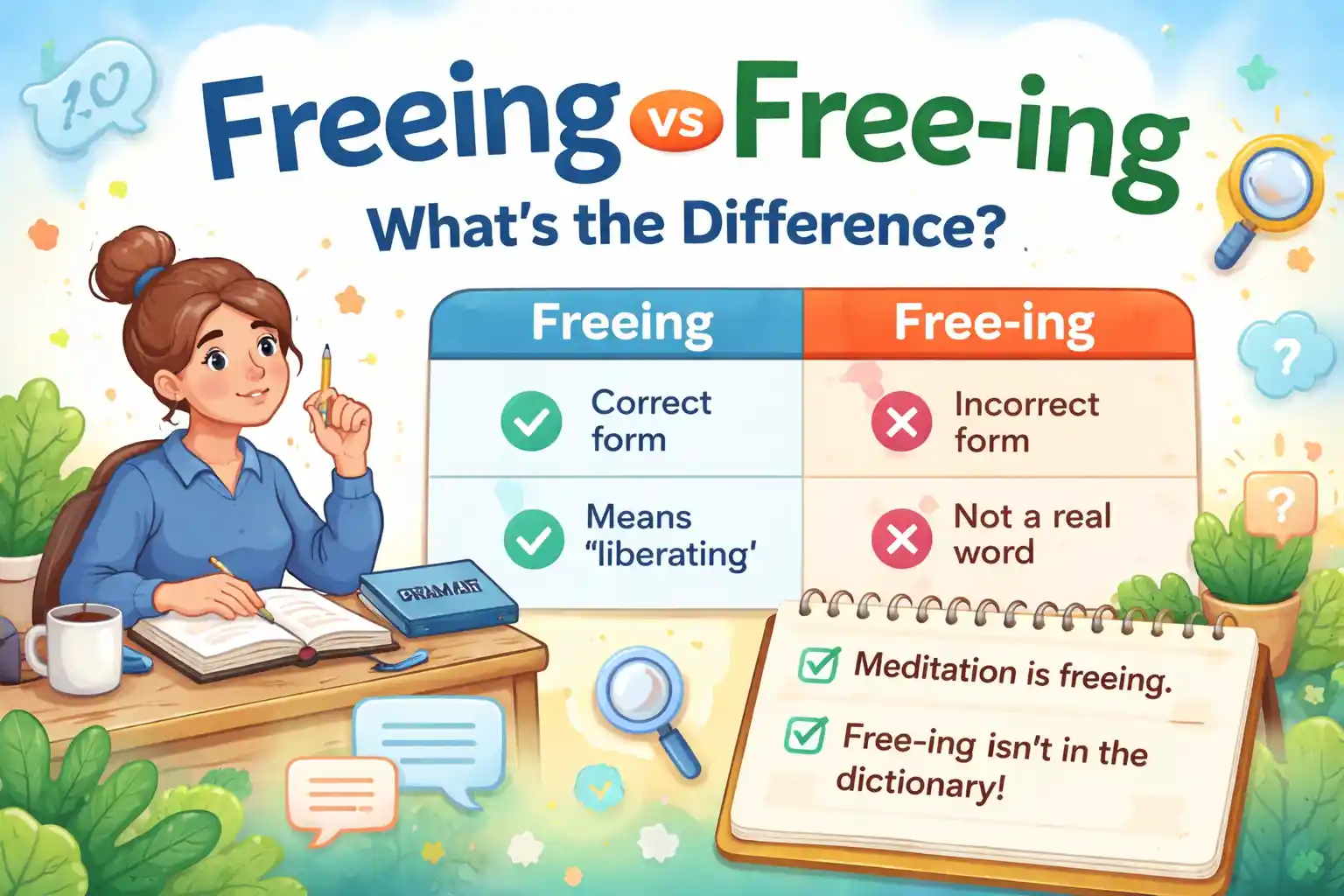
When you’re learning English, certain words can be confusing due to their similar spelling or sound. A common example that often leads to confusion is “freeing vs freeing.”
Despite their identical spelling, understanding the correct usage and meaning behind these words can make a big difference in your writing and communication.
In this comprehensive guide, we’ll break down the meanings, grammatical rules, and provide helpful tips to help you understand when to use “freeing” correctly. So, whether you’re a beginner or an expert, let’s dive into the world of these tricky terms.
Quick Answer
“Freeing” is a verb in its present participle or gerund form, meaning to release or set something or someone free. There’s no difference between “freeing” and “freeing” in terms of spelling, but understanding context and grammar can help you use the word correctly.
Comparison Table
| Word | Correct or Incorrect | Meaning |
| Freeing | Correct | To release or make something free |
| Freeing | Correct | Same as above. There is no alternate form |
Meaning of Each Word
The word “freeing” is the present participle or gerund form of the verb “free.” It refers to the action of releasing someone or something from a restriction, confinement, or a state of being bound. It’s typically used in both active voice and progressive verb tenses.
For example, “She is freeing the birds from their cage.” Here, “freeing” is the action of releasing the birds.
Even though “freeing” may appear to be a tricky word to understand at first, its meaning is straightforward and involves setting something or someone free.
Grammar Rule Behind the Correct Word
“Freeing” is grammatically correct in the following cases:
- Present Participle: It’s used as a part of continuous verb tenses.
- Example: “They are freeing the animals from their cages.”
- Gerund: It can also function as a noun in a sentence.
- Example: “Freeing the prisoners was the most important task.”
Note that “freeing” is never incorrect or an alternate form of another word. There’s no different spelling or alternative usage in this case; “freeing” is always the correct form when used to denote releasing something or someone.
Example Sentences
Here are 10 example sentences to show how “freeing” is used correctly in everyday English:
The police are freeing the hostages from the building.
She’s freeing herself from the chains of her past.
He’s freeing up his schedule to help others.
They are freeing the birds back into the wild.
Freeing animals from the zoo is a noble cause.
Freeing your mind from stress is important for mental health.
The charity is focused on freeing those trapped in poverty.
By freeing their thoughts, they found clarity.
The prisoners were freed after years of unjust imprisonment.
We’re working towards freeing the environment from pollution.
Common Mistakes People Make
- Confusing “Freeing” with “Free”: Some people might mistakenly think “freeing” is synonymous with “free,” but “freeing” is a verb, not an adjective.
- Incorrect use in tense: “Freeing” should only be used in progressive tenses or as a gerund. Using it outside these contexts can lead to confusion.
Easy Trick to Remember the Difference
Remember that “freeing” always relates to an action. If you’re talking about the act of releasing something or someone, you’ll use “freeing.”
For example, if you’re setting someone free from a cage, “freeing” is the right word. To simplify, think of “freeing” as the verb form that describes the process of making someone or something free.
When to Use Each Word
- Use “Freeing” when you’re describing the action of making something or someone free, like in sentences such as “He is freeing the animals” or “Freeing prisoners was their main objective.”
- Avoid using “Freeing” outside of these contexts where a continuous action or gerund form is required.
People Also Ask
- What does “freeing” mean?
- “Freeing” means releasing something or someone from captivity or a restriction.
- How do you use the word freeing in a sentence?
- “She is freeing the animals from their cages.”
- Is “freeing” a noun or a verb?
- “Freeing” is a verb in its present participle or gerund form.
- When do you use the word freeing?
- Use “freeing” when talking about the act of releasing something or someone.
- Can you use “freeing” in the past tense?
- No, “freeing” is a present participle or gerund. The past tense of “free” is “freed.”
FAQs
- What is the difference between “free” and “freeing”?
- “Free” is an adjective, while “freeing” is a verb form, specifically the present participle or gerund form of the verb “free.”
- Can “freeing” be used as a noun?
- Yes, when used as a gerund, “freeing” can function as a noun, e.g., “Freeing the animals was their mission.”
- Is “freeing” ever incorrect?
- No, “freeing” is always the correct term when describing the action of releasing or making someone or something free.
- How do I avoid common mistakes with “freeing”?
- Always use “freeing” as part of a continuous tense or as a gerund, never as an adjective or in the past tense.
- Why do people confuse “freeing” with other words?
- People may confuse “freeing” with other forms of the verb “free,” like “freed,” or they may mistakenly use it in the wrong grammatical context.
Related Grammar Mistakes
Final Summary
In conclusion, “freeing” is a simple verb form that refers to the act of releasing someone or something from a restriction or confinement. Understanding its proper usage will help you communicate more clearly and avoid common mistakes. Whether you’re writing or speaking, remember that “freeing” is used for continuous actions or as a gerund, and there’s no tricky alternative spelling or hidden rule behind its use.