
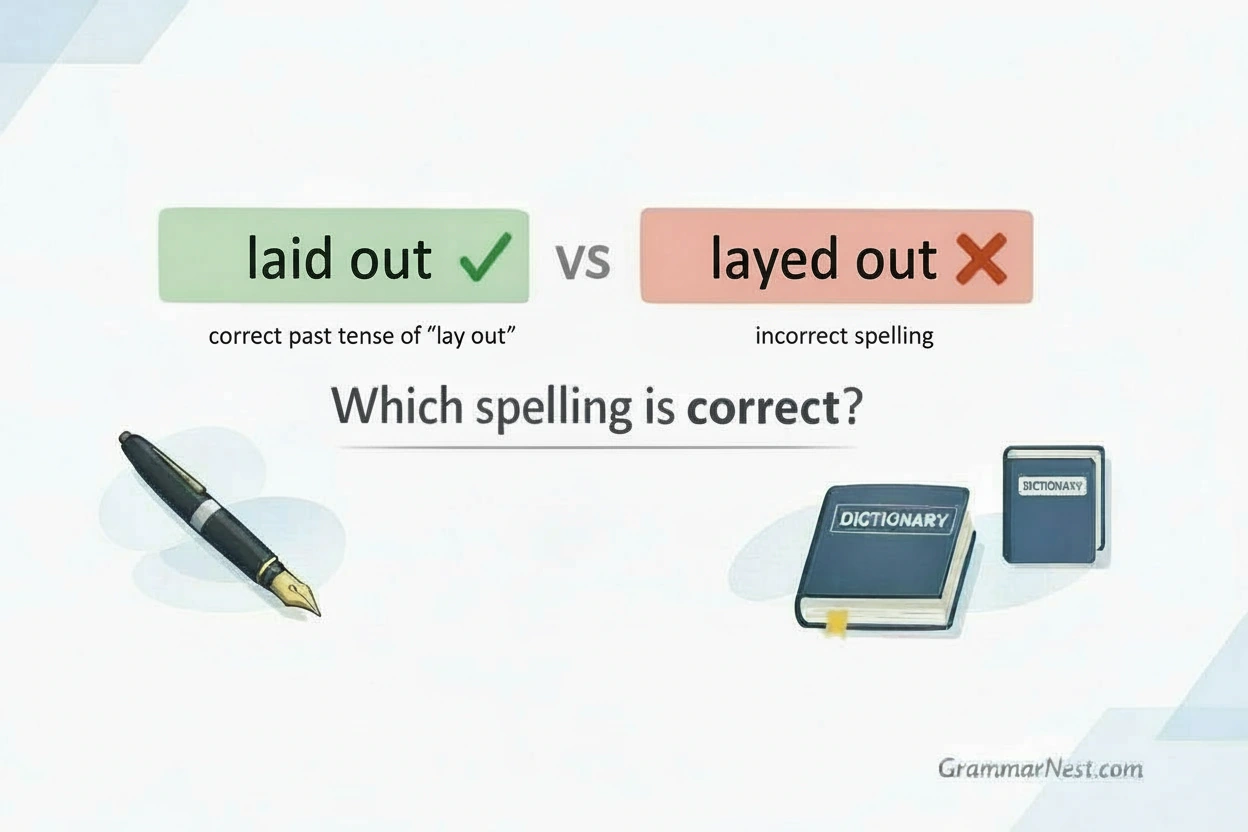
English grammar can be tricky, especially when words sound correct but are actually spelled incorrectly. A common example is “laid out vs layed out.”
Many writers assume that “layed out” is the past tense of lay, but this is a very common spelling mistake. In reality, “layed out” is not considered correct in standard English.
Because the verbs lay, lie, and laid already confuse many learners, it’s easy to understand why this error appears so often in emails, articles, and social media posts.
In this guide, we will clearly explain:
- The correct spelling
- The grammar rule behind it
- Real examples of usage
- Easy tricks to remember the difference
By the end of this article, you’ll never confuse laid out vs layed out again.
Quick Answer
The correct phrase is “laid out.”
The spelling “layed out” is incorrect in modern English.
- Laid out → correct past tense of lay out
- Layed out → incorrect spelling
Example:
✔ Correct: She laid out the plans for the new project.
❌ Incorrect: She layed out the plans for the new project.
Comparison Table
| Word | Correct or Incorrect | Meaning |
| Laid out | ✅ Correct | Past tense of lay out, meaning to arrange, present, or organize something |
| Layed out | ❌ Incorrect | Misspelling of laid out |
Meaning of Each Word
Laid Out (Correct)
The phrase laid out is the past tense of “lay out.”
It can mean:
- To arrange something carefully
- To present information clearly
- To plan or organize something
- To place items in order
Examples of meaning:
- The designer laid out the website structure.
- The teacher laid out the rules for the exam.
It is widely used in professional writing, journalism, and everyday communication.
Layed Out (Incorrect)
The spelling “layed out” appears logical, but it is not grammatically correct.
English uses “laid” as the past tense of lay, not layed.
This mistake usually happens because people try to apply the regular -ed past tense rule.
Example of the incorrect form:
❌ He layed out the documents.
Correct version:
Grammar Rule Behind the Correct Word
To understand laid out vs layed out, you must understand the verb “lay.”
The verb lay is irregular, which means it does not follow the normal -ed pattern.
Verb Forms of “Lay”
| Verb Form | Word |
| Base Form | Lay |
| Past Tense | Laid |
| Past Participle | Laid |
| Present Participle | Laying |
So when you use “lay out” in the past tense, it becomes:
Lay out → Laid out
Examples:
- She lays out the clothes every morning.
- She laid out the clothes yesterday.
Because lay is irregular, “layed” does not exist in standard grammar.
Quick Grammar Tip
If the verb is lay, the past tense will always be laid, not layed.
Example Sentences
Here are examples showing the correct usage of laid out.
The manager laid out the company’s new strategy during the meeting.
She laid out the ingredients before starting the recipe.
The architect laid out the design for the new building.
The teacher laid out clear expectations for the students.
He laid out the documents on the table for everyone to review.
The guide laid out the travel plan for the entire trip.
They laid out the rules before the competition started.
The writer laid out his argument carefully in the article.
She laid out her clothes the night before the interview.
The project manager laid out the completion timeline.
Incorrect examples:
❌ He layed out the project timeline.
✔ He laid out the project timeline.
Common Mistakes People Make
Many learners confuse “laid out” and “layed out” due to common grammatical misunderstandings.
Assuming All Past Tenses End in -ed
People often believe that every verb follows this pattern:
- Walk → Walked
- Work → Worked
But lay is irregular.
Correct:
- Lay → Laid
Not:
- Lay → Layed
Confusing Lay and Lie
Another common confusion involves lay and lie.
| Verb | Meaning |
| Lay | To put something down |
| Lie | To rest or recline |
Examples:
- She laid the book on the table.
- He lay on the couch.
Overcorrecting Spellings
Because many verbs use -ed, writers instinctively type layed, even though it is incorrect.
Spell checkers often catch this mistake, but not always.
Easy Trick to Remember the Difference
A simple trick can help you remember the correct spelling.
Think: Lay → Laid
Just remember this pattern:
Lay → Laid
If you see layed, it should immediately look wrong.
Another trick:
Compare with similar verbs:
- Say → Said
- Pay → Paid
- Lay → Laid
Notice the pattern: “ai” instead of “ay.”
When to Use Each Word
Use “Laid Out” When:
You want to describe:
- Arranging something
- Presenting ideas
- Organizing items
- Explaining plans clearly
Examples:
- The teacher laid out the lesson plan.
- She laid out the clothes for tomorrow.
Do NOT Use “Layed Out”
The phrase layed out should never be used in formal or standard English writing.
It is simply a spelling mistake.
Always replace it with:
✔ Laid out
People Also Ask
Is “layed out” ever correct?
No. “Layed out” is not correct in standard English. The correct phrase is “laid out.”
Why do people write “layed out”?
Many writers mistakenly apply the regular -ed past tense rule to the verb lay. However, lay is an irregular verb.
What does “laid out” mean?
“Laid out” means to arrange, organize, present, or explain something clearly.
Is “laid out” formal English?
Yes. The phrase laid out is commonly used in both formal and informal writing.
Can “laid out” mean explained?
Yes. It can mean clearly explained or presented.
Example:
She laid out the entire proposal during the meeting.
FAQs
Is “laid out” the past tense of “lay out”?
Yes. Laid out is the correct past tense form of lay out.
Is “layed out” in the dictionary?
No reputable English dictionary recognizes layed out as correct.
Why is “laid” spelled differently?
Because lay is an irregular verb, its past tense changes form rather than adding -ed.
Can “laid out” mean arranged?
Yes. One of its main meanings is to arrange something carefully.
Example:
She laid out the decorations for the party.
Do native speakers ever say “layed out”?
Sometimes people mistakenly write it, but it is considered a grammatical error.
Related Grammar Mistakes
If you found laid out vs layed out confusing, you might also struggle with these similar grammar mistakes:
- Loose vs Lose
- Then vs Than
- Affect vs Effect
- Your vs You’re
- drier vs dryer
- Lie vs Lay
These mistakes happen because English contains many irregular verbs and similar spellings.
Learning the grammar rules behind them can dramatically improve your writing accuracy.
Final Summary
Understanding laid out vs layed out is actually quite simple once you know the grammar rule.
Here is the key takeaway:
- Laid out → ✅ Correct
- Layed out → ❌ Incorrect
The reason is that “lay” is an irregular verb, and its past tense is “laid.”
Whenever you describe arranging, presenting, or organizing something in the past, the correct phrase will always be:
✔ Laid out
Example:
The manager laid out the entire strategy during the meeting.
Once you remember the rule “Lay → Laid,” this grammar mistake becomes easy to avoid.
If you’re learning English grammar or improving your writing skills, mastering small distinctions like laid out vs layed out can make your communication clearer, more professional, and more confident.