
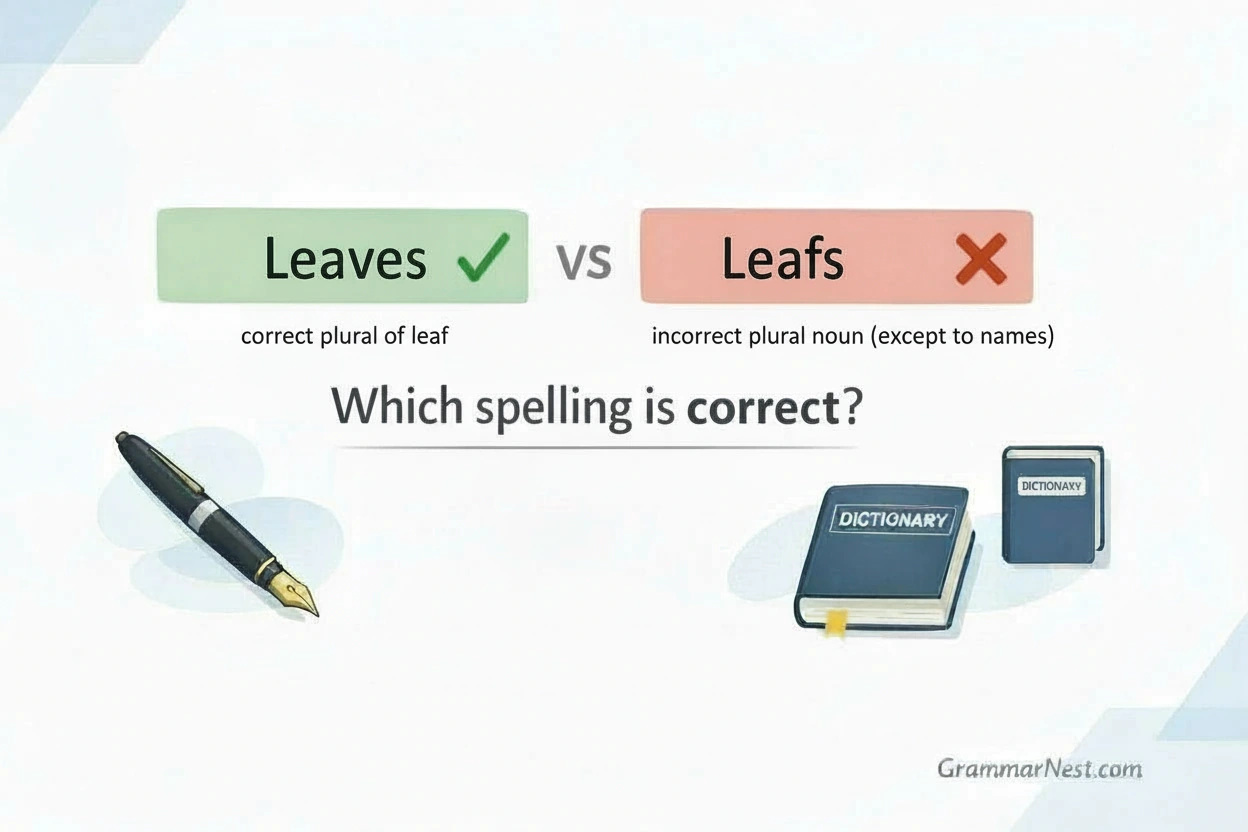
English spelling rules can sometimes be confusing, especially when words change their form in the plural. One common question many learners ask is: “Is it leaves or leafs?”
At first glance, both words look correct because they follow patterns found in other English words. However, only one is considered the standard plural form of “leaf.”
Understanding the difference between leaves vs leafs is important for clear writing, proper grammar, and avoiding common mistakes in English.
In this complete guide, you’ll learn:
- The correct plural form of leaf
- The grammar rule behind the spelling
- Real example sentences
- Common mistakes people make
- Easy tricks to remember the difference
Let’s clear up the confusion once and for all.
Quick Answer
The correct plural form of leaf is leaves.
- Leaves → Correct plural form of leaf
- Leafs → Generally incorrect, except in very rare technical uses (like a verb form)
Example:
✔ The trees are covered with beautiful leaves in autumn.
❌ The trees are covered with beautiful leafs.
In standard English grammar, leaves is the correct word to use.
Comparison Table
| Word | Correct or Incorrect | Meaning |
| Leaves | ✅ Correct | Plural form of leaf |
| Leafs | ❌ Usually incorrect | Rare verb form meaning “to flip through pages.” |
Meaning of Each Word
Leaves
Leaves is the plural form of the noun leaf.
A leaf is:
- A flat green part of a plant or tree
- Something that grows from branches
- Responsible for photosynthesis in plants
When there is more than one leaf, we say leaves.
Examples:
- The wind blew the leaves across the street.
- Maple leaves turn red in autumn.
Leafs
The word leafs is rarely used as a plural noun.
Instead, it can appear as a verb form of leaf, meaning:
To flip through pages quickly.
Example:
- She leafs through the magazine while waiting.
However, this usage is uncommon and unrelated to plants.
For plants and trees, leaves are always correct.
Grammar Rule Behind the Correct Word
The reason leaf → leaves happens is due to a common English spelling rule.
Many nouns ending in -f or -fe change to -ves in plural form.
Rule:
f → ves
Examples:
| Singular | Plural |
| leaf | leaves |
| knife | knives |
| wolf | wolves |
| life | lives |
| shelf | shelves |
So:
leaf → leaves
This rule explains why leafs is not the correct plural spelling.
However, English has exceptions, such as:
- roofs
- beliefs
- chiefs
But leaf is not one of those exceptions.
Example Sentences
Here are real examples showing how to use leaves correctly.
The ground was covered with golden leaves.
Autumn leaves create beautiful colors in the forest.
The gardener swept the fallen leaves.
Fresh green leaves appeared in spring.
The wind carried the dry leaves across the road.
Maple leaves turn bright red during fall.
The tree lost all its leaves during winter.
The children played in a pile of leaves.
The plant has large, shiny leaves.
Rain washed the dust from the leaves.
Notice that leafs never appear in these examples because leaves is the correct plural form.
Common Mistakes People Make
Many learners accidentally write leafs instead of leaves.
Here are some common mistakes:
Adding “s” automatically
Many English words form plurals simply by adding -s.
Example:
- book → books
- chair → chairs
This makes people think:
leaf → leafs
But this rule does not apply here.
Confusing verb and noun forms
Sometimes people see sentences like:
“He leafs through a book.”
This verb form can confuse writers into thinking leafs is also the plural noun.
It is not.
Autocorrect errors
Some spell checkers may not highlight leafs as incorrect because it exists as a verb form.
But for plants and trees, leaves are always correct.
Easy Trick to Remember the Difference
Here is a simple trick:
If it grows on a tree, it’s always “leaves.”
Another helpful memory tip:
Think of the phrase:
Autumn leaves
Not:
Autumn leafs
This phrase is very common in English songs, poems, and books.
When to Use Each Word
Use Leaves when talking about:
- Plants
- Trees
- Nature
- Seasons
- Botany
Examples:
✔ The tree has green leaves.
✔ The wind blew the leaves away.
Use Leafs only when referring to:
- The verb to leaf through something
Example:
✔ He leafs through the newspaper every morning.
Again, this is a verb, not a plural noun.
People Also Ask
Is it leafs or leaves?
The correct plural of leaf is leaves. The spelling leafs is usually incorrect when referring to plant leaves.
Why is leaf plural leaves?
English grammar changes some nouns ending in f to ves in the plural form. Therefore, leaf becomes leaves.
Is leafs ever correct?
Yes, but only as a verb form, meaning to flip through pages quickly.
Example:
She leafs through a book.
What is the plural of leaf?
The plural of leaf is leaves.
Why don’t we say leafs?
Because English spelling rules change f → ves in some words when forming the plural.
FAQs
What is the plural of leaf?
The correct plural is leaves.
Is “leafs” grammatically correct?
Not when referring to plants. Leafs is usually incorrect in that context.
Why does leaf become leaves?
English plural rules sometimes change f to ves.
Example:
leaf → leaves
Do all words ending in f change to ves?
No. Some words simply add s.
Examples:
- roofs
- chiefs
- beliefs
But leaf → leaves follows the f → ves rule.
Is leaves singular or plural?
Leaves are the plural form of leaf.
Related Grammar Mistakes
Many English learners confuse similar plural forms.
Here are a few common examples:
- Cringy or Cringey
- Knife or Knifes / Knives
- Life or Lifes / Lives
- More Then or More Than
- Loaf or Loafs / Loaves
Understanding plural spelling rules helps avoid these mistakes.
Quick Grammar Tip
If a noun ends in -f, check whether it changes to -ves in plural form.
Examples:
- leaf → leaves
- knife → knives
- wolf → wolves
Learning these patterns will make your English writing more accurate.
Final Summary
The confusion between leaves or leafs is very common, but the correct answer is simple.
Leaves is the correct plural form of leaf.
Key points to remember:
- Leaves = correct plural noun
- Leafs = rare verb form meaning “to flip through pages.”
- English often changes f → ves when forming plurals
Example:
✔ The tree has many green leaves.
❌ The tree has many green leafs.
Once you understand this grammar rule, the difference becomes easy to remember.
So next time you write about trees, plants, or autumn, you’ll know the correct word is leaves.