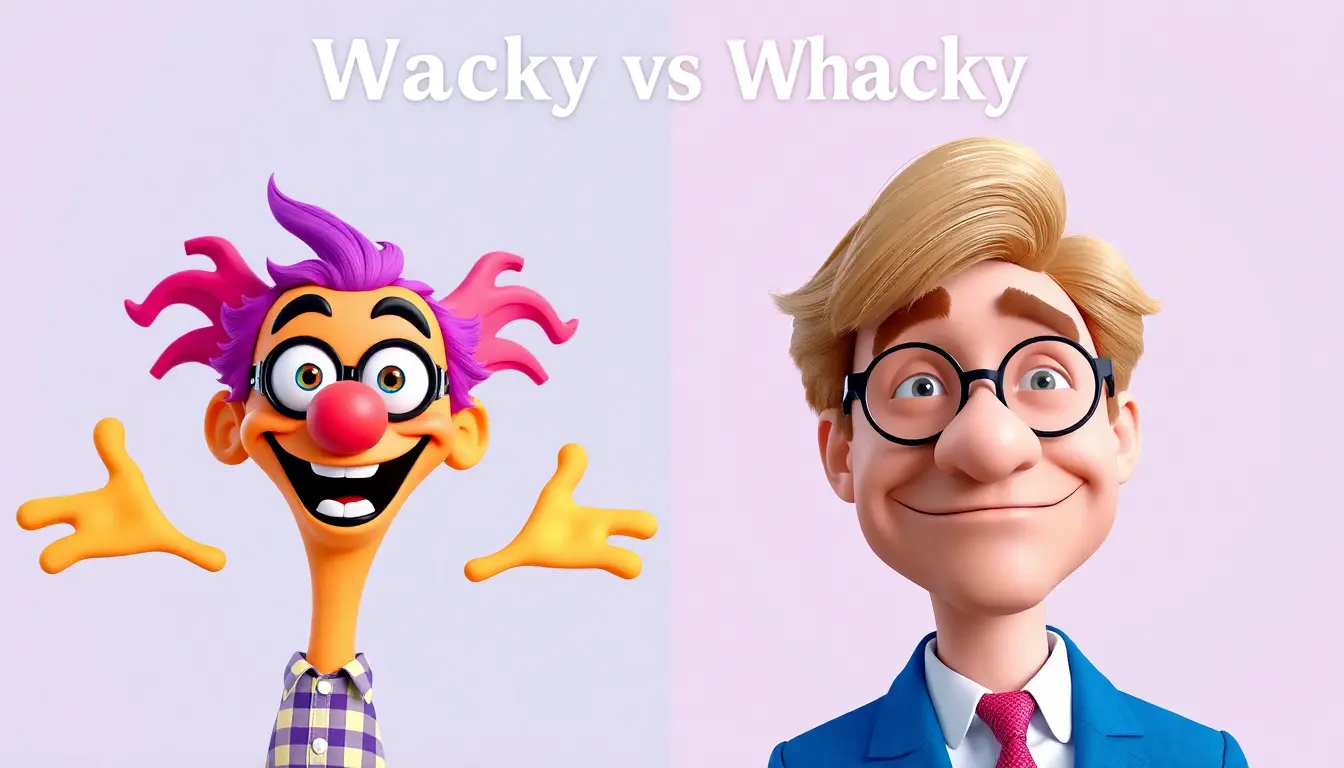
English can be tricky, especially when two words like wacky and whacky sound so similar but are used differently.
Whether you’re writing a playful article or crafting a fun piece of dialogue, knowing when and how to use these words correctly is crucial.
In this guide, we will clarify the difference, show real-world examples, and offer expert tips to help you master these words.
Quick Answer
Wacky is the preferred spelling, meaning quirky, strange, or out of the ordinary. Whacky is a less common, alternative spelling that some people mistakenly use, but it’s considered incorrect by most dictionaries.
Wacky vs Whacky Comparison Table
| Word | Correct/Incorrect | Meaning | Usage Context |
| Wacky | Correct | Quirky, strange, or silly | “That was a wacky party!” |
| Whacky | Incorrect | Intended meaning of “wacky.” | Avoid this spelling in formal writing |
Meaning of Each Word
- Wacky: An adjective used to describe something odd, unusual, or eccentric. It’s often used to describe behavior or things that are out of the ordinary in a humorous or light-hearted way.
Example: He wore a wacky hat to the party. - Whacky: This is simply a common misspelling of “wacky.” While it’s occasionally used informally, it doesn’t appear in most dictionaries and is considered an error in formal writing.
Incorrect Example: She has such a whacky sense of humor.
Grammar Rule Explained
The word “wacky” has been the standard spelling in English for many decades. It’s widely accepted in dictionaries, style guides, and by editors. On the other hand, whacky is an informal variant; it is not standard and is often confused with the correct spelling.
Why does this happen?
- Whacky may seem like a natural variation due to the phonetic resemblance of the word’s pronunciation. However, wacky is the official, dictionary-approved spelling.
Tip: When in doubt, use wacky to avoid confusion or errors in formal or professional writing.
Example Sentences
That movie had some really wacky plot twists.
His wacky sense of humor made everyone laugh.
She wore a wacky outfit to the costume party.
The wacky idea of a flying car is becoming a reality.
I can’t believe how wacky the situation turned out to be!
They threw a wacky wedding reception with circus performers.
His wacky behavior always makes the office more fun.
She gave a wacky speech at the conference.
The comedian’s wacky jokes kept the crowd in stitches.
It’s a wacky world where anything is possible!
Common Mistakes People Make
- Using “whacky” instead of “wacky”: Many people use “whacky” when they mean “wacky,” but this is incorrect.
- Assuming “whacky” is a legitimate variant: While some might argue it sounds more phonetically accurate, wacky is the only correct spelling.
- Misplacing the adjective: “Wacky” is used to describe eccentric or strange things, but it should not be confused with terms like “whacky” in formal writing.
Easy Trick to Remember the Difference
A simple trick to remember is: If it’s about something odd or quirky, it’s “wacky”-the “a” makes it feel like something zany and fun, just like the word itself!
When to Use Each Word
- Use “wacky” when you want to describe something eccentric or funny.
Example: The clown wore a wacky red nose. - Avoid “whacky” in any formal writing, including academic papers, professional documents, or publications.
Correct: His wacky antics amused the crowd.
Quick Grammar Tip
Wacky is the only correct spelling for this term. Always double-check your writing, and if you’re unsure, stick to “wacky” to maintain clarity and professionalism.
People Also Ask
- What does wacky mean?
Wacky means quirky, eccentric, or unconventional, often in a humorous way.
- Is whacky a real word?
Whacky is not considered a standard word in the English language, though it’s sometimes mistakenly used as a variant of wacky.
- Can wacky describe a person?
Yes, a person can be described as “wacky” if their behavior is eccentric or unusual in a fun way.
- Why is wacky spelled with a ‘w’ and not ‘wh’?
The correct spelling of wacky comes from the word “whack,” which means to hit with force, symbolizing the striking nature of eccentricity.
FAQs
- Can I use whacky in casual conversation?
While it might be understood in casual speech, it’s best to avoid using “whacky” in writing or formal contexts.
- Why do people spell wacky as whacky?
Some people mistakenly spell “wacky” as “whacky” due to phonetic similarity, but it’s an incorrect variation.
- Are there other words like this in English?
Yes! Words like “color” vs. “colour,” and “realize” vs. “realise” often lead to similar confusion. - Can wacky be used for things other than people?
Absolutely! Wacky can describe anything from ideas to situations, not just people.
- Does wacky always have a humorous meaning?
Yes, wacky usually conveys something odd in a humorous or light-hearted way.
Related Grammar Mistakes
Pro Writing Tips
- Consistency is key: Stick to the correct spelling of “wacky” throughout your writing to avoid confusion.
- Context matters: When describing something eccentric or offbeat, wacky adds a playful tone. Use it carefully to ensure your meaning is clear and fun.
- Proofread: Always double-check your writing for spelling mistakes. Tools like Grammarly or Hemingway can help catch these errors.
Final Summary
While wacky is the correct spelling to describe eccentric or quirky things, whacky is an informal misspelling that should be avoided in formal writing. By understanding when and how to use wacky, you can make your writing more fun, engaging, and accurate. Remember to always use wacky in your next playful sentence and make your writing stand out with proper grammar!