
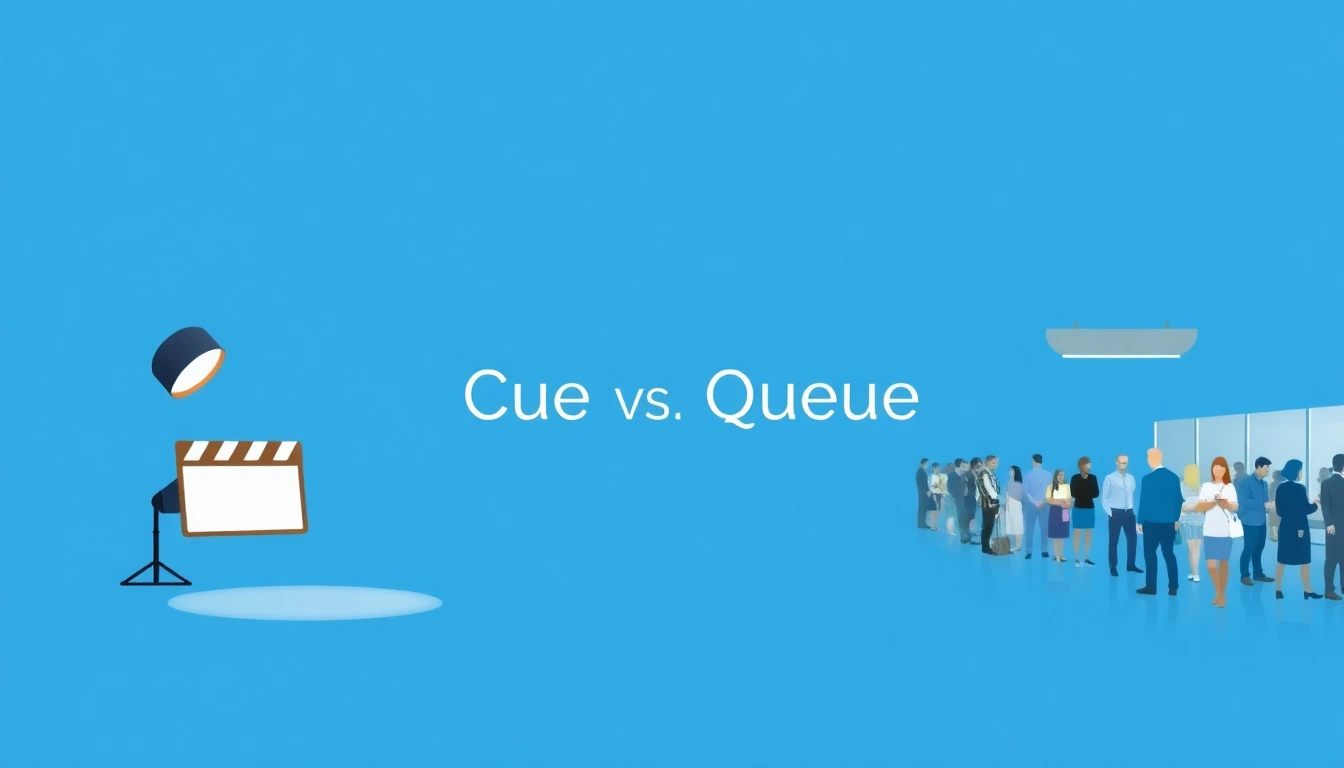
Cue and queue may look similar, but their meanings and uses are quite different. In English, these two words are often confused due to their similar spelling and pronunciation. However, understanding when to use each can elevate your writing and communication.
Whether you’re preparing for an exam, writing an email, or just trying to improve your language skills, knowing the difference between “cue” and “queue” will help you sound more fluent and professional.
In this article, we’ll dive into the correct usage, meaning, and common mistakes associated with these two words, offering you tips and tricks to remember their differences. Let’s clarify the confusion once and for all!
Quick Answer
- Cue refers to a signal or prompt for an action, typically in a performance or interaction (e.g., the director gave the cue to start the play).
- Queue refers to a line or sequence, often for waiting or organizing (e.g., people were waiting in the queue for tickets).
Comparison Table
| Word | Correct/Incorrect | Meaning | Usage Context |
| Cue | Correct | A signal or prompt for action | Used in performances, signals, and instructions |
| Queue | Correct | A line or sequence of people or things | Used when referring to a waiting line or sequence |
Meaning of Each Word
Cue
- Definition: A cue is typically a signal or prompt to start or do something. It can also refer to a hint or reminder, often in theatrical, musical, or everyday settings.
- Example: The stage manager gave the actor a cue to begin their lines.
Queue
- Definition: A queue refers to a line or sequence of people or things arranged in a particular order. It is often used when describing people waiting for their turn or to refer to a list of tasks in a specific order.
- Example: People are standing in a long queue outside the cinema.
Grammar Rule Explained
The word cue is most often used as a noun to describe a signal or reminder, especially in performances like theater or music. It can also be used as a verb, meaning to prompt someone to begin or act in a certain way.
Queue, on the other hand, is generally used as a noun to describe a line of people or things. It can also be used as a verb, meaning to arrange things in a line or to wait in a line.
Key Differences:
- Cue is for signals and prompts.
- Queue is for waiting in line or organizing in sequence.
Example Sentences
Cue:
The orchestra is waiting for the conductor’s cue to begin playing.
She gave me a subtle cue to stop talking during the meeting.
The director called for the actor’s cue on stage.
I missed my cue and started talking too early.
As soon as I saw his cue, I entered the room.
Queue:
There was a long queue at the coffee shop this morning.
They had to wait in the queue for over an hour to get tickets.
Please stand in the queue to check out at the supermarket.
People are always queuing outside the bakery for fresh bread.
The tasks are listed in a queue for you to complete one by one.
Common Mistakes People Make
- Mixing up cue and queue when referring to waiting in line (e.g., “I’m standing in the cue” should be “queue”).
- Using queue in situations where a signal or prompt is required (e.g., “Give me a queue” instead of “Give me a cue”).
- Using cue to describe a line of people or things.
Easy Trick to Remember the Difference
Here’s a simple memory hack:
- Think of cue as something you “cue” up in a show or event – it’s a signal for action.
- Think of queue as a line of people waiting for something, and it has more letters, just like a longer line.
When to Use Each Word
Use cue:
- When referring to a signal or prompt.
- In contexts like music, theater, or public speaking.
- When instructing or guiding actions (e.g., “I’ll give you the cue to speak”).
Use queue:
- When talking about a line of people or things.
- When arranging things in a sequence (e.g., “The files are queued for processing”).
- When referring to waiting in line (e.g., “I had to wait in the queue”).
Quick Grammar Tip
Cue is related to prompting an action, while queue refers to waiting in line. Remember, queue has more letters, just like a longer line!
People Also Ask
1. What is the difference between cue and queue?
Cue refers to a signal or prompt for an action, while queue refers to a line or sequence of things.
2. Is it “queuing” or “cueing”?
“Queuing” is correct when referring to standing in line, while “cueing” refers to giving a signal or prompt.
3. Can queue be used as a verb?
Yes, “queue” can be used as a verb, meaning to line up or arrange in order.
4. How do you use cue in a sentence?
Example: “The actor waited for his cue to enter the stage.”
5. How do you remember the difference between cue and queue?
Think of queue as a long line, and cue as a signal to act.
FAQs
1. What’s the best way to remember the difference between cue and queue?
Cue is for prompts and signals, while queue is for lines of people or things. One has more letters, just like a longer line.
2. Can I use “cue” when talking about a waiting line?
No, “cue” refers to a prompt or signal. Use “queue” when talking about a line of people.
3. Is “queueing” a correct word?
Yes, “queueing” is the correct form when referring to standing in line.
4. What is a “cue” in the context of theater?
In theater, a cue is a signal for an actor or crew member to start performing an action.
5. Can “queue” be used in a non-literal sense?
Yes, you can use “queue” metaphorically to refer to a sequence or order of events.
Related Grammar Mistakes
Pro Writing Tips
- Always proofread your work to catch mistakes like using cue instead of queue or vice versa.
- If you’re ever unsure, ask yourself if you’re referring to a line of people or a signal to begin something.
- Keep your language clean and precise to avoid common spelling and grammar issues.
Final Summary
In conclusion, the difference between cue and queue is simple once you understand the context. Cue is for prompts and signals, while queue refers to a line or sequence. By remembering the simple tricks and using the words correctly, you’ll not only avoid errors but also elevate your writing to a more professional level.