
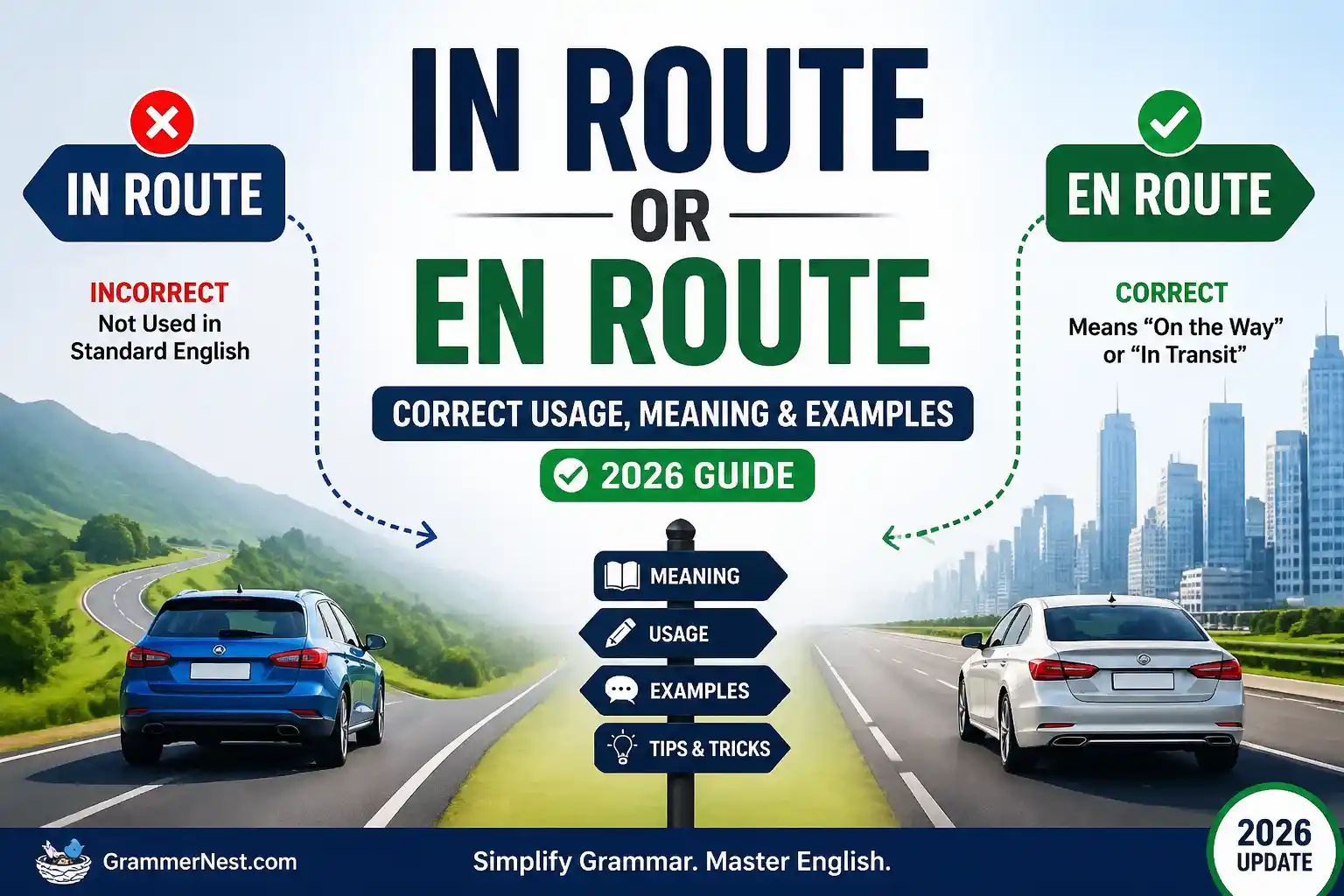
If you’ve ever been confused about whether to say “in route” or “en route”, you’re not alone. These two phrases are often used interchangeably, but one of them is more grammatically correct than the other.
Understanding the difference between them is essential, especially in formal writing and speech. Whether you’re traveling, giving directions, or writing an article, using the right phrase can help you sound more professional and polished.
Let’s break down the difference and explore the proper usage of each.
Quick Answer
- En Route is the correct phrase, meaning “on the way” or “in transit.”
- In Route is an incorrect variant, and although some people use it, it is not grammatically accepted.
Comparison Table
| Word | Correct/Incorrect | Meaning | Usage Context |
| En Route | Correct | On the way, in transit | Used to describe being in the process of traveling or on the way to a destination. |
| In Route | Incorrect | Not accepted grammatically | A commonly misused variant, not considered proper grammar. |
Meaning of Each Word
- En Route (French for “on the way”) is used to indicate that someone or something is in transit or on their way to a destination.
- Example: “The package is en route to your home.”
- In Route is a mistaken variation. Though often heard in conversation, it doesn’t hold up grammatically. The correct form is en route.
Grammar Rule Explained
The phrase en route comes from French, where “en” means “on” and “route” means “way” or “road.” This makes “en route” the correct expression for referring to someone or something that is currently traveling or heading to a destination.
In route is not a grammatically correct expression in English. Despite this, people occasionally use “in route” instead of “en route,” which grammar experts consider a mistake.
Example Sentences
The delivery truck is en route to the warehouse.
She is en route to the airport for her flight.
The doctor is en route to the hospital for the emergency.
My package is en route to the address provided.
He is en route to meet his friends for dinner.
The shipment will arrive en route by noon.
I’m en route to the store; I’ll be there in 10 minutes.
The bus is en route to the station.
They are currently en route to the event.
I am en route to pick up my daughter from school.
Common Mistakes People Make
- Using in route instead of en route.
- Saying “I’ll be in route to the airport” instead of “I’ll be en route to the airport.”
- Misunderstanding the origin of the phrase and using it incorrectly in formal writing.
Easy Trick to Remember the Difference
To help remember, think of the French “en” meaning “on.” En route literally translates to “on the way,” which makes sense when describing transit. Simply remember: “En = On,” and “in” doesn’t fit in the phrase.
When to Use Each Word
- En Route: Use it when you want to describe someone or something that is on the way to a destination. For example, use it in everyday conversation, emails, or business correspondence when referring to travel or delivery.
- Correct: “The package is en route and should arrive by tomorrow.”
- In Route: Avoid using in route at all, as it is grammatically incorrect.
- Incorrect: “The truck is in route to the warehouse.”
Quick Grammar Tip
En route is a phrase borrowed from French. It is used to indicate that something or someone is currently on the way to a destination. Keep this in mind to avoid confusing your audience.
People Also Ask
Q: Is it correct to say “in route”?
No, the correct phrase is “en route.” “In route” is considered incorrect.
Q: What does “en route” mean?
“En route” means “on the way” or “in transit.” It describes something or someone heading towards a destination.
Q: Can I use “in route” in casual speech?
While some people may use “in route” in informal settings, it is grammatically incorrect. Always use “en route” in formal and written contexts.
Q: How do you use “en route” in a sentence?
Example: “The shipment is en route and will arrive tomorrow.”
FAQs
Q: Can “en route” be used in formal writing?
Yes, “en route” is widely accepted in both formal and informal writing.
Q: Why do people say “in route” instead of “en route”?
“In route” is a common mistake. People may be influenced by other expressions, but “en route” is the correct form.
Q: Where did the phrase “en route” come from?
The phrase “en route” originates from French, where “en” means “on” and “route” means “way.”
Q: Is it okay to use “in route” in casual conversations?
While some might say “in route” casually, it is not correct. It’s best to use “en route” for clarity.
Q: How do you pronounce “en route”?
“En route” is pronounced as “ahn root.” It’s important to pronounce it correctly, especially in formal settings.
Related Grammar Mistakes
Pro Writing Tips
- Use en route when describing something or someone traveling. It’s a formal and correct expression used in both written and spoken English.
- Avoid using “in route” as it’s a grammatical error. Stay consistent with en route for professional communication.
Final Summary
Understanding the difference between en route and in route is crucial for clear and correct communication. While en route is grammatically accepted and commonly used, in route is a mistake that should be avoided. Remember, en route means “on the way,” and it’s borrowed from French. By following this guide, you’ll always use the correct phrase and sound like a grammar expert.