
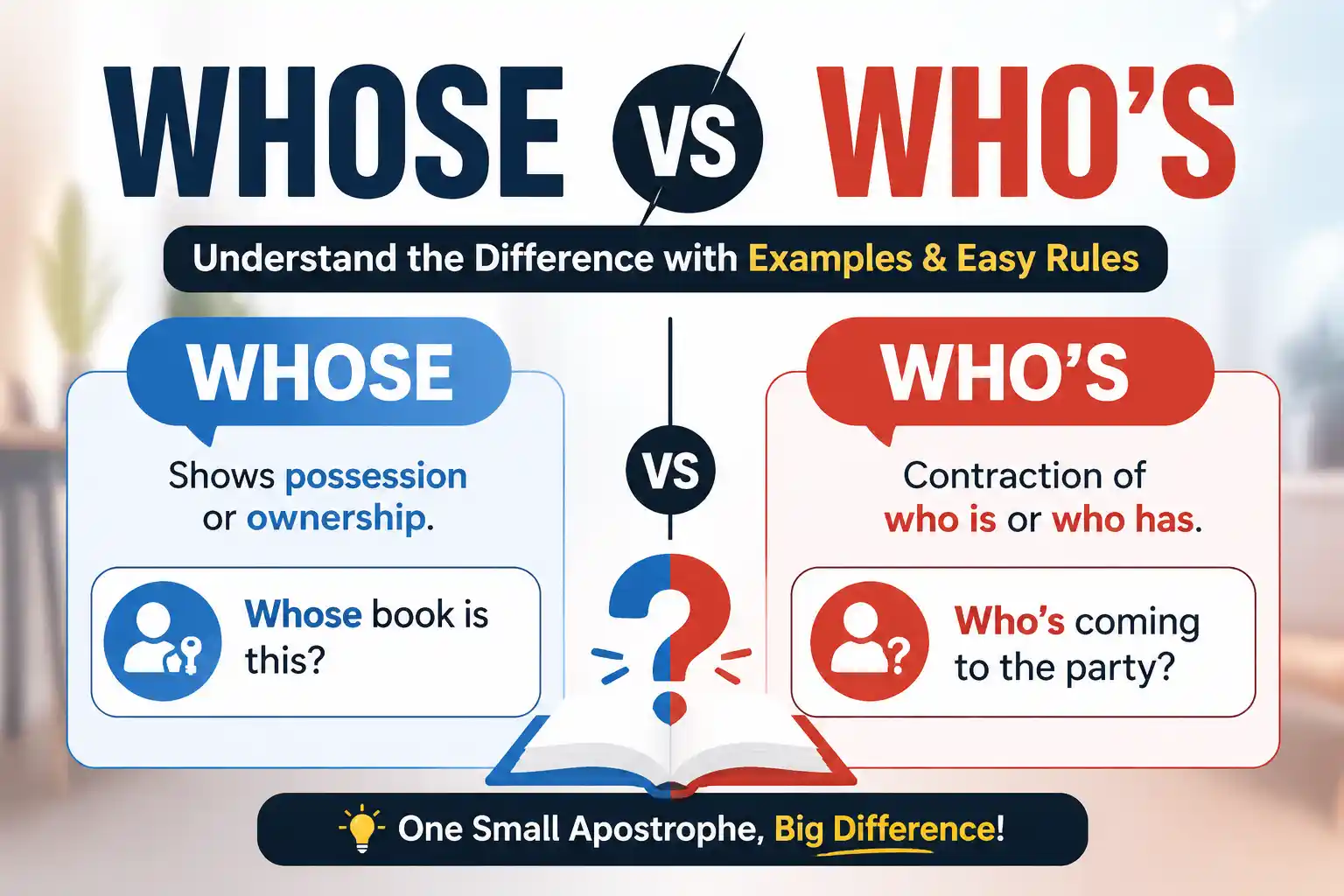
The confusion between “whose” and “who’s” is one of the most common grammar mistakes, especially among beginners.
While they may sound the same, they serve different purposes in the English language.
In this comprehensive guide, we will clear up this confusion once and for all, providing you with clear explanations, real-life examples, and tips to avoid this error in your writing and speech.
Quick Answer
- Whose is a possessive pronoun, showing ownership or association (e.g., Whose book is this?).
- Who’s is a contraction of who is or who has (e.g., Who’s going to the party?).
Comparison Table
| Word | Correct/Incorrect | Meaning | Usage Context |
| Whose | Correct | Possessive (shows ownership or relation) | Whose coat is this? |
| Who’s | Correct | Contraction of who is or who has | Who’s coming to dinner? |
Meaning of Each Word
Whose: Possessive Pronoun
“Whose” indicates possession or a relationship. It asks about ownership, origin, or a connection to something. For example:
- Whose car is parked outside? (Asking about ownership)
- Whose idea was it to visit the museum? (Asking about the origin of an idea)
Who’s: Contraction of “Who is” or “Who has”
“Who’s” is a contraction of the words “who is” or “who has.” It’s used in questions and statements:
- Who’s coming to the party? (Who is coming?)
- Who’s got the keys? (Who has got the keys?)
Grammar Rule Explained
Whose:
- Use it to show possession or association.
- It functions as an adjective in a sentence, typically modifying a noun.
- Example: “Whose pen is this?” (The pen belongs to someone.)
Who’s:
- Use it as a contraction for “who is” or “who has.”
- It can be used in a question or statement.
- Example: “Who’s ready to go?” (Who is ready to go?)
Example Sentences
Whose:
Whose shoes are these?
I met a woman whose name I forgot.
Whose turn is it to speak?
Whose book did you borrow?
Do you know whose idea it was to start this project?
Who’s:
Who’s the best player on the team?
Who’s coming to the concert tonight?
Who’s been eating all the cookies?
Who’s at the door?
Who’s ready for a challenge?
Common Mistakes People Make
- Confusing whose with who’s in questions: Who’s car is this? → Incorrect. It should be Whose car is this?.
- Confusing who’s with whose in possessive statements: Whose coming to the party? → Incorrect. It should be Who’s coming to the party?.
Easy Trick to Remember the Difference
- Whose is used for possession. Think of the “s” in “whose” as indicating something belongs to someone.
- Who’s is short for “who is” or “who has”. If you can replace it with either “is” or “has,” it’s who’s.
When to Use Each Word
- Use “whose” when asking about ownership or association:
- Whose dog is barking?
- Use “who’s” when asking about someone’s identity or action:
- Who’s your favorite actor?
Quick Grammar Tip
Remember, if you can expand who’s into “who is” or “who has,” it’s the contraction form. If not, you likely need “whose” for possession.
People Also Ask
- What’s the difference between “whose” and “who’s”?
- “Whose” is a possessive pronoun, while “who’s” is a contraction of “who is” or “who has.”
- Is “who’s” always a contraction?
- Yes, “who’s” is always a contraction of “who is” or “who has.”
- Can I use “who’s” for possession?
- No, for possession, use “whose.”
- What are some examples of “whose” in a sentence?
- “Whose coat is this?” and “I don’t know whose car that is.”
FAQs
- Can “who’s” be used to show possession?
- No, use “whose” for possession.
- Is it correct to say “Who’s going to the store?”
- Yes, “who’s” is correct because it’s short for “who is.”
- What’s the best way to remember when to use “whose”?
- Associate “whose” with ownership or relationships. Ask, “Who does this belong to?”
- Can “who’s” mean “whose”?
- No, “who’s” is a contraction for “who is” or “who has,” while “whose” shows possession.
- What are the most common mistakes with “whose” and “who’s”?
- The most common mistake is using “who’s” when you mean “whose” in possessive contexts.
Related Grammar Mistakes
Pro Writing Tips
- Be careful with contractions in formal writing. While “who’s” is correct for informal communication, use the full form (“who is” or “who has”) in more formal settings.
- Always proofread your writing to ensure you’re using the correct word for its intended purpose.
Final Summary
Understanding the difference between “whose” and “who’s” is crucial for mastering English grammar. By remembering the simple rules, whose for possession and who’s as a contraction of “who is” or “who has”-you can easily avoid common mistakes. Practice with real-life examples, and soon, using these correctly will become second nature.