Either Fallacy – Meaning, Examples & Grammar Guide (2026)
Either or Fallacy

Have you ever been faced with a choice that seemed limited to just two options and thought it was a grammar rule or a logic rule? That’s where the Either-or Fallacy comes in. Many people confuse this concept because it sounds simple: “either this or that.” However, it’s not just about choices-it’s about faulty reasoning. … Read more
Who vs Whom – Correct Usage, Rules & Examples (2026)

who vs whom

English learners and even native speakers often get confused between who and whom. Both words refer to people, but using them incorrectly can make sentences sound unprofessional or awkward. Many avoid whom altogether because its rules feel outdated or complicated. In this guide, we’ll simplify the difference, provide clear rules, practical examples, and memory tricks … Read more

Who vs Whom Trick – Easy Grammar Guide & Examples (2026)

who vs whom trick

Many English learners-and even native speakers-struggle with “who” vs “whom”. It’s a common grammar challenge because both words refer to people, but their roles in a sentence differ. Choosing the wrong word can make your writing or speech sound unpolished or overly formal. In this guide, we’ll break down the who vs whom trick, explain … Read more

Compliment vs Complement – Meaning, Rules & Examples (2026 Guide)

compliment-vs-complement

English learners often confuse compliment and complement because these words sound similar but have very different meanings. One deals with praise, while the other focuses on completing or enhancing something. Even experienced writers sometimes mix them up.  Understanding the difference is essential to avoid embarrassing mistakes in writing or conversation. In this guide, we’ll break … Read more

Loose or Lose – Correct Usage, Meaning & Examples (2026)

Loose or Lose

Many English learners and writers often confuse loose and lose, even though their meanings are quite different.  Misusing these words can make your writing look unprofessional.  This guide explains the difference clearly, with examples, grammar rules, and easy tips to remember them. Quick Answer  Comparison Table Word Correct or Incorrect Meaning Loose Correct Not tight, … Read more

Mistakingly or Mistakenly – Correct Spelling, Meaning & Examples (2026 Guide)

Mistakingly or Mistakenly

Many English learners and even native speakers often struggle with similar-looking words like “mistakingly” and “mistakenly.”  This confusion arises because the words look almost identical and both relate to errors or wrong actions.  Understanding which one is correct can improve your writing, make you sound professional, and help you avoid common mistakes in essays, emails, … Read more

A Hour or An Hour – Correct Usage, Grammar & Examples (2026 Guide)

A Hour or An Hour

Many English learners and even native speakers often stumble over “a hour” and “an hour.” At first glance, it might seem simple-just choose one article-but there’s a subtle grammar rule that can make the difference between correct and incorrect usage.  Understanding this will improve your writing, speaking, and exam performance. In this guide, we’ll break … Read more

Cringy or Cringey – Correct Spelling, Meaning & Examples (2026 Guide)

Cringy or Cringey

English spelling can sometimes be confusing, especially when two versions of the same word appear online. A good example is “cringy” vs “cringey.” You may have seen both spellings used on social media, blogs, and even in casual writing. Because both look correct, many people wonder which spelling they should actually use. This confusion happens … Read more

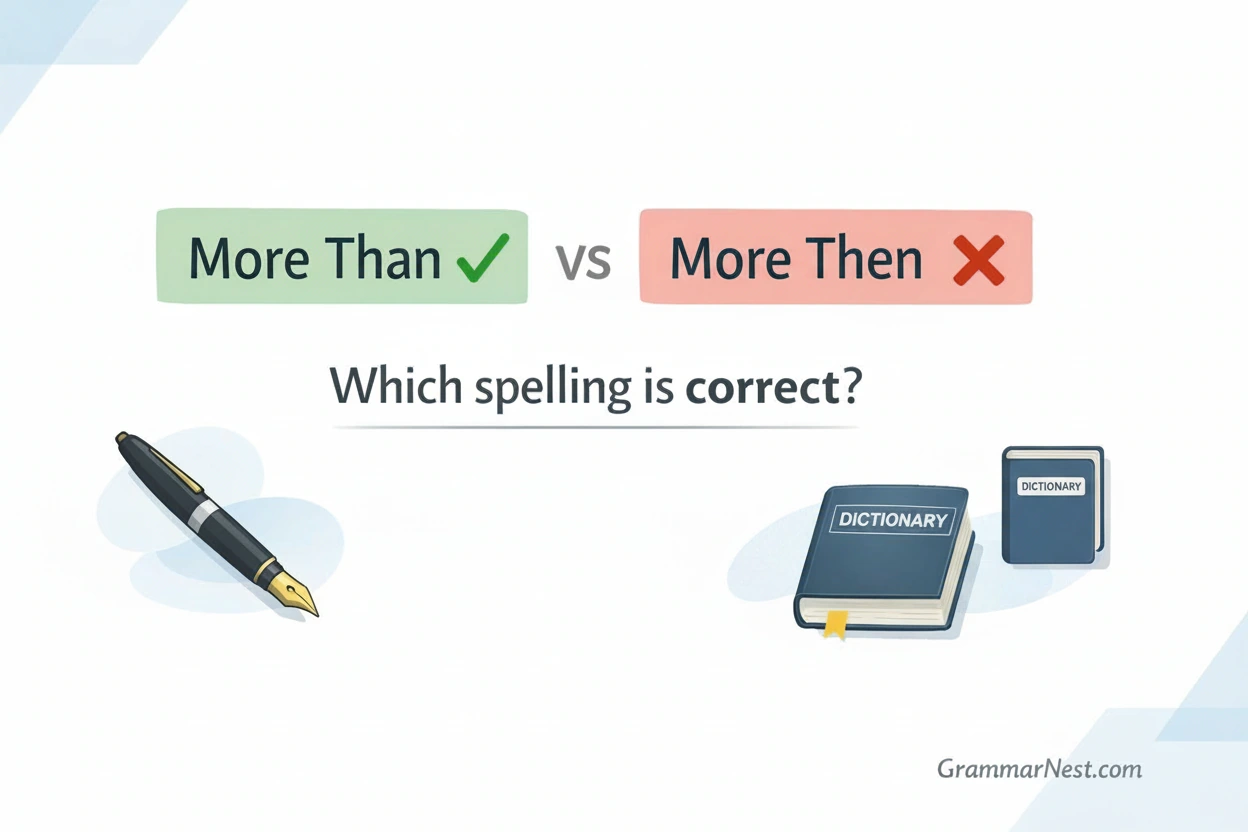
More Then or More Than – Correct Usage, Meaning & Examples (2026 Guide)

More Then or More Than

English learners and even native speakers sometimes confuse “More Then” and “More Than.” The reason is simple: the words “then” and “than” sound similar when spoken quickly. Because of this pronunciation similarity, many people accidentally write “more then” instead of the correct phrase “more than.” However, from a grammar perspective, these two words serve completely … Read more

Authorizing or Authorising – Correct Usage, Rules, Examples & Common Mistakes 2026 Guide

authorizing or authorising

English spelling can sometimes feel confusing, especially when words have more than one correct form. One common question learners ask is whether authorizing or authorising is the correct spelling. Both versions actually exist in English, but they belong to different spelling systems. Understanding when to use each spelling can improve your writing, especially in professional, … Read more