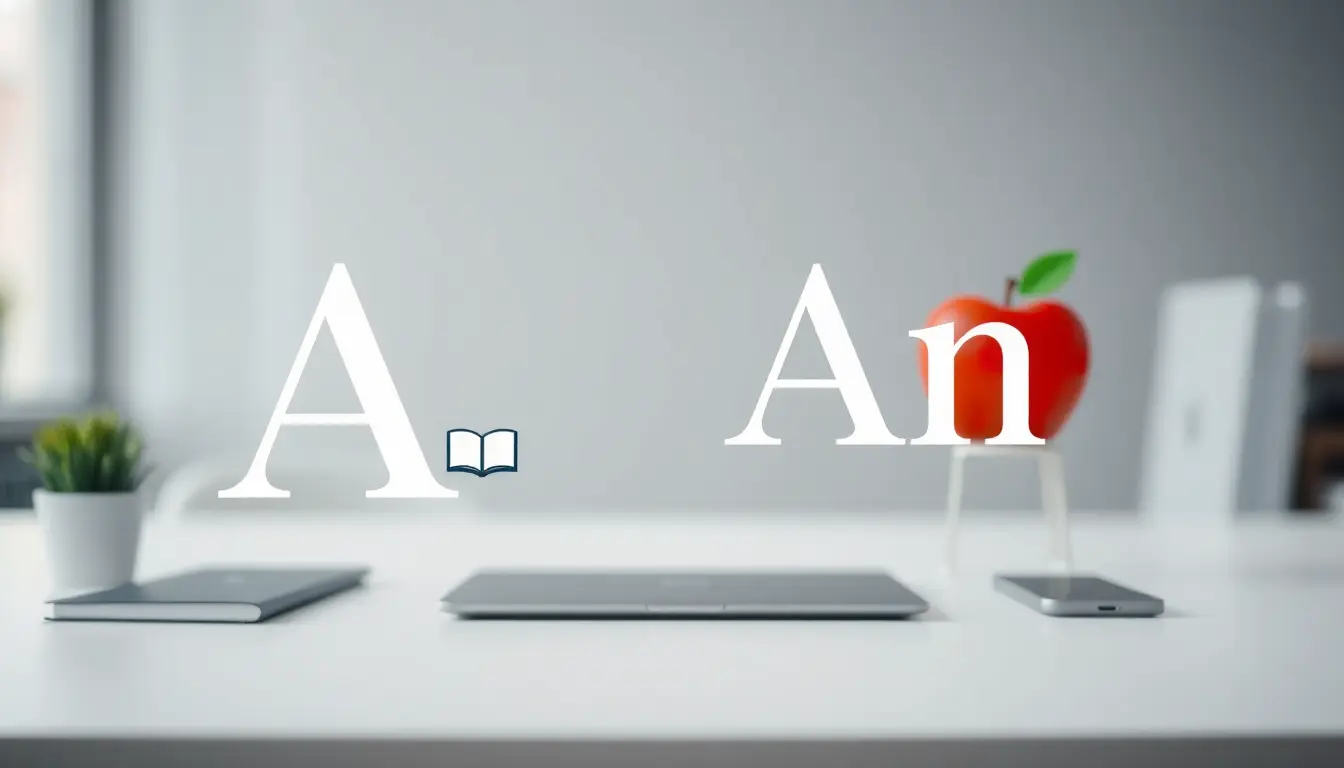
When it comes to the simplest and most common words in the English language, “an” and “a” are often confused.
You might find yourself asking, “When do I use ‘a ‘ or ‘an ‘?” Whether you’re writing an essay, speaking in casual conversations, or preparing for exams, using these articles correctly is essential for sounding fluent and clear.
In this article, we’ll explore the difference between “an” and “a” and give you easy tricks to remember which one to use.
Quick Answer
The rule is simple:
- Use “an” before vowel sounds (e.g., “an apple”, “an hour”).
- Use “a” before consonant sounds (e.g., “a dog”, “a university”).
Knowing this rule helps prevent common mistakes!
Comparison Table
| Word | Correct/Incorrect | Meaning | Usage Context |
| An | Correct | Used before vowel sounds | An apple, an hour |
| A | Correct | Used before consonant sounds | A dog, A university |
Meaning of Each Word
- A: “A” is used when the next word starts with a consonant sound. It’s the most commonly used indefinite article.
- Example: “I saw a cat.”
- An: “An” is used when the next word starts with a vowel sound (a, e, i, o, u). It’s important to note that “an” depends on the sound, not the letter.
- Example: “She has an umbrella.”
Grammar Rule Explained
The main rule is simple:
- “A” is used before words that begin with a consonant sound.
- “An” is used before words that begin with a vowel sound.
Keep in mind that vowel sounds are not always the vowels (a, e, i, o, u) themselves. For example, “university” begins with a “y” sound, a consonant sound, so it uses “a” (i.e., a university).
Example Sentences
- “A”:
- I bought a car yesterday.
- She is a teacher at my school.
- He adopted a dog from the shelter.
- “An”:
- I saw an eagle flying high.
- An hour passed before I got home.
- She is an amazing singer.
Common Mistakes People Make
- Using “an” before words that start with a consonant sound (e.g., “an university”).
- Using “a” before words that start with a vowel sound (e.g., “a apple”).
Easy Trick to Remember the Difference
- “An” is used before vowel sounds, which are usually open sounds like a, e, i, o, and u.
- “A” is used before everything else, particularly consonant sounds.
- Memory hack: Think of “an” as the “open” article for open sounds, and “a” as the “closed” article for the rest.
When to Use Each Word
- “A”: Use it when you can hear a consonant sound at the beginning of the next word.
- Example: “I need a book.”
- “An”: Use it when you can hear a vowel sound at the beginning of the next word.
- Example: “I want an apple.”
Quick Grammar Tip
Remember: It’s not about the letter that starts the word, but the sound. For example, “honor” starts with “h”, a consonant letter, but the “h” is silent, so it takes “an” (e.g., an honor).
People Also Ask
- When do I use “a” vs “an”?
- “A” is used before consonant sounds, and “an” is used before vowel sounds.
- Can I say “an university”?
- No, you should say “a university” because “university” starts with a “y” consonant sound.
- Why is it “an” hour but “a house”?
- “Hour” starts with a silent “h,” which gives it a vowel sound, so it takes “an.” “House” starts with a hard “h,” which is a consonant sound, so it takes “a.”
- Can “a” and “an” be used with all nouns?
- Yes, they can be used with any singular, countable noun. Just make sure the word that follows has the correct sound.
FAQs
- How do I know whether to use “a” or “an”?
- It’s all about the sound of the following word. If it starts with a vowel sound, use “an”; otherwise, use “a”.
- Why do we use “an” before “hour” but “a” before “house”?
- “Hour” has a silent “h,” making it start with a vowel sound, so it takes “an.” “House” has a pronounced “h,” which is a consonant sound, so it takes “a.”
- Is “a” always correct before consonant sounds?
- Yes, as long as the following word starts with a consonant sound, “a” is the right choice.
- Can I say “a apple”?
- No, because “apple” starts with a vowel sound. It should be “an apple.”
- Does it matter if the word starts with a vowel letter but not a vowel sound?
- Yes! For example, “university” starts with a “u,” but it sounds like a “y,” a consonant sound, so it takes “a.”
Related Grammar Mistakes
Pro Writing Tips
- When writing, always double-check for proper article usage. It’s an easy mistake to make, but it can significantly affect the professionalism of your writing.
- Practice by reading your sentences aloud; this will help you hear whether the next word starts with a vowel or consonant sound.
Final Summary
Understanding the difference between “an” and “a” is a fundamental grammar rule that will improve both your writing and speaking. Just remember: use “an” before vowel sounds and “a” before consonant sounds. By mastering this, you’ll avoid common mistakes and sound much more natural in English.