
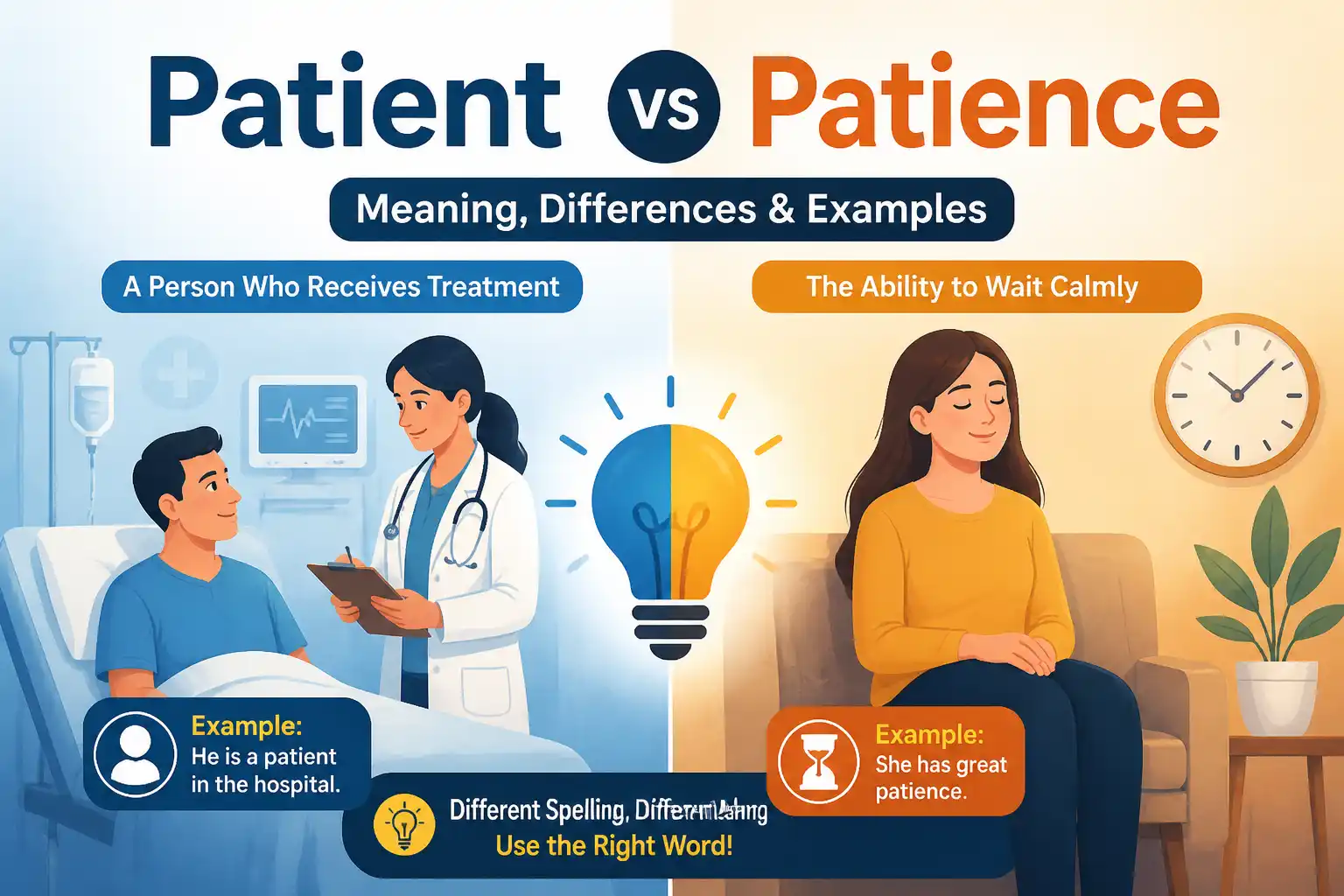
When it comes to understanding English vocabulary, patient and patience are often confused, even by native speakers.
The difference is subtle yet important, and mastering these two words will enhance both your written and spoken communication.
In this guide, we’ll break down their meanings, usage, and grammar rules, ensuring that you never mix them up again.
Quick Answer
- Patient: An adjective describing the ability to remain calm and endure without frustration. Example: She was very patient while waiting for her turn.
- Patience: A noun referring to the ability to wait calmly without getting angry. Example: He showed great patience when dealing with difficult customers.
Comparison Table
| Word | Correct/Incorrect | Meaning | Usage Context |
| Patient | Correct | Describes someone who can wait calmly. | She is a very patient teacher. |
| Patience | Correct | Refers to the ability to endure without frustration. | He had little patience for delays. |
| Patiently | Correct | The adverb form of patient, describing actions done calmly. | She waited patiently for the bus. |
Meaning of Each Word
Patient
The word patient is an adjective that describes someone who has the ability to wait calmly without becoming upset. It’s a quality that reflects tolerance and understanding, especially in situations where things take time or don’t go as planned.
- Example: Despite the long queue, she remained patient and did not complain.
Patience
Patience is a noun that refers to the capacity or ability to endure delays, problems, or suffering without becoming angry or upset. It’s a virtue often associated with remaining calm and composed in challenging situations.
- Example: Patience is required when working with children.
Grammar Rule Explained
The key difference between patient and patience lies in their parts of speech:
- Patient is an adjective. It describes a quality of a person or thing.
- Patience is a noun. It represents the concept or quality itself.
When speaking or writing, remember:
- An adjective describes a person or thing.
- Noun = Represents an idea or quality.
Example Sentences
The patient woman waited for hours without complaining.
She practiced patience in the face of adversity.
His patience with the children was commendable.
The doctor is patient when explaining the diagnosis to patients.
After waiting for a long time, I lost my patience.
To be a good teacher, you need to be both patient and empathetic.
You must have patience when learning a new skill.
The patient customer was the last one to leave.
My patience ran out when I was stuck in traffic for an hour.
He was patient enough to finish the project on time.
Common Mistakes People Make
- Confusing patient (adjective) with patience (noun).
Example: He showed patience in the queue (Incorrect).
Correct: He was patient in the queue. - Using patience when the patient is required to describe someone’s quality.
Example: She is full of patience (Incorrect).
Correct: She is a patient person. - Overusing patience when the patient should describe how someone acts.
Example: He waited with patience (Incorrect).
Correct: He waited patiently.
Easy Trick to Remember the Difference
- Patient = You can wait patiently.
- Patience = You need patience to wait.
A simple trick is to link the patient with the ability to act calmly, and patience with the concept of waiting.
When to Use Each Word
- Use patient when describing a person or how someone behaves in a situation.
Example: He was patient during the meeting. - Use patience when referring to the quality or virtue itself.
Example: Patience is a valuable trait in a teacher.
Quick Grammar Tip
Quick Tip: Always remember that patient is an adjective (describes someone), while patience is a noun (refers to the quality). If you’re unsure, think: Can I add “very” before it? If yes, it’s likely an adjective (e.g., very patient).
People Also Ask
1. What is the difference between patient and patience?
- Patient is an adjective describing someone’s ability to wait calmly, while patience is a noun referring to the capacity to endure waiting without frustration.
2. Can patience be used as an adjective?
- No, patience is a noun. The adjective form is patient.
3. How can I remember the difference between patience and patient?
- Patient describes a person, while patience refers to the concept of calmly enduring delays.
4. What does “patience is a virtue” mean?
- It means that the ability to wait calmly and without frustration is a valuable quality.
FAQs
1. Is “patience” the opposite of “impatience”?
Yes, patience is the opposite of impatience, which refers to the inability to wait calmly.
2. Can someone be too patient?
While patience is generally a virtue, being overly patient in certain situations might mean not asserting yourself when necessary.
3. What is the best way to practice patience?
To practice patience, try mindfulness exercises, such as deep breathing or meditation, to stay calm during stressful situations.
4. Can you be patient without having patience?
Being patient requires the quality of patience, so it’s a bit of a paradox!
5. Does “patient” only refer to a person?
While it usually refers to a person, a patient can also describe a calm and enduring situation or thing. For example, the patient’s wait was worth it.
Related Grammar Mistakes
Explore more on these grammar topics to polish your writing further.
Pro Writing Tips
- When writing formal content, such as essays or business emails, choose the right word based on its role in the sentence. Use patient to describe someone’s demeanor and patience when talking about their virtue or quality.
- Always double-check the part of speech: adjective (patient) or noun (patience).
Final Summary
In conclusion, the difference between patient and patience boils down to their parts of speech. Patient is an adjective that describes a person’s ability to endure, while patience is a noun representing the quality of calm endurance. By understanding these distinctions and practicing their usage in context, you can significantly improve your writing and communication skills.
1 thought on “Patient vs Patience – Key Differences, Examples & Grammar Rules (2026)”