Farther vs Further – Correct Spelling, Meaning & Examples (2026)
Farther or Further

The words farther and further often confuse even seasoned writers.  Though their meanings overlap, each has its specific usage.  In this guide, we’ll break down the difference between the two words, explain when to use each, and provide practical examples and grammar rules to help you get it right. Quick Answer Comparison Table Word Correct … Read more

Preform vs Perform – Correct Usage, Meaning, and Examples (2026)

Preform or Perform

The English language can be tricky when it comes to similar-sounding words, and “preform” and “perform” are prime examples of this.  Many people are unsure about when to use one word over the other, often mixing them up in their writing.  In this guide, we’ll explore the differences between preform and perform, helping you understand … Read more

Winner vs Winer – Correct Spelling, Meaning & Examples (2026 Guide)

Winner or Winer

The words “winner” and “winer” may sound similar, but they have very different meanings and uses in English.  People often mix them up because of their close pronunciation, but understanding the difference is crucial for clear communication. “Winner” is a common word, whereas “winer” is an uncommon and rarely used term. However, it’s still important … Read more

Life vs Lives – Correct Usage, Meaning & Examples (2026)

Life or Lives

The confusion between “life” and “lives” stems from the fact that they are both nouns referring to existence, but they have different grammatical rules.  “Life” is used when referring to the existence of a single person, animal, or thing, while “lives” is the plural form of “life” and refers to multiple existences or lifetimes. Let’s … Read more

Alot vs A Lot – Correct Usage, Meaning & Examples (2026)

Alot or A Lot

When it comes to writing, one common mistake that confuses many people is choosing between “alot” and “a lot.” Despite its frequent use, “alot” is actually incorrect, while “a lot” is the proper form. This confusion stems from the fact that “alot” has been commonly seen in informal writing and speech. In this guide, we’ll … Read more

Donut vs Doughnut – Correct Spelling, Meaning & Examples (2026)

Donut vs Doughnut

The difference between “donut” and “doughnut” has been a topic of confusion for many.  While both spellings refer to the same sweet, ring-shaped pastry, knowing when and how to use them correctly can improve your writing and communication.  In this guide, we’ll explore the differences between the two, their meanings, grammar rules, and common mistakes. … Read more

Sheath or Sheathe – Correct Usage, Meaning & Examples (2026)

Sheath or Sheathe

Many English learners and even native speakers get confused between “sheath” and “sheathe.” At first glance, they look almost identical-just one extra “e” at the end-but their meanings and usage are completely different. This confusion happens because: But here’s the truth: one is a noun, and the other is a verb. Understanding this simple difference … Read more

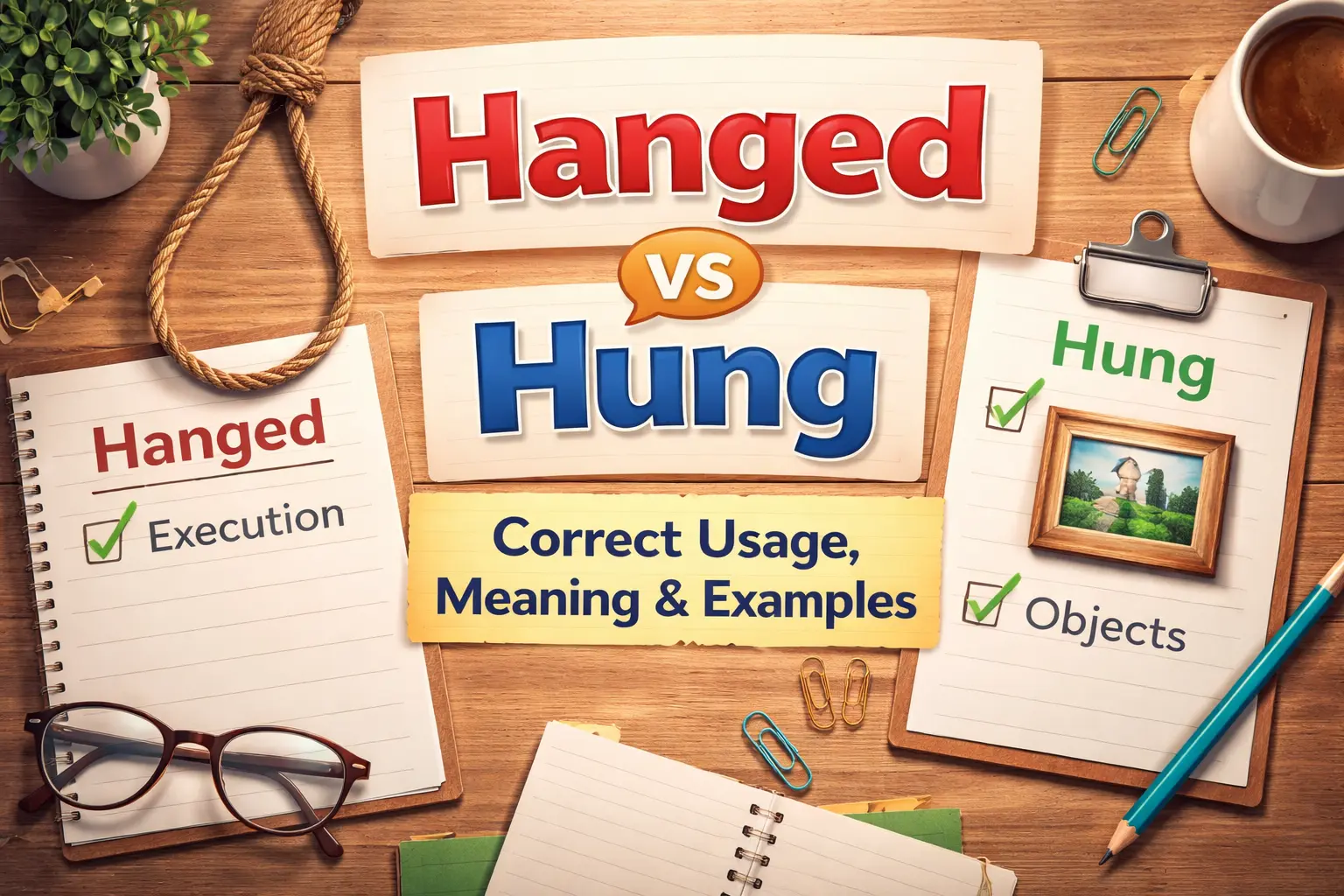
Hanged vs Hung – Correct Usage, Meaning & Examples (2026)

Hanged vs Hung

The confusion between “hanged vs hung” is one of the most common grammar mistakes in English. Both words come from the same verb – hang – which makes things even more tricky. Many learners (and even native speakers) use these words interchangeably. But here’s the catch: they are NOT always interchangeable. Understanding the difference is … Read more

Peek vs Peak – Meaning, Difference & Examples (2026)

Peek vs Peak

Many English learners-and even native speakers-often confuse peek vs peak. The reason is simple: both words sound the same. These are called homophones, meaning they share the same pronunciation but have different meanings and spellings. Because they sound identical, it’s easy to mix them up in writing. But using the wrong word can completely change … Read more

Colon vs Semicolon – Correct Usage, Rules & Examples (2026)

Colon vs Semicolon

Many English learners (and even native speakers) get confused between a colon vs semicolon. Both punctuation marks look similar and are used to connect ideas, but they serve very different purposes. A colon (:) often introduces something, while a semicolon (;) connects closely related sentences. The confusion happens because both can appear between independent clauses. … Read more